Key takeaways
- Tag every rent payment and bill with a property and a Schedule E line, and you get profit per property. In this guide's example, a duplex takes in $22,250 of rent against $22,082 of expenses: a $168 profit.
- Some cash never touches Schedule E: loan principal, and a security deposit until part of it is kept. Line 12 is interest only, so check it against Form 1098, box 1.
- Depreciate the building, not the land, over 27.5 years with the mid-month convention: $231,360 ÷ 27.5 = $8,413 a year for the example duplex. For a property set up on an earlier return, follow that return's depreciation schedule.
- Improvements are depreciated, but three safe harbors ($2,500 de minimis, routine maintenance, and small taxpayers) can make some of them deductible in the year they're paid.
- A loss on line 21 isn't always deductible this year. The $25,000 allowance for owners who actively participate phases out between $100,000 and $150,000 of modified AGI. Average stays of 7 days or less change the rules.
What is a rental property bookkeeping template?
In short: One log of every dollar in and out of each rental, every row tagged with a property and a Schedule E line. The year-end totals then give you profit per property and land on Schedule E (Form 1040) without re-sorting.
Most free templates are a monthly income and expense sheet by property. That handles the routine rent and bills. The entries that go wrong are the ones where cash and tax part ways.
Depreciation is an expense nobody writes a check for. Loan principal and a security deposit move real money but are neither an expense nor income. An improvement is paid today and deducted over 27.5 years. A template is worth using when it keeps those apart, so this guide spends most of its words on them.
The diagram below follows this guide's running example, Maple Duplex, a fictional two-unit rental that the builder's "Fill with an example" loads. Its mortgage payment goes to First Bank, a fictional lender, and the deposit and roof come from the workbook's practice rows.
Where Maple Duplex's cash goes, 2026
- Cash$850Monthly payment to First Bank
- Line 12, mortgage interest$610
- Loan principal: off Schedule E$240
- Cash$1,850Security deposit received July 1, 2025
- Returned at move-out: off Schedule E$1,450
- Kept June 30, 2026: line 3, rent$400
- Cash$12,400New roof, placed in service September 15, 2026
- Line 18 for 2026 (3.5 months)$132
- Line 18 each later year$451
- Cash$0No check is written for depreciation
- Line 18, the building's 2026 depreciation$8,413
Teal: on Schedule E. Grey: real money that isn't income or an expense.
Is a free workbook enough? In our view, yes for 1 to 20 properties when you're willing to type or paste the transactions. Software starts to pay off with bank feeds, tenant portals, or many units:
| Option | Good for | What to watch |
|---|---|---|
| A blank spreadsheet | One property, very few transactions | You design the categories, formulas, and depreciation yourself |
| This template | 1 to 20 properties; owners and bookkeepers who want Schedule E, depreciation, deposits, and a Form 1098 check in one file | You type or paste transactions; there's no bank feed |
| Property management or accounting software | Many units, bank feeds, tenant portals, online rent | A monthly subscription and setup time |
How do you use the rental property bookkeeping template?
In short: Type each property's yearly totals into the Schedule E boxes and add the purchase details for depreciation. Then download the workbook and keep adding transactions during the year.
- Type yearly totals in the yellow boxes, one per Schedule E line. A calculation works too: 1850*12 is twelve months of $1,850, and 1140-150 takes a $150 refund off. A box that comes out below zero turns red and stays out of the totals until you fix it; the builder never flips it to a positive amount. "Fill with an example" loads the two properties used in this guide.
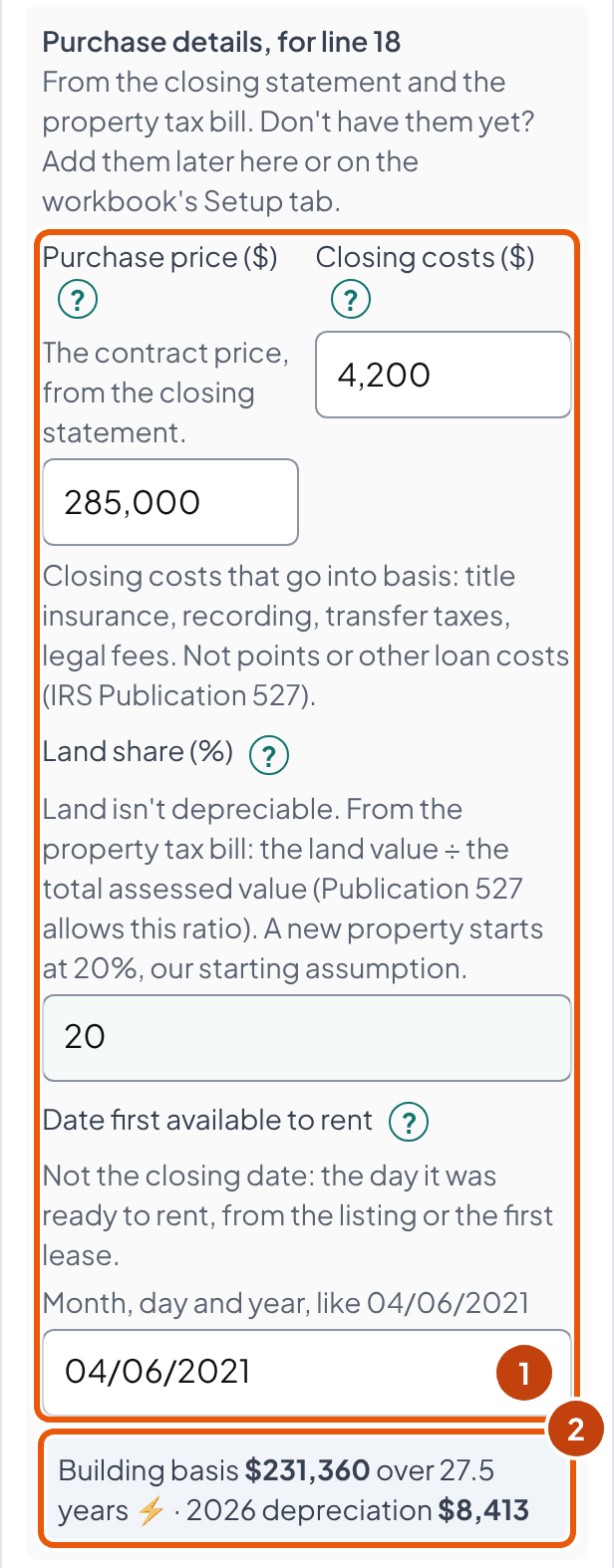
- Add purchase details under "Properties and purchase details": the price and closing costs from the closing statement, the land share from the property tax bill, and the date the property was first available to rent. Line 18 is calculated from them. Did an earlier return already set up the depreciation? Then click "Use the amount from your records" on line 18 instead (why).
- Add improvements and deposits in their groups, and anything unlisted with "+ Add your own line". The builder picks the Schedule E line from the name, and you can change it.
- Read the checks under the preview. They cover a property with expenses but no rent, a 0% land share, a loss that may be limited, a short-term rental, the Form 1098 match, and the 5- and 15-year items that take the 100% special allowance. They also name any improvement or deposit the totals leave out, and why (no date, or a cost that isn't a number).
- Open "How we worked out … line 21" under the preview to see every step for the property shown: price and closing costs, the building basis, the year's depreciation, line 20, line 21, and the cash left before loan principal.
- Download Excel. The file opens in Excel, and in Google Sheets through File → Import. "Print or save as PDF" and "Copy summary" send the Schedule E lines to a preparer.
- Keep using the file. Add each payment on the Transactions tab; every other tab updates.
What's in the Excel workbook
| Tab | What it does |
|---|---|
| Start Here | Contents with links, and how the file works |
| Setup | Tax year, properties, and each building's basis |
| Transactions | The one place you type: date, property, category, amount |
| Deposits | Security deposits as a liability, kept amounts to rent |
| Depreciation | Buildings and improvements; 5- and 15-year items take the 100% special allowance unless elected out |
| Schedule E | Lines 3 to 21 for each property, ready for the form |
| Monthly P&L | Income, NOI, and cash flow by month |
| Year-End Checks | Form 1098 match, flags, a filing checklist, and the OK shown on every tab |
| Categories | Every category with its Schedule E line; add your own |
Which Schedule E line does each rental expense go on?
In short: Each expense has one line from 5 to 19. Depreciation goes on line 18, and an expense without a line of its own goes on line 19, Other.
Schedule E, Part I has a column for each property and room for three on a page. With more, you "complete and attach as many Schedules E as you need" (Schedule E instructions).
Here is the builder's example for Maple Duplex, a two-unit rental in Columbus, Ohio, bought in 2021, for tax year 2026. The property and its numbers are fictional; "Fill with an example" in the builder loads them.
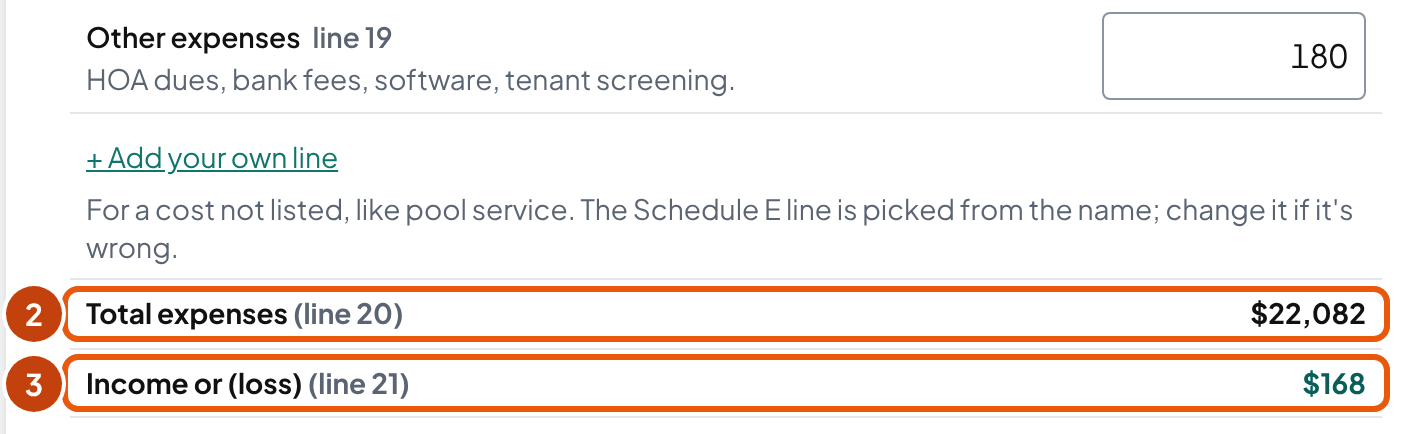
| Line | Schedule E line | What goes here | Maple Duplex |
|---|---|---|---|
| 3 | Rents received | Rent, late fees, pet rent, advance rent, deposits kept | $22,250 |
| 5 | Advertising | Listing fees, signs | $35 |
| 6 | Auto and travel | Driving to the property to collect rent, manage, or repair it | – |
| 7 | Cleaning and maintenance | Cleaning, lawn care, pest control, snow removal | $360 |
| 8 | Commissions | Leasing commissions, Airbnb or VRBO host fees | – |
| 9 | Insurance | Landlord and liability insurance | $1,140 |
| 10 | Legal and other professional fees | Attorney, tax preparation, bookkeeping | $250 |
| 11 | Management fees | What the owner pays a property manager | – |
| 12 | Mortgage interest paid to banks, etc. | Interest only, from Form 1098 | $7,320 |
| 13 | Other interest | Seller or private loans, credit cards used for the rental | – |
| 14 | Repairs | Fixes that keep the property in working order | $285 |
| 15 | Supplies | Bulbs, filters, small hardware | $43 |
| 16 | Taxes | Property taxes, rental licenses | $3,480 |
| 17 | Utilities | Water, trash, gas, or power the owner pays | $576 |
| 18 | Depreciation expense or depletion | The building over 27.5 years, plus improvements | $8,413 |
| 19 | Other | HOA dues, bank fees, tenant screening, software | $180 |
| 20 | Total expenses | Lines 5 to 19 | $22,082 |
| 21 | Income or (loss) | Line 3 minus line 20 | $168 |
| Rent, line 3: $1,850 × 12 + $50 late fee | $22,250 |
| Expenses paid in cash, lines 5 to 17 and 19 | $13,669 |
| Depreciation, line 18 (no cash that year) | $8,413 |
| Total expenses, line 20: $13,669 + $8,413 | $22,082 |
| Income, line 21: $22,250 − $22,082 | $168 |
Before loan principal, the property brought in $22,250 − $13,669 = $8,581 of cash, but it's taxed on $168. Depreciation is the difference. It's also why a rental with positive cash flow can show a loss on paper.

Bank lines that don't go on Schedule E
Some bank lines are neither income nor expense. The template has a category for each, so every line gets a label and the totals stay right:
- Loan principal. Not deductible. It lowers the loan balance and counts in cash flow only.
- Escrow deposits. Not deductible when you fund escrow. Enter taxes and insurance when the lender pays them, from your Form 1098 or escrow statement.
- Owner money in or out, and transfers. Money you put in or take out, and moves between your own accounts. Not income or expense.
- Personal, not rental. Personal spending from a shared account. Better: keep a separate account for the rentals.
Bookkeeper tip: When a property manager collects the rent, in our view the gross rent goes on line 3 and the manager's fee on line 11, both from the owner statement. Enter only the net deposit, and both lines come out too low. The rent then won't tie to the manager's year-end statement.
What counts as rental income, and what doesn't?
In short: Everything a tenant pays for the use of the property is rent on line 3, including bills the tenant pays for the owner. A security deposit the owner plans to return isn't income until part of it is kept.
IRS Publication 527 names several kinds of rent beyond the monthly payment. The workbook has a category for each:
- Advance rent, income "in the year you receive it regardless of the period covered or the method of accounting you use": January's rent paid in December counts in December.
- A payment to cancel a lease early.
- Expenses the tenant pays for the owner, for example a water bill taken off the rent. "If your tenant pays any of your expenses, those payments are rental income." The owner can deduct the expense too, so the entry goes on both lines.
- Property or services instead of rent, at fair market value: a tenant who paints the unit in exchange for a month's rent.
- Fees such as late fees and non-refundable pet fees.
Security deposits: money held until part of it is kept
Publication 527 is direct: "Don't include a security deposit in your income when you receive it if you plan to return it to your tenant at the end of the lease."
What if the owner keeps part of it because the tenant didn't live up to the lease? The part kept is income in that year. The exception is a deposit meant to cover the last month: "If an amount called a security deposit is to be used as a final payment of rent, it is advance rent." So it's income when received.
In the workbook, deposits go on the Deposits tab. The part kept at move-out is added to that property's line 3 in the year of the move-out.
| Deposit received July 1, 2025 | $1,850 |
| Income in 2025 from the deposit | $0 |
| Returned when the tenant moved out, June 30, 2026 | $1,450 |
| Kept for carpet cleaning and a broken blind: $1,850 − $1,450 | $400 |
| Maple Duplex line 3 for 2026: $22,250 + $400 | $22,650 |
The $1,450 returned never touches Schedule E, and the carpet cleaning is an expense on its own line when it's paid. These are the practice rows the workbook adds when you tick "Also add practice transactions".
| Risky | Safer |
|---|---|
| Recording the deposit as rent when it arrives | Log it on the Deposits tab; only the part kept becomes rent |
| Holding a "last month's rent" deposit as a deposit | Count it as income when received: it's advance rent |
| Netting the kept $400 against the cleaning bill | $400 on line 3, and the cleaning cost on line 7 when paid |
Bookkeeper tip: States set their own rules for deposits: where they're held, whether they earn interest for the tenant, and how fast they're returned. The Deposits tab has a "Held in" column, and the Year-End Checks tab shows the total held. Match that total to the account the deposits sit in.
How do you split a mortgage payment and check it against Form 1098?
In short: Only the interest is deductible, on line 12. Principal pays down the loan, and escrow counts only when the lender pays the tax or insurance bill. Form 1098 checks both halves.
| Part of the payment | Category in the workbook | Why |
|---|---|---|
| Interest | Mortgage interest (line 12) | Interest on a rental mortgage is deductible (Publication 527) |
| Principal | Loan principal (not on Schedule E) | It pays down the loan; it isn't an expense |
| Escrow deposit | Escrow deposits (not on Schedule E) | Taxes and insurance count when the lender pays them from escrow |
| Interest → Mortgage interest, line 12 | $610 |
| Principal → Loan principal, not on Schedule E | $240 |
| Payment to First Bank | $850 |
| Interest for the year: 12 × $610 (line 12) | $7,320 |
| Principal for the year: 12 × $240 | $2,880 |
Maple Duplex pays its $3,480 tax bill and $1,140 insurance directly. If the lender collected escrow for them instead, that would add ($3,480 + $1,140) ÷ 12 = $385 a month (our assumption for the example). The two bills would still go on lines 16 and 9 when the lender paid them, not as the $385 went in.
Two checks against Form 1098
The lender sends Form 1098 "if you paid $600 or more in interest on a mortgage," by January 31 (Schedule E instructions). Box 1 is the interest received. The lender generally includes "prepayment penalties and late charges" in it (Form 1098 instructions), so a late fee paid to the bank belongs in the interest total too.
Maple Duplex's line 12 reads $7,320, the same as box 1. The Year-End Checks tab has a box 1 column for each property and flags any difference.
Box 2 is the "outstanding principal on the mortgage as of January 1." It allows a second check the IRS doesn't ask for but we find useful.
Compare next year's box 2 with this year's: the drop should equal the principal recorded, $2,880 for Maple Duplex, unless the owner paid extra. A different gap usually means payments were split wrong, and then line 12 is off by the same amount.
Line 12 is for interest paid to banks and other financial institutions. Interest on a seller-financed or private loan, or on a loan with no Form 1098, goes on line 13. If a co-borrower received the 1098, the owner's share goes on line 13, with a statement naming who got it.
Points, including loan origination fees, aren't deducted when paid. They "must be deducted over the life of the loan" (Schedule E instructions).
Sample wording: note to the tax preparer
Maple Duplex, 2026: line 12 is $7,320 and matches Form 1098, box 1. Principal paid was $2,880. Property tax ($3,480) and insurance ($1,140) were paid directly, not from escrow.
In the builder: the Year-End Checks tab in the file compares line 12 with box 1 for each property. Open the builder ↑
How do you calculate depreciation on a rental property?
In short: Start from the building's basis: the price plus closing costs that belong in basis, minus the land. Divide by 27.5 years for a residential rental, and prorate the first year with the mid-month convention. For the duplex in this guide's example: $231,360 ÷ 27.5 = $8,413 a year.
Residential rental buildings are depreciated over 27.5 years and nonresidential buildings over 39, straight line, with the mid-month convention (Publications 527 and 946).
When does depreciation start? When the property is "ready and available for a specific use," not when the first tenant moves in. In Publication 527's own example, a house bought April 6 and ready for rent July 5 is placed in service in July. It wasn't rented until September.
Step 1: the building's basis
Closing costs split two ways in Publication 527:
- Added to basis: abstract fees, charges for installing utilities, legal fees, recording fees, surveys, transfer taxes, title insurance, and amounts the seller owed that the buyer agreed to pay.
- Left out: fire insurance premiums, rent for occupancy before closing, charges for getting a loan (points, loan assumption fees, credit reports, a lender's appraisal), and amounts put into escrow.
So read the settlement statement line by line rather than taking its total.
Land isn't depreciable, because "land does not wear out, become obsolete, or get used up" (Publication 946).
The cost is split by fair market value. If the owner isn't certain of it, "you can divide the cost between them based on their assessed values for real estate tax purposes" (Publication 527). In that publication's example, an assessment of $160,000 with $24,000 for the land gives a land share of 15%.
| Purchase price | $285,000 |
| Closing costs added to basis | $4,200 |
| Cost: $285,000 + $4,200 | $289,200 |
| Land share from the assessment | 20% |
| Building basis: $289,200 × 80% | $231,360 |
If $900 of the $4,200 had been points on the loan, only $3,300 would go into basis: ($285,000 + $3,300) × 80% = $230,640. The points would be deducted over the life of the loan instead.

Step 2: the first year and every year after
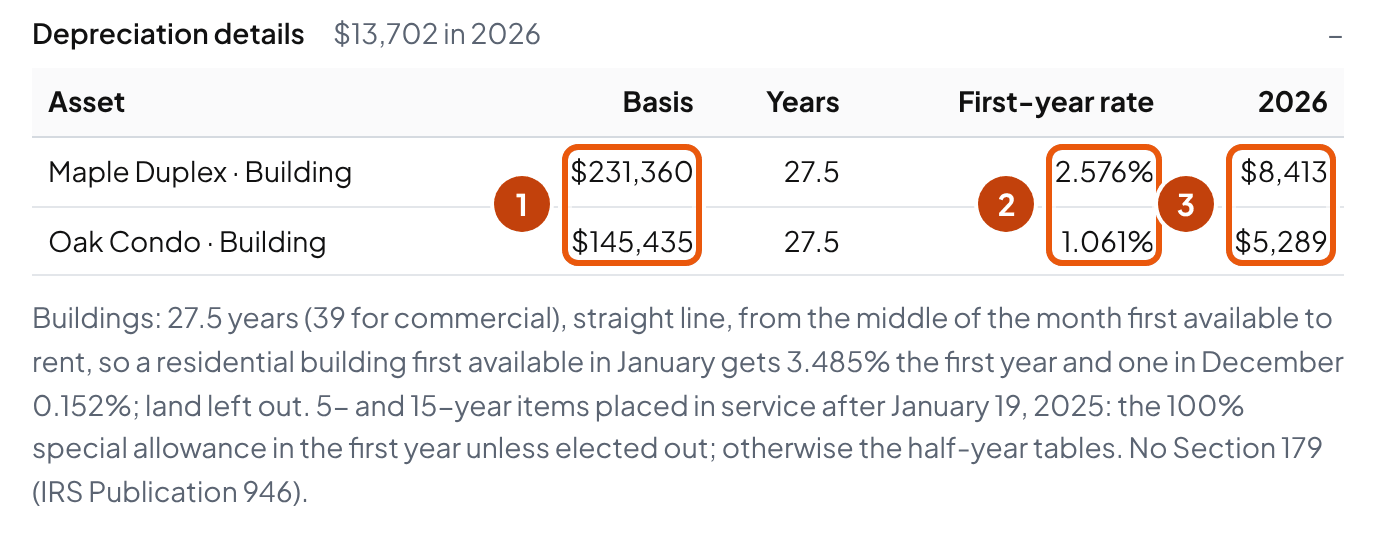
Under the mid-month convention, a property first available in any month is treated as placed in service in the middle of that month. So the first year gets (12.5 − month) ÷ 12 of a full year. For 27.5 years, that's a first-year rate of (12.5 − month) ÷ 12 ÷ 27.5, the same rates as the table in Publication 946:
| First available to rent in | First-year rate | On a $231,360 basis |
|---|---|---|
| January | 3.485% | $8,063 |
| April | 2.576% | $5,959 |
| September | 1.061% | $2,454 |
| December | 0.152% | $351 |
| Maple Duplex, 2021 (April): $231,360 × 8.5 ÷ 12 ÷ 27.5 | $5,959 |
| Maple Duplex, each full year from 2022: $231,360 ÷ 27.5 | $8,413 |
| Maple Duplex, total before 2026 (2021 to 2025) | $39,612 |
| Maple Duplex, left to depreciate after 2026 | $183,335 |
| Oak Condo, basis: ($168,000 + $3,100) × 85% | $145,435 |
| Oak Condo, 2024 (September): $145,435 × 3.5 ÷ 12 ÷ 27.5 | $1,542 |
| Oak Condo, 2025 and 2026: $145,435 ÷ 27.5 | $5,289 each |
The workbook's Depreciation tab shows the same four figures for every building and improvement: before this year, this year, the total, and what's left. The last year is prorated too, so recovery runs into a 28th or 29th calendar year, depending on the month.
A property someone else set up: follow the last return
For a property placed in service in an earlier year, line 18 should follow the depreciation schedule already on the returns. That schedule fixes the basis, the land share, and any special allowance the preparer took on improvements.
If the builder's figure doesn't match, click "Use the amount from your records" on line 18 and type the schedule's amount. The file carries it to the Setup tab, and the Schedule E tab uses it for that property instead of the calculation.
Missed depreciation doesn't wait for the owner. Basis goes down by the depreciation "allowed or allowable, whichever is greater" (Publication 946). In the publication's words: "If you do not claim depreciation you are entitled to deduct, you must still reduce the basis of the property by the full amount of depreciation allowable."
If Maple Duplex's owner had never claimed it, the basis would still be $39,612 lower going into 2026. Publication 946 also describes Form 3115 and a one-time adjustment for unclaimed depreciation. That's the preparer's call; the bookkeeper's part is to raise it early.
Bookkeeper tip: Ask for the prior preparer's depreciation schedule, not only last year's Form 4562. The Schedule E instructions require Form 4562 mainly for property first placed in service that year, listed property, or a Section 179 deduction. So a return for an older rental often has no 4562 at all.
Is it a repair or an improvement?
In short: A repair keeps the property in its ordinary working condition and is deducted this year. An improvement betters, restores, or adapts it and is depreciated, unless one of three safe harbors lets the owner deduct it anyway.
The Schedule E instructions give the everyday line. Repairs are "fixing a broken lock or painting a room," and improvements include "adding substantial insulation or replacing an entire HVAC system." Publication 527 describes the three kinds of improvement:
| Kind | What it means (Publication 527) | Examples |
|---|---|---|
| Betterment | Fixes a pre-existing defect, enlarges or expands the property, or increases its capacity, strength, or quality | An addition, an upgraded electrical panel |
| Restoration | Replaces a substantial structural part, or rebuilds the property to like-new condition | A new roof, replacing all the windows |
| Adaptation | Alters the property to a use that isn't consistent with its intended ordinary use when renting began | Converting a garage into a rental unit |
Publication 527's list of improvement examples includes a new roof, a water heater, flooring, wall-to-wall carpeting, a furnace, and central air conditioning. Maple Duplex's $285 faucet repair is a repair. The $2,950 water heater in the practice rows, paid to Rapid Plumbing (a fictional plumber), is on the improvement list, and the workbook flags it because it's a repair entry over $2,500.
Three safe harbors to check before depreciating
| Safe harbor | The limit | How it's used |
|---|---|---|
| De minimis | Up to $2,500 per invoice or item (without an audited financial statement) | A statement titled "Section 1.263(a)-1(f) de minimis safe harbor election" with each year's return; the amounts go on line 19 (Publication 527) |
| Routine maintenance | Recurring work to keep a building structure or system in ordinary operating condition, expected more than once in the 10 years after it was placed in service | Covers some restorations, such as replacing a major component; never betterments |
| Small taxpayers | Building with an unadjusted basis of $1 million or less; average gross receipts of $10 million or less; the year's repairs, maintenance, and improvements on that building no more than 2% of its unadjusted basis or $10,000, whichever is less | A statement with each year's return, building by building |
| De minimis: $2,950 is more than $2,500 per invoice | Doesn't apply |
| Small taxpayer limit: 2% × $231,360 (less than $10,000) | $4,627 |
| Work on the building in 2026: $285 faucet + $2,950 water heater | $3,235 |
| $3,235 is at or under $4,627 | Qualifies |
With the small taxpayer election for Maple Duplex, the water heater is deducted in 2026 instead of depreciated at about $107 a year ($2,950 ÷ 27.5). Two notes. We used the building basis without the land as the unadjusted basis, which is our reading. And the limit applies to the year's total for the building, so a $1,500 job in December ($4,735 in all) would put the whole year over it.
How improvements are depreciated
| Recovery period | Examples (Publication 527, Table 2-1) | Method in the builder |
|---|---|---|
| 5 years | Appliances such as stoves and refrigerators, carpets, furniture used in the rental | 100% special allowance if placed in service after January 19, 2025; MACRS half-year table if elected out or earlier |
| 15 years | Fences, roads, shrubbery | 100% special allowance if placed in service after January 19, 2025; MACRS half-year table if elected out or earlier |
| 27.5 years | The residential building and its structural components, such as furnaces and water pipes; a new roof | Straight line, mid-month |
| 39 years | Nonresidential (commercial) buildings | Straight line, mid-month |
A roof is depreciated like the building. The practice rows include a $12,400 roof on Maple Duplex, finished September 15, 2026. For 2026 that's $12,400 × 3.5 ÷ 12 ÷ 27.5 = $132, then $12,400 ÷ 27.5 = $451 a year.
Items with 5- and 15-year lives usually come off in one year now. For qualified property acquired and placed in service after January 19, 2025, "Unless you elect out, you must take a 100% special depreciation allowance" (Publication 946). The refrigerator below goes on line 18 in full the year it's placed in service.
Used items count too. Publication 946 says qualified property "can be either new property or certain used property". IRS Notice 2026-11 applies the used-property test in Regulations section 1.168(k)-2 to property acquired after January 19, 2025. Under it, the property must have been bought, and it "was not used by the taxpayer or a predecessor at any time prior to such acquisition". So a used refrigerator bought from an appliance store can qualify.
The builder takes the allowance by default. If the owner elected out, pick "Elected out" on the item. The election is a statement attached to the return, and it covers "any class of property": every 5-year item placed in service that year, say. For the first tax year ending after January 19, 2025, the owner could instead elect 40%; the builder doesn't calculate that one.
Items still on the half-year table (elected out, or placed in service before January 20, 2025) have one more rule the builder doesn't apply. The mid-quarter convention replaces the half-year one when more than 40% of the year's basis in property other than buildings went into service in the last three months (Publication 527).
| 100% special allowance, the IRS default (what the builder shows) | $1,400 |
| Elected out, half-year convention, year 1: $1,400 × 20% | $280 |
| Elected out, mid-quarter, 4th quarter, year 1: $1,400 × 5%, if it's the year's only item of this kind | $70 |
| Maple Duplex line 18 with the allowance: $8,413 + $1,400 | $9,813 |
| Maple Duplex line 21 with the allowance: $22,250 − $23,482 | ($1,232) |
With the allowance, Maple Duplex's $168 profit turns into a $1,232 loss for 2026. Elected out, line 18 is $8,693 and line 21 a $112 loss ($22,250 − $22,362). The return decides which applies, so agree it with the preparer before the books are closed, and pick "Elected out" on the item if that's the answer.
Sample wording: asking the client about a large invoice
The $2,950 you paid Rapid Plumbing on August 3: was it a repair to the old water heater or a new one? If it's a replacement, it may need to be depreciated, or your preparer may be able to deduct it under a safe harbor, so I'll list it separately for them.
In the builder: add the item under "Improvements", or keep it in Repairs, and line 18 or line 14 updates. Open the builder ↑
When isn't the Schedule E result what the owner deducts?
In short: When line 21 is a loss, the passive activity rules may limit it. A vacation home or a short-stay rental can fall under different rules altogether, so the books need the day counts.
Passive loss limits and the $25,000 allowance
Rental real estate is generally a passive activity. Passive losses generally can't offset other income, and what's left carries forward (Publication 527).
The main exception is an owner who actively participated: owning at least 10% and making management decisions such as approving tenants and rental terms. Such an owner "may be able to deduct up to $25,000 of loss."
Above $100,000 of modified AGI, the allowance "is limited to 50% of the difference between $150,000 ... and your MAGI." At $150,000 it's gone. Lower amounts apply to married filing separately.
| Allowance: 50% × ($150,000 − $120,000) | $15,000 |
| Deducted against other income this year | $15,000 |
| Carried forward: $18,000 − $15,000 | $3,000 |
Form 8582 figures this. It isn't needed when every condition in Publication 527 is met, including a loss of $25,000 or less and modified AGI of $100,000 or less. The builder flags any property with a loss; the tax software or preparer applies the limit.
Vacation homes and short-term rentals: count the days
A unit counts as a home when personal use is more than 14 days or 10% of the days rented at a fair price, whichever is greater (Schedule E instructions). Its deductible expenses are then limited. Publication 527's example: an apartment rented 160 days allows 16 days of personal use, so 17 days makes it a home.
A home rented for fewer than 15 days in the year isn't reported at all. Whatever the day counts show, expenses for personal days aren't rental expenses. With 7 personal days and 63 rented days, 10% (7 ÷ 70) of the expenses stay off Schedule E.
Two more rules matter for Airbnb and VRBO. If the average stay is 7 days or less, the activity "isn't a rental activity" under the passive loss rules (Publication 925). The $25,000 rental real estate allowance then doesn't apply, and whether its losses are passive turns on the owner's participation, a question for the preparer.
With significant services such as maid service, the rental goes on Schedule C, not Schedule E. In the builder, tick "I have short-term rentals" for a gross booking income category, and enter the platform's host fees as commissions.
Bookkeeper tip: Work out the average stay from the platform's yearly statement: nights booked ÷ number of stays. 208 nights over 52 stays is a 4-night average. Put the fair rental days and personal days on line 2 of the workbook's Schedule E tab.
What monthly routine keeps rental books current?
In short: Enter and tag the month's bank lines, split the mortgage payment, log deposits and improvements when they happen, and reconcile to the bank statement.
- Enter the month's rent and bills on the Transactions tab, each with a property and a category. Take card purchases from the card statement, not the card payment (why). A bank account used only for the rentals makes every line a rental line; the IRS doesn't require one.
- Split the mortgage payment into interest, principal, and escrow.
- Log deposits and improvements on their tabs when they happen, with the date placed in service.
- Save receipts with the date and amount in the file name, and put the link in the Receipt column.
- Reconcile to the bank statement, then glance at the Monthly P&L tab for each property's cash flow.
Records to keep, and for how long
Records that support a return are generally kept for 3 years from filing, or 6 years if more than 25% of gross income was left out. Records about the property itself last longer.
Keep the closing statement, improvement invoices, and depreciation schedules "until the period of limitations expires for the year in which you dispose of the property in a taxable disposition" (IRS Topic 305). For a rental held 20 years, that's more than 20 years.
What should you ask a landlord client for?
In short: The closing statement, the prior return's depreciation schedule, every Form 1098, the list of deposits held, and access to the rental account. Most year-end problems trace back to one of them missing.
Sample wording: what to ask a new landlord client for
To set up your rental books for 2026, please send: 1. The closing (settlement) statement for each property, and the date each one was first ready to rent 2. Your latest property tax bill, for the land and building values 3. Last year's return, including the depreciation schedule for each property 4. Every Form 1098 and any escrow statement from your lenders 5. A list of security deposits you hold, by tenant 6. Invoices for work over $2,500 since you bought each property 7. Read-only access to the rental bank account, or monthly statements
The same workbook works as a monthly deliverable, one file per client per year. Price the work by the number of properties and monthly transactions with the bookkeeping pricing template. Then put the scope in writing with the engagement letter template. The letter is the place to say who decides the depreciation method and the elections above.
One line to keep in view. Anyone paid to prepare all or substantially all of a federal return needs a PTIN; organizing the records for the preparer doesn't (IRS PTIN FAQ).
Schedule E questions A and B: Forms 1099 for contractors
Above the property columns, Schedule E asks two yes-or-no questions. Line A: "Did you make any payments in 2025 that would require you to file Form(s) 1099?" Line B: "If 'Yes,' did you or will you file required Form(s) 1099?" (Schedule E, 2025).
The 2025 instructions for line A say: "In general, if you paid at least $600 for services performed by someone who is not your employee (nonemployee compensation), you must file Form 1099-NEC."
For 2026 payments the amount changes. The 1099-MISC and 1099-NEC instructions (12/2026) say that "for tax years beginning after 2025," the threshold "increased to $2,000." Form 1099-NEC is filed for each person "to whom you have paid at least $2,000" for "Services performed by someone who is not your employee (including parts and materials)."
Two limits in the same instructions matter for landlords:
- Reporting applies "only when payments are made in the course of your trade or business. Personal payments are not reportable."
- Payments to a corporation, including an LLC taxed as a C or S corporation, generally aren't reported.
The instructions add that "you are engaged in a trade or business if you operate for gain or profit." Whether a particular rental meets that is a question for the preparer, so ask before answering line A.
| Rapid Plumbing: $285 faucet (April) + $2,950 water heater (August) | $3,235 |
| Roofer for the September roof | $12,400 |
| 2026 threshold for Form 1099-NEC, per payee | $2,000 |
Both payees are over $2,000, and the water heater counts in full because the threshold includes parts and materials. If the rental is a trade or business and neither contractor is a corporation, the answer to line A is Yes, and line B asks whether the forms were filed. The same payments made in 2025 would have been tested against $600.
The workbook's Year-End Checks tab words its 1099 line for the file's tax year: $600 for 2025 and earlier, $2,000 for 2026. For 2027 and later it asks you to check the new amount, because the $2,000 "may be adjusted for inflation beginning in calendar year 2027" (1099 instructions, 12/2026).
To file a 1099 you need the contractor's taxpayer identification number. The IRS "suggests that you request the recipient complete Form W-9" (General Instructions for Certain Information Returns). Ask before the first payment, while the contractor still wants to be paid.
Sample wording: asking the client for W-9s
Before we pay Rapid Plumbing or the roofer, could you ask each of them for a completed Form W-9? If your rental counts as a business for tax purposes, payments of $2,000 or more to a contractor in 2026 are reported on Form 1099-NEC. Schedule E asks whether you filed them. I'll list the 2026 totals by contractor for your preparer.
What are the most common rental bookkeeping mistakes?
In short: Most are cash-versus-tax mix-ups. Here is what each one would do to the example duplex's numbers.
| Risky | Safer | Effect on Maple Duplex |
|---|---|---|
| Deducting the whole $850 mortgage payment | Interest on line 12 ($7,320, matched to Form 1098 box 1); principal off Schedule E | $2,880 of principal deducted: line 21 becomes a $2,712 loss instead of a $168 profit |
| Depreciating the land with the building | Take out the 20% land share first | $289,200 ÷ 27.5 = $10,516 a year instead of $8,413: $2,103 too much each year |
| The $1,850 deposit booked as rent in July 2025 | Deposits tab; only the $400 kept becomes rent, in 2026 | 2025 rent overstated by $1,850; 2026 needs $400, not $0 |
| The $2,950 water heater in Repairs with no election statement | An improvement, or the small taxpayer election attached to the return | $2,950 deducted instead of $40 of 2026 depreciation (August, mid-month): $2,910 too much without the election |
| Leaving depreciation off to "save it for later" | Claim it every year | $8,413 of deductions missed in 2026, while basis still drops by $8,413 |
| Answering Schedule E line A without adding up contractor payments | Total each contractor for the year and collect W-9s | Rapid Plumbing was paid $3,235 in 2026, over the $2,000 threshold |
The builder's checks and the workbook's Year-End Checks tab flag several of these as you go.
Frequently asked questions
Is there a free rental property bookkeeping template?
Yes. The builder on this page is free and needs no sign-up. Type each property's yearly amounts to see Schedule E line by line, then download an Excel workbook that also opens in Google Sheets. Its tabs cover transactions, security deposits, depreciation, Schedule E by property, a monthly profit report, and year-end checks. Nothing you type leaves your browser.
How do I keep the books for a rental property?
Record every payment in and out once, with the date, the property, a category, and the amount. Use categories that match the lines on Schedule E so the year-end totals are ready for the return. Keep security deposits apart from rent, split each mortgage payment into interest, principal, and escrow, and list improvements apart from repairs. Reconcile to the bank statement each month; a bank account used only for the rentals makes that much quicker.
Can I use Excel for rental property accounting?
Yes. For a handful of properties a well-built spreadsheet is usually enough. Each row needs a property and a Schedule E category, depreciation has to be calculated correctly, and deposits and loan principal stay out of income and expenses. The workbook from this page does that with formulas and works in Excel and Google Sheets. Software starts to pay off with bank feeds, tenant portals, or many units.
What expenses can I deduct on a rental property?
Schedule E has lines for advertising, auto and travel, cleaning and maintenance, commissions, insurance, legal and other professional fees, management fees, mortgage interest, other interest, repairs, supplies, taxes, utilities, and depreciation. Line 19 takes other ordinary and necessary expenses such as HOA dues. Loan principal isn't deductible, and improvements are depreciated over several years unless a safe harbor applies.
Is a security deposit rental income?
Not when you receive it, if you plan to return it at the end of the lease (IRS Publication 527). If you keep part of it because the tenant didn't meet the lease terms, the part you keep is income in the year you keep it. A deposit that's to be used as the last month's rent is advance rent, so it's income when you receive it.
How do I calculate depreciation on a rental property?
Take the purchase price plus the closing costs that belong in basis, and subtract the value of the land. Depreciate the rest over 27.5 years for a residential rental, straight line, with the mid-month convention (IRS Publications 527 and 946). A full year is the building basis divided by 27.5, so a $231,360 basis gives $8,413. The first year depends on the month the property was first available to rent: 3.485% in January down to 0.152% in December. For a property already on earlier returns, follow that depreciation schedule.
Is mortgage principal deductible on a rental property?
No. Only the interest is deductible, on Schedule E line 12 for a bank or other financial institution, or line 13 for a private or seller loan. Principal lowers the loan balance, and escrow deposits aren't deductible when made: property taxes and insurance count when the lender pays them. Line 12 should match box 1 of Form 1098, which the lender sends when you paid $600 or more of interest.
What is the difference between a repair and an improvement on a rental?
A repair keeps the property in ordinary working condition, like fixing a broken lock or painting a room, and is deducted in the year paid. An improvement betters, restores, or adapts the property, like a new roof or replacing an entire HVAC system, and is depreciated. Three safe harbors can let an owner deduct some improvements in the year paid: de minimis (up to $2,500 per invoice or item), routine maintenance, and small taxpayers.
Can I deduct a loss on my rental property?
Often, but not always in full. Rental losses are generally passive, and passive losses can't offset other income. If you actively participate, you may deduct up to $25,000 of rental loss against other income. The allowance shrinks by 50% of modified AGI over $100,000 and is gone at $150,000 (IRS Publication 527). The rest carries forward. Form 8582 figures the limit.
How long should I keep rental property records?
Generally 3 years from the date you file the return, or 6 years if you left out more than 25% of the gross income. Records about the property itself last longer. Keep the closing statement, improvement receipts, and depreciation schedules until the period of limitations expires for the year you sell or otherwise dispose of it (IRS Topic 305). For a rental, that's often decades.
Does this template work for Airbnb and other short-term rentals?
Yes. Check the short-term rental option to add a category for gross booking income, and enter platform fees as commissions. Three rules to check with the preparer. Personal use of more than 14 days or 10% of the days rented, whichever is greater, makes it a home and limits expenses. An average stay of 7 days or less means it isn't a rental activity under the passive loss rules. And significant services such as maid service move it to Schedule C.
Do landlords have to file Form 1099-NEC for contractors?
Payments made in the course of a trade or business are reported on Form 1099-NEC when they reach $2,000 or more for 2026 payments ($600 for 2025 and earlier). The IRS says the $2,000 may be adjusted for inflation from 2027, so check the amount each year. Whether a rental counts as a trade or business depends on the owner's situation, so ask the preparer before answering Schedule E line A.
How we built this page
Ledgental Team wrote this guide and built the workbook builder. Ledgental also makes a bookkeeping app that's free during its beta; this template doesn't connect to it. Everything you type stays in your browser and in the file you download.
What the numbers rest on
- Schedule E lines, depreciation and deposits follow the IRS: the Schedule E instructions, Publication 527 and Publication 946 (Table A-6 for 27.5-year property with the mid-month convention; Table A-1 for the half-year convention). The builder's depreciation is checked by known-answer tests against those tables (January 3.485%, July 1.667%, December 0.152%).
- The guide's example is a test too. We worked Maple Duplex and Oak Condo out by hand ($5,959 in 2021, $39,612 before 2026, $8,413 in 2026, $168 on line 21; Oak Condo $1,542 in 2024 and $261 on line 21), and the tests check the builder against those figures. We also recalculated a downloaded workbook in LibreOffice, and its Schedule E matched the builder to the cent.
- The example (Maple Duplex, Oak Condo, the practice rows) is fictional. The escrow amount, the owner's modified AGI and loss, the refrigerator in the examples, and the split of shared costs by units are our assumptions.
- The 100% special allowance is taken by default for 5- and 15-year items placed in service after January 19, 2025, the IRS default in Publication 946, with "Elected out" as the other choice. The builder knows only the date placed in service, so it treats that as the acquisition date too.
- What the builder doesn't calculate: mid-quarter convention tables, Section 179, the 40% election for the first tax year ending after January 19, 2025, a special allowance on items placed in service before January 20, 2025, the $25,000 passive loss allowance and its phase-out, and the short-term rental rules. The builder flags each case and points to the IRS text instead.
- Not covered: state income tax, local rental taxes, and the sale of a property (depreciation recapture).
What changed
- October 12, 2026 (special allowance): 5- and 15-year items placed in service after January 19, 2025 now take the 100% special allowance, the IRS default, with "Elected out (MACRS)" on each item. Before, the builder used the half-year table, as if the owner had elected out. The workbook's Depreciation tab has a Special allowance column and the start date on Setup. The refrigerator example and its line 18 changed with it.
- October 12, 2026 (builder): an amount box that comes out below zero now turns red and stays out of the totals, instead of being turned into a positive number. Improvement and deposit rows the totals can't use are named in the checks with the reason. A "How we worked out … line 21" panel shows each step, and the answer now gives the cash left before loan principal. The IRS figures (27.5 and 39 years, the $25,000 allowance, 14 days and 10%, the 7-day average stay, the 40% mid-quarter test) are named constants with their sources. A new check flags 5- and 15-year items where the 100% special allowance may apply. In the workbook, the 1099 line follows the tax year, and a master check on Year-End Checks shows on every tab. We added tests for this guide's example, and a diagram of where Maple Duplex's cash goes.
- October 12, 2026: the guide is rewritten in shorter sentences and paragraphs. A new section covers splitting costs when every rental runs through one account: the workbook's split by units, labeled as our assumption, and wording for asking a client to tag each payment. New paragraphs cover credit card bills and costs the owner paid personally. The hero now leads with profit per property and the mortgage principal mistake.
- October 4, 2026: added this "How we built this page" section, a citation box and the reuse license (CC BY 4.0); a link icon beside every heading; known-answer tests for the depreciation and Schedule E engine; number fields changed to plain text with a numeric keypad, labeled fields for improvements and deposits, and borders and phone text sizes brought up to the site's accessibility floor.
- September 30, 2026: guide rewritten with question headings and "In short" leads, jump cards, examples from "Fill with an example", comparison tables and sample wording; the optional line 18 override and new checks (passive loss allowance, short-term rules, mid-quarter convention) added; four images and the card preview retaken.
- September 29, 2026: first published.
Cite this page
Copy one of these lines to credit the page. To link to one section, use the link icon beside its heading.
- Plain line
- Ledgental, Free Rental Property Bookkeeping Template, updated October 2026, https://ledgental.com/tools/rental-property-bookkeeping-template
- APA
- Ledgental. (2026, October). Free Rental Property Bookkeeping Template. https://ledgental.com/tools/rental-property-bookkeeping-template
- Chicago
- Ledgental. “Free Rental Property Bookkeeping Template.” Last modified October 2026. https://ledgental.com/tools/rental-property-bookkeeping-template.
Reusing this page: the guide's text, tables, and screenshots are licensed under CC BY 4.0. Credit "Ledgental" with a link to this page. Quotations from the IRS and state agencies are public domain, and quotations from other sources stay under their owners' terms.
Sources
- Instructions for Schedule E (Form 1040) (2025), Internal Revenue Service
- Publication 527 (2025), Residential Rental Property, Internal Revenue Service
- Publication 946 (2025), How To Depreciate Property, Internal Revenue Service
- Instructions for Form 4562 (2025), Internal Revenue Service
- Notice 2026-11, Interim Guidance on Additional First Year Depreciation Deduction under § 168(k), Internal Revenue Service
- Publication 925 (2025), Passive Activity and At-Risk Rules, Internal Revenue Service
- Instructions for Form 1098 (12/2026), Internal Revenue Service
- Tangible property final regulations (safe harbors), Internal Revenue Service
- Topic no. 305, Recordkeeping, Internal Revenue Service
- Schedule E (Form 1040) (2025), Internal Revenue Service
- Instructions for Forms 1099-MISC and 1099-NEC (12/2026), Internal Revenue Service
- General Instructions for Certain Information Returns (2025), Internal Revenue Service
- Frequently asked questions: Do I need a PTIN?, Internal Revenue Service
General information about US federal rules, not tax or legal advice. IRS rules and figures were checked at the source in September and October 2026 and can change each year; state rules on deposits and taxes differ. Maple Duplex, Oak Condo, and the practice rows are fictional, and the escrow amount, the owner's modified AGI and loss, the refrigerator in the examples, and the split of shared costs by units are our assumptions. Review the return with a tax professional. This page isn't affiliated with the IRS or any state agency.