Key takeaways
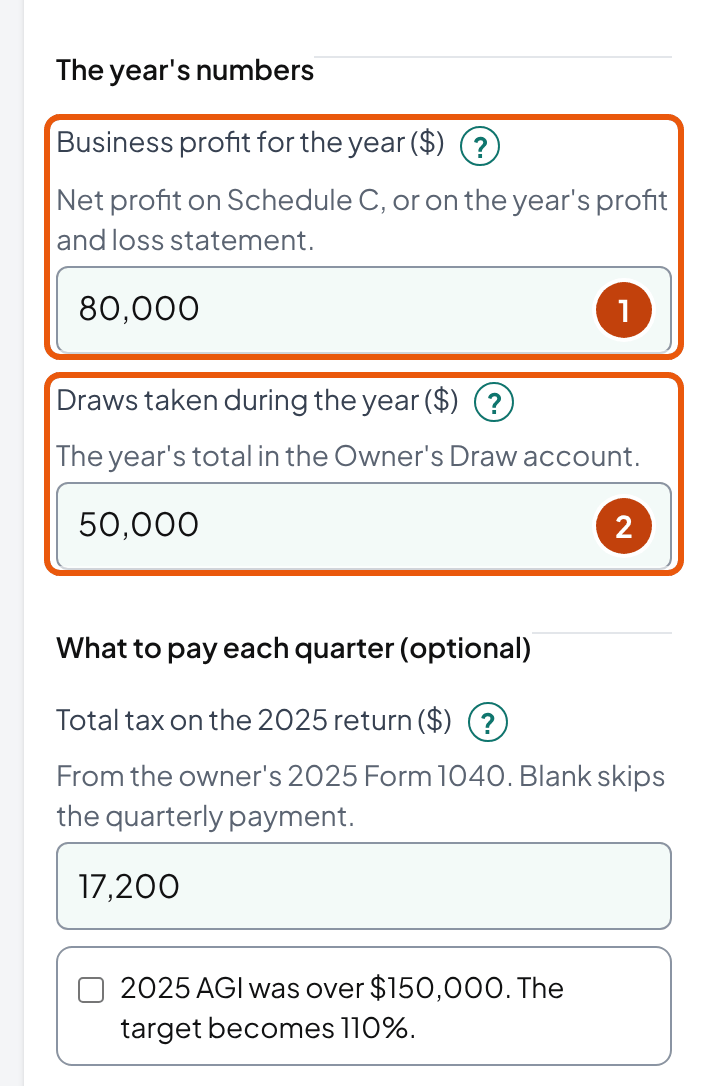
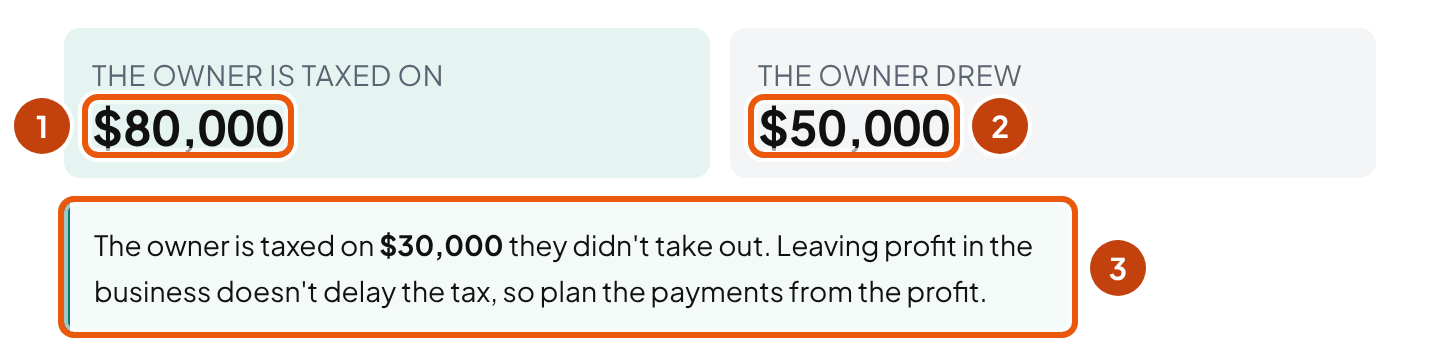
- A draw isn't taxed when the owner takes it. Owners of sole proprietorships, single-member LLCs, and partnerships are taxed on their share of the year's profit, whether they draw all of it, some, or none. In this guide's example, an owner drew $50,000 and is taxed on $80,000.
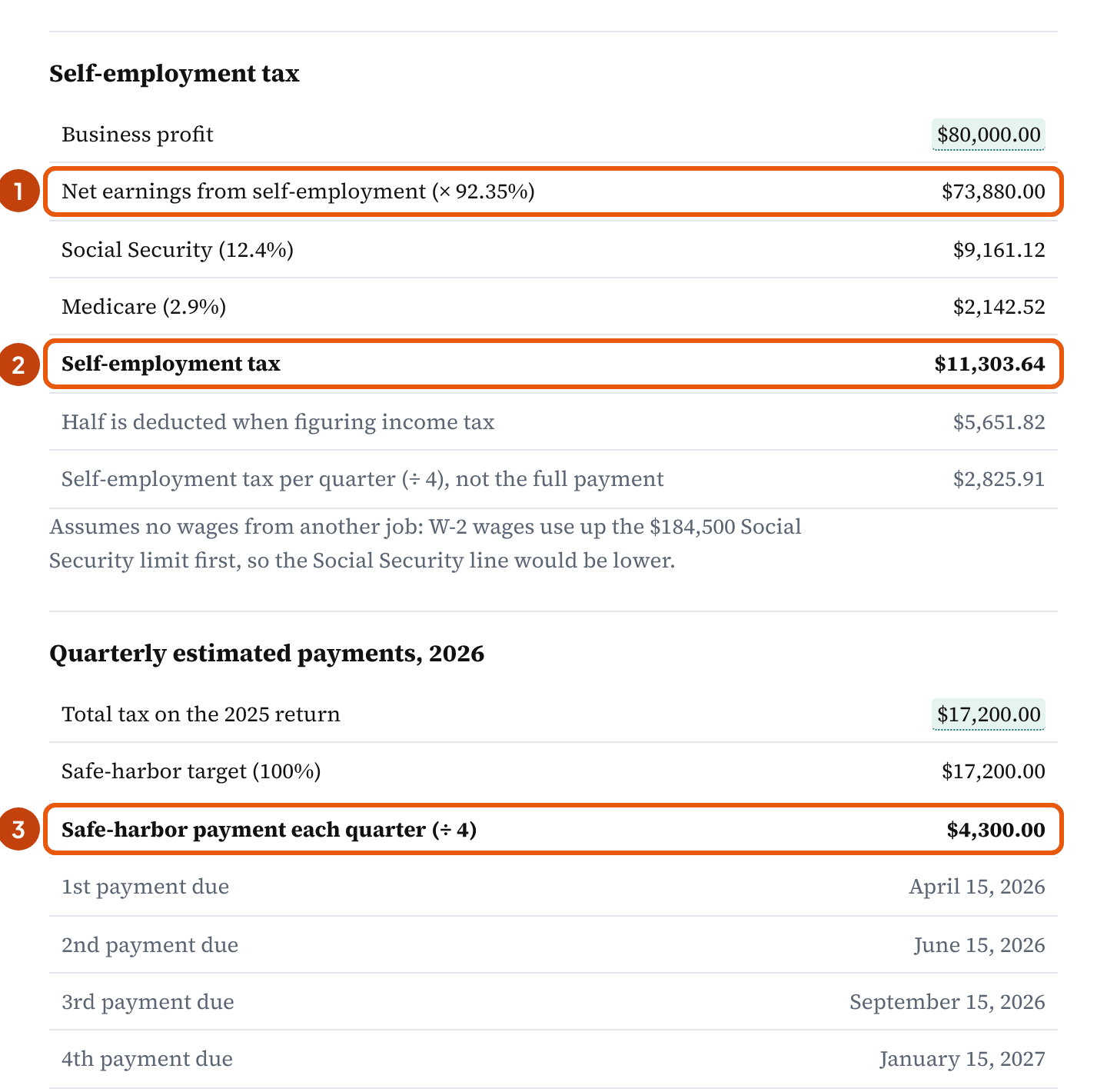
- Self-employment tax for 2026 is 15.3% (12.4% Social Security, 2.9% Medicare) on 92.35% of net earnings. The Social Security part stops at $184,500 (IRS Topic 554; SSA, 2026 wage base). On $80,000 of profit it's $11,303.64, whatever the owner draws.
- Partners are taxed on their share under the agreement plus guaranteed payments, not on half and not on what they took out. Cash drawn above a partner's basis can be a taxable gain. Basis is roughly what they put in plus profit left in, minus what they took out.
- S corporation owners who work in the business take a reasonable salary first. Distributions carry no Social Security or Medicare tax. Above stock basis they're a capital gain, and a year with a distribution needs Form 7203.
- Plan quarterly payments from year-to-date profit, not from a percentage of draws. Size them to the safe harbor: 100% of last year's tax, or 110% above $150,000 of AGI (Form 1040-ES, 2026). The calculator works out the quarterly amount from last year's tax.
How are owner draws taxed?
In short: They aren't taxed when the owner takes them. The owner is taxed on the business's profit, or their share of it, and the type of business decides which taxes apply to that profit.
A draw moves money the business has already earned from the business account to the owner. So the tax follows what the business earned and whose share it is, not how much the owner took out.
The draw itself matters only at the edges: when it goes above the owner's basis, or an S corporation owner takes it instead of a salary. It also matters when the cash to pay the tax is already gone.
| Business type | How the owner gets paid | What's taxed | Social Security and Medicare | Where it's reported |
|---|---|---|---|---|
| Sole proprietor or single-member LLC | Draws | All of the business's net profit | Self-employment tax on the profit | Schedule C and Schedule SE |
| Partnership or multi-member LLC | Draws (distributions) and guaranteed payments | Each partner's share of profit under the agreement, plus guaranteed payments | Self-employment tax for general partners; limited partners on guaranteed payments only | Form 1065, Schedule K-1 |
| S corporation | W-2 salary, then distributions | Salary, plus the owner's share of profit | On the salary only | W-2 and Form 1120-S, Schedule K-1 |
| C corporation | W-2 salary and dividends | Salary, and dividends when paid | On the salary only | W-2 and Form 1099-DIV |
The same profit in three business types
Take Maria Lopez, who owns Lopez Cleaning Co LLC. Her bookkeeper, Jordan Miles of Northline Bookkeeping, closes 2026 with $80,000 of profit, and Maria took $50,000 out. Both people are fictional.
Here is what she's taxed on in each setup, figured with the calculator above. Income tax isn't included, because it depends on her whole return.
| Lopez Cleaning Co, 2026 | What Maria is taxed on | Self-employment or payroll tax | What she took out |
|---|---|---|---|
| Single-member LLC (Schedule C) | $80,000 of profit | $11,303.64 self-employment tax | $50,000 of draws |
| Partnership, Maria's 60% share | $48,000 (60% of $80,000) | $6,782.18 self-employment tax | $50,000 of draws, $2,000 more than her share |
| S corporation, $40,000 salary (our assumption) | $40,000 salary + $36,940 K-1 = $76,940 | $6,120 payroll tax on the salary (both halves) | $40,000 salary + $10,000 of distributions |
The cash Maria took is the same $50,000 in every row, and it never sets the taxed amount. In the S corporation row, the K-1 is $80,000 − $40,000 − $3,060 of employer payroll tax. Whether a $40,000 salary is reasonable for her work is its own question (below).
This guide covers US federal rules for 2026. States tax pass-through income in their own ways, so check the state return too.
Why is the owner taxed on profit, not on draws?
In short: Because the IRS taxes what the business earned in the year. A draw only moves part of it to the owner's personal account.
The partner's K-1 instructions say a partner "may be liable for tax on your share of the partnership income, whether or not distributed." The S corporation instructions use the same words.
For Maria, on Schedule C, the profit goes straight onto her return. The Schedule C instructions say not to deduct "amounts paid to yourself." Two cases follow from that.
The owner draws more than the profit
| Income she's taxed on | $80,000 |
| Draws above the profit: $95,000 − $80,000 | $15,000 |
The $15,000 isn't income. It comes out of her equity: money she put in earlier, or profit taxed in earlier years. For partners and S corporation owners, the limit is their basis. Basis is roughly what they put in plus profit left in, minus what they took out (see partners and S corporations).
The owner draws nothing
| Income she's taxed on | $80,000 |
| Self-employment tax, from the calculator | $11,303.64 |
The tax is the same. Maria pays it from personal funds, or takes a draw to cover it.
Bookkeeper tip: When a client asks "Why do I owe tax? I barely took anything out," put their profit and draws into the calculator above. Then send them the result with Copy summary.
How are sole proprietors and single-member LLC owners taxed?
In short: Income tax and self-employment tax on the Schedule C profit. The owner gets no payroll, and the draws aren't deductible.
The IRS treats a single-member LLC "as an entity disregarded as separate from its owner, unless it files Form 8832 and affirmatively elects to be treated as a corporation." So Maria isn't an employee of her own LLC, and she gets no W-2.
The business runs no payroll for her, and Jordan records her draws in equity. Her five employees are a different matter. Their wages run through payroll, and at year end Jordan accrues the wages they've earned but not yet been paid.
How self-employment tax is figured
- Start with the net profit from Schedule C.
- Multiply by 92.35% to get net earnings from self-employment (IRS Topic 554).
- If that's under $400, there's no self-employment tax.
- Social Security: 12.4% of net earnings, up to $184,500 for 2026 ($176,100 for 2025, SSA).
- Medicare: 2.9% of all net earnings, with no limit.
- Half of the total is deducted when figuring income tax.
| Net profit | $80,000.00 |
| Net earnings: $80,000 × 92.35% | $73,880.00 |
| Social Security: $73,880 × 12.4% | $9,161.12 |
| Medicare: $73,880 × 2.9% | $2,142.52 |
| Self-employment tax | $11,303.64 |
| Half, deducted when figuring income tax | $5,651.82 |
The draws ($50,000, $0, or $95,000) don't change any of these lines. Income tax comes on top and depends on Maria's whole return, so the calculator leaves it out.
When the owner also has a W-2 job
The calculator assumes the owner has no wages. A W-2 job changes two lines.
First, W-2 wages use up the Social Security limit before self-employment earnings do, because "the tax on your wages is paid first" (SSA).
In the Social Security Administration's own 2026 example, someone with $100,000 of wages and $85,500 of self-employment earnings pays the full 15.3% on $84,500 of it. Only the 2.9% Medicare part applies to the last $1,000.
Second, the 0.9% Additional Medicare Tax starts above $200,000 of self-employment income for most filers ($250,000 married filing jointly, $125,000 married filing separately). Wages lower that threshold dollar for dollar.
In the IRS's example, a single filer with $130,000 of wages and $145,000 of self-employment income owes it on $75,000 of the self-employment income (IRS). Maria is well below both lines, so neither changes her numbers.
How are partnership draws taxed?
In short: Each partner is taxed on their share of the profit under the partnership agreement, plus any guaranteed payments, whatever they drew. The share isn't automatically half.
The partnership files Form 1065 and gives each partner a Schedule K-1 with their share. Partners aren't employees. The IRS says they "should not be issued a Form W-2, Wage and Tax Statement, in lieu of Form 1065, Schedule K-1, for distributions or guaranteed payments from the partnership."
Some pages say each partner is taxed on half of the profit. That's true only when the agreement splits it 50/50.
| Partner A's share: $120,000 × 60% | $72,000 |
| Partner B's share: $120,000 × 40% | $48,000 |
| Partner A drew during the year | $40,000 |
| Partner B drew during the year | $60,000 |
A is taxed on $72,000 and B on $48,000, even though B took out more cash. The draws only change each partner's capital account. A's self-employment tax is $10,173.28.
Guaranteed payments
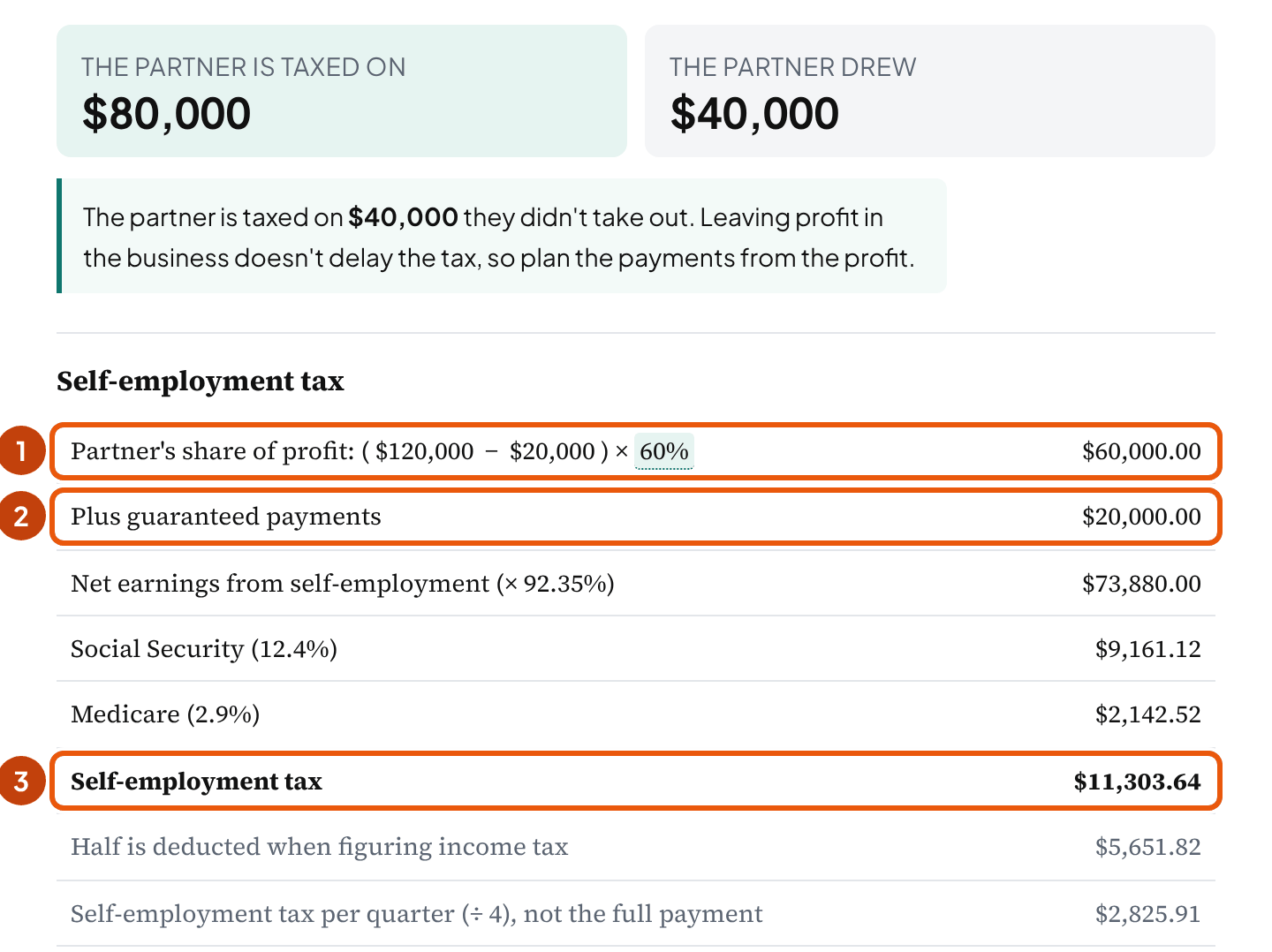
A guaranteed payment is a fixed amount a partner gets for their work or for the use of their capital, "determined without regard to the partnership's income" (IRS Publication 541). The partnership deducts it before splitting the rest. The partner reports it as income on top of their share.
Say A works in the business full time, and the agreement pays A $20,000 a year for it:
| Profit left to split: $120,000 − $20,000 | $100,000 |
| A's share: $100,000 × 60% | $60,000 |
| A is taxed on: $60,000 + $20,000 | $80,000 |
| B is taxed on: $100,000 × 40% | $40,000 |
| A's self-employment tax on $80,000 | $11,303.64 |
A ends up with the same taxable income and self-employment tax as Maria. The guaranteed payment moved $8,000 of taxable income from B to A ($48,000 − $40,000), whatever either of them drew.
The calculator counts the guaranteed payment toward A's self-employment tax. That's our reading of the Schedule SE instructions quoted under limited partners below, and the calculator lists it as an assumption under "What this uses". We haven't confirmed the general partner rule in Publication 541, so check it with the tax preparer.
Limited partners
Limited partners follow a different self-employment tax rule. They "should include only guaranteed payments for services actually rendered to or on behalf of the partnership" (Schedule SE instructions).
If B were a limited partner with no guaranteed payment, B would still pay income tax on the $40,000 share, but no self-employment tax on it.
The calculator figures a general partner, so for a limited partner only the guaranteed payments line counts toward self-employment tax. Before you treat an LLC member as a limited partner, check with the tax preparer.
Drawing more than basis
Can a partner owe tax on a draw? Generally only on cash above their basis. A partner "generally recognizes gain on a partnership distribution only to the extent any money (and marketable securities treated as money) included in the distribution exceeds the adjusted basis of the partner's interest in the partnership" (IRS Publication 541).
Basis goes up with contributions and the partner's share of income, and down with distributions and losses.
In the 60/40 example without a guaranteed payment, suppose B started the year with $10,000 of basis. Then $10,000 + $48,000 = $58,000, and B drew $60,000, so $2,000 of the cash is above basis.
We've left out B's share of partnership liabilities, which also adds to basis. So treat this as a warning sign to check, not a gain to report.
Bookkeeper tip: Keep a separate draw account and capital account for each partner. At year end, reconcile each partner's K-1 share and draws to their capital account. If a capital account is heading below zero, raise it with the tax preparer.
How are S corporation distributions taxed?
In short: A working owner takes a reasonable salary through payroll first. The rest of the profit is taxed on the K-1 whether or not it's distributed, and distributions carry no Social Security or Medicare tax.
The salary comes before any distribution. The IRS puts it this way: an S corporation must "pay reasonable compensation to a shareholder-employee in return for services that the employee provides to the corporation before non-wage distributions may be made to the shareholder-employee."
Payments to an officer "must be treated as wages to the extent the amounts are reasonable compensation for services rendered to the corporation."
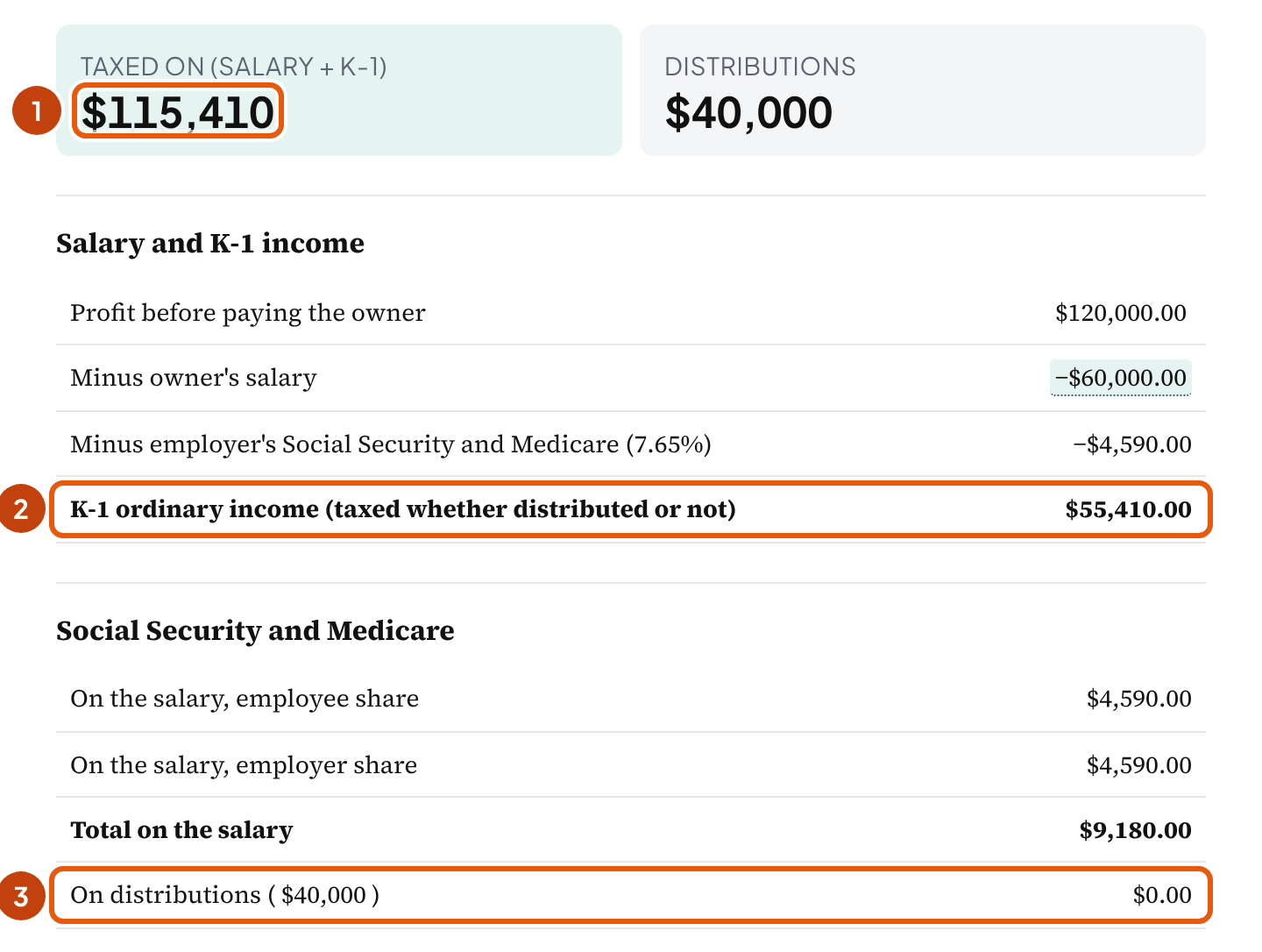
Say Lopez Cleaning Co grows to $120,000 of profit before paying Maria, and it elects to be taxed as an S corporation. Maria sets her salary at $60,000 and takes $40,000 in distributions. The $60,000 is our assumption for the example, not a benchmark for a cleaning business.
| Profit before paying Maria | $120,000 |
| Maria's W-2 salary | $60,000 |
| Employer's Social Security and Medicare: $60,000 × 7.65% | $4,590 |
| K-1 ordinary income: $120,000 − $60,000 − $4,590 | $55,410 |
| Social Security and Medicare on the salary (employee + employer) | $9,180 |
| Distributions taken | $40,000 |
| Social Security and Medicare on the distributions | $0 |
Maria pays income tax on $60,000 of salary plus $55,410 of K-1 income, $115,410 in all, whatever she distributes. The $40,000 of distributions isn't taxed again.
Why the salary has to be reasonable
Social Security and Medicare apply to the salary, not to the distributions. That gap is why owners ask about the election, and why the IRS looks at the salary. Here is the same $120,000 in three setups, figured with the calculator:
| Same $120,000 of profit | Social Security and Medicare | Compared with the LLC |
|---|---|---|
| Single-member LLC: self-employment tax on $120,000 | $16,955.46 | |
| S corporation, $60,000 salary (both halves of payroll tax) | $9,180.00 | $7,775.46 less |
| S corporation, $90,000 salary | $13,770.00 | $3,185.46 less |
Is the gap a saving? Not on its own. It shrinks as the salary rises, and payroll has its own costs: a payroll service, unemployment taxes, quarterly filings.
Income tax changes too. The S corporation deducts the employer's half of payroll tax, where the LLC owner deducts half of self-employment tax. The calculator doesn't compare the two setups, so we would treat these numbers as the start of a conversation with the tax preparer, not the answer.
What's reasonable depends on the facts. The factors the IRS lists include training and experience, duties and responsibilities, time and effort devoted to the business, and dividend history. They also include payments to non-shareholder employees, what comparable businesses pay for similar services, and compensation agreements.
The IRS gives no safe percentage, and it can treat distributions as wages when the salary is too low.
A court case on low salaries: In David E. Watson, P.C. v. United States (8th Cir. 2012), an accountant paid himself $24,000 a year in salary and took the rest as distributions: $203,651 in 2002 and $175,470 in 2003. The court upheld a finding that "the reasonable amount of Watson's remuneration for services performed totaled $91,044," and treated that amount as wages.
Distributions and stock basis
A distribution "is tax-free to the extent it does not exceed the shareholder's stock basis" (IRS). Past that point, the same IRS page says, "a non-dividend distribution in excess of stock basis is taxed as a capital gain on the shareholder's personal return."
Basis goes up with the owner's share of income first, then down with distributions, then down with losses. Tracking it "is the shareholder's responsibility," not the corporation's.
Shareholders who received a non-dividend distribution, claimed a loss, sold stock, or got a loan repaid file Form 7203 (Form 7203 instructions). So an owner who takes any distribution needs a basis figure each year.
| Stock basis at the start of the year (our assumption) | $10,000 |
| Plus K-1 income | $55,410 |
| Basis before distributions | $65,410 |
| Minus $40,000 of distributions: basis at year end | $25,410 |
If Maria had taken $80,000 instead, $14,590 would be above basis and could be taxed as a capital gain. The calculator flags it, but it ignores debt basis and other basis items. Treat the flag as a reason to check Form 7203, not a final number.
How are C corporation owners paid?
In short: Not with draws. An owner who works there is paid wages as an employee, and profit comes out as dividends.
A C corporation pays its own income tax. The IRS says "an officer of a corporation is generally an employee," and "any distribution to shareholders from earnings and profits is generally a dividend."
Wages carry Social Security and Medicare tax; dividends don't. The owner still pays income tax on the dividends, after the corporation has already paid tax on the same profit. Dividends are reported on Form 1099-DIV, and qualified dividends are taxed at lower capital gain rates (IRS Topic 404).
Bookkeeper tip: "Draw" isn't a category for a C corporation. If a client moves money to themselves and calls it one, ask what it is: salary (run it through payroll), a dividend, or a loan (put it in writing).
How much should an owner set aside for taxes on draws?
In short: Not a percentage of draws, such as the 25% to 35% some pages suggest. Start from year-to-date profit, then size the payments to the IRS safe harbor.
Estimated payments are generally required when the owner expects to owe at least $1,000 for 2026 after withholding and refundable credits. The penalty-free target, per Form 1040-ES (2026), is the smaller of 90% of the 2026 tax or 100% of the tax on the 2025 return.
The 100% becomes 110% if 2025 AGI was over $150,000 ($75,000 married filing separately). You know last year's figure in advance, so it's usually the easier target.
| Self-employment tax from the calculator: $11,303.64 ÷ 4 | $2,825.91 a quarter |
| Total tax on Maria's 2025 return (assumed for the example) | $17,200 |
| Safe harbor at 100%: $17,200 ÷ 4 | $4,300 a quarter |
| If her 2025 AGI had been over $150,000: $17,200 × 110% ÷ 4 | $4,730 a quarter |
Paying $4,300 by each due date generally keeps Maria out of the underpayment penalty for 2026. It doesn't cover the bill: if her 2026 tax comes out higher, the rest is due with the return.
The calculator above does the same arithmetic. Enter the total tax on the 2025 return under "What to pay each quarter", and tick the box if 2025 AGI was over the limit. It shows the payment for each quarter with the due dates, next to the self-employment tax.
| 2026 estimated tax payment | Due date |
|---|---|
| 1st | April 15, 2026 |
| 2nd | June 15, 2026 |
| 3rd | September 15, 2026 |
| 4th | January 15, 2027 |
Two exceptions worth knowing
Does profit come in unevenly, like a landscaper who earns most of it in summer? Then equal payments ask for money before it's earned.
Form 1040-ES says the owner may "lower or eliminate the amount of your required estimated tax payment for one or more periods by using the annualized income installment method." That method is filed on Form 2210 with Schedule AI.
The January payment can also be skipped if the 2026 return is filed by February 1, 2027, with the whole balance paid.
Percentages you'll see online ("set aside 25% to 35% of draws") are rules of thumb, not IRS figures. They can be far off in either direction. They're also applied to draws, which is the wrong base: an owner who draws little can still owe the most.
Bookkeeper tip: At each quarter end, send the client year-to-date profit, not year-to-date draws. Their estimate follows the profit, and the calculator turns it into the self-employment tax.
How do you record owner's draws in the books?
In short: As an equity transaction. A draw lowers cash and owner's equity and never touches the profit and loss statement.
Want to see a draw among a full month's entries? Our journal entry examples follow a fictional coffee shop's March, from the opening balances to the trial balance. They include a $1,500 draw and the owner's own money put back in.
| Business type | Common account name | Account type |
|---|---|---|
| Sole proprietor or single-member LLC | Owner's Draw | Equity (contra to Owner's Capital) |
| Partnership or multi-member LLC | Partner Draws, one per partner | Equity (contra to each partner's capital) |
| S corporation | Shareholder Distributions | Equity |
| C corporation | Dividends (declared by the board), or payroll for wages | Equity or expense (wages) |
Entries for Lopez Cleaning Co LLC
When Maria takes money out: Debit Owner's Draw $4,000 Credit Business checking $4,000 At year end, close the year's draws to capital: Debit Owner's Capital $50,000 Credit Owner's Draw $50,000
The closing entry resets Owner's Draw to zero and moves the year's draws into capital, so the balance sheet shows what Maria has left in the business. Date it on the last day of the year, so January starts at zero. Partnerships close each partner's draw account to that partner's capital account.
Before you close the year, check three things. No payments to a sole proprietor or partner sit in wages, contract labor, or officer compensation. Personal bills paid from the business account are coded to draws. And an S corporation owner's salary ran through payroll before the distributions.
Some S corporation owners are paid by check, or take "draws", with no payroll at all. On the books those payments are Shareholder Distributions, not salary. The IRS can treat them as wages when the owner works in the business and no reasonable salary was paid (above), so raise it with the tax preparer before year end.
Is it a draw, an expense, a contribution, or a loan?
Not every payment between the owner and the business is a draw. Ask which way the money went, what it paid for, and whose money it was. The diagram sorts the common cases for a sole proprietor or single-member LLC, with why each one goes where it does, and then what changes for partners and corporations.
Money moved between the owner and the business. Which way did it go, and what did it pay for?
From the business to the owner
Or business money that paid an owner's cost
- The business account paid a personal bill→ Owner's DrawPersonal spending isn't a business cost.
- A transfer to the owner's savings to cover their income tax→ Owner's DrawFederal income tax isn't a business deduction (IRS Publication 334).
- A bill that's partly personal, like a phone the owner also uses→ Split it: the business part to the expense, the rest to Owner's DrawPublication 334: the personal part "is generally not deductible."
From the owner to the business
Or owner money that paid a business cost
- The owner put personal money into the business account→ Owner's Capital (a contribution)The owner's money coming back in, not a sale.
- The owner paid a business bill from a personal card→ The expense at its cost, against Owner's Capital, or a due-to-owner liability if the business will pay it backIt's still the business's cost. The owner decides: a contribution, or a debt to repay.
The same move in another type of business
- Partnership or multi-member LLC
- The same answers, in each partner's own draw and capital accounts.
- S corporation
- No draw account: Shareholder Distributions, unless the tax preparer treats it as salary or a written loan. Distributions count against stock basis. Checks to a working owner with no payroll are distributions, and the IRS can treat them as wages.
- C corporation
- No draws: salary through payroll, a dividend, or a loan put in writing.
Nobody knows what it was for? Ask the owner in writing, and see the two common practices below.
The opposite mistake costs the owner money. A business cost coded to draws drops off the profit and loss statement, so the profit, and the self-employment tax on it, come out too high.
A rental cost the owner paid personally generally stays a cost of that rental; see the rental property bookkeeping template.
Why does Owner's Draw show a negative number? It's a contra-equity account, so it carries a debit balance until you close it to capital at year end.
Total equity below zero means the owner has taken out more than they put in plus the profit left in, or the business has lost money over the years. For a partner or an S corporation owner, raise it with the tax preparer, because basis may be the next question.
When nobody knows what a transfer was for
Say three transfers to Maria's personal account in May have no note and no receipt. Is each one a draw or an expense? In the r/Bookkeeping threads we read, bookkeepers handle this in two ways, and neither is a rule.
In the biggest of those threads, the most-upvoted answers say the owner decides how a payment is booked. The bookkeeper asks, keeps the owner's written answer, notes "per client" in the memo, and reminds the owner they must be able to back it up.
In another thread, the top answer holds doubtful items in an "Ask [owner]" account and sends the owner a list each month. Others book them to Owner's Draw until support arrives.
Either way, the bank transfer alone doesn't settle it. IRS Publication 583 says "Proof of payment of an amount, by itself, does not establish you are entitled to a tax deduction" (IRS). So put your question to the owner in writing, and keep the answer:
Sample wording: unexplained transfers
Three transfers to your personal account in May don't have a note. Tell me what each one was for, and I'll record it that way. If any of them paid a business cost, keep the receipt in case you're asked for it.
If this comes up every month, add a line to your engagement letter that the client confirms the business purpose of what they spend.
How do you explain owner draw taxes to a client?
In short: With their own two numbers, profit and draws, side by side, and one next step.
When a client asks why they owe tax on money they didn't take, a short note with their own figures answers it better than the rule, in our view. Copy summary in the calculator gives you the numbers to paste. Change these to the client's:
Sample wording: sole proprietor
Quick note on your draws: the $50,000 you moved to yourself this year isn't what the IRS taxes. Your tax is based on the business's $80,000 profit, including the $30,000 still in the account. On that profit, self-employment tax alone is about $11,300 before income tax. Let's check your January 15 estimated payment with your tax preparer.
In the calculator: Enter the client's profit and draws, then use Copy summary for the figures. Open the calculator ↑
Sample wording: S corporation owner
Before you take more distributions this year, let's put your salary on payroll. The IRS expects S corporation owners who work in the business to take reasonable wages first. Distributions are also limited by your stock basis: above it, the extra can be taxed as a capital gain, and you'll need Form 7203 with your return.
In the calculator: Choose S corporation owner and enter the salary, distributions, and starting basis. Open the calculator ↑
Do you send monthly reports through the Ledgental app? It's ours, and free during its beta. You can share the year-to-date profit and loss on the client's own page and ask them to approve it. Then the profit, not the draws, is the number in front of them when a quarterly payment comes up.
Where explaining ends and tax advice begins
The IRS draws some lines. Anyone paid to prepare all or substantially all of a federal return needs a PTIN. A bookkeeper who "gathers client receipts and invoices, and organizes and records all information" isn't a tax return preparer (IRS PTIN FAQ).
Representation is a separate line: "Enrolled agents, certified public accountants, and attorneys have unlimited representation rights before the IRS" (IRS).
Between those lines, this is our judgment, not a rule. Showing a client how the mechanism works with their own numbers, as in the notes above, is explaining.
Deciding what goes on the return, how much to pay each quarter, what salary is reasonable, or whether to elect S corporation status is for the tax preparer. We would hand those questions over with the numbers attached.
Sample wording: handing off
These are the numbers from your books; please take them to your tax preparer to set your quarterly payments and decide on the salary.
What are the common mistakes with owner draws?
In short: Most start from treating the draw as the taxable amount, or as an expense. Here are the risky versions next to safer ones.
| Risky | Safer |
|---|---|
| Booking draws as an expense | Record draws in equity; profit stays at what the business earned |
| Putting a sole proprietor or partner on payroll | Draws for sole proprietors; draws and guaranteed payments for partners |
| "Set aside 25% to 35% of your draws" | Size estimated payments from year-to-date profit and the safe harbor |
| "Each partner is taxed on half" | Allocate profit as the partnership agreement says |
| S corporation owner with distributions and no salary | Run payroll for a reasonable salary before distributions |
| Ignoring S corporation basis | Track basis every year and file Form 7203 for any year with a distribution |
| Coding a business cost to draws, or leaving out one the owner paid personally | Book the expense; if the owner paid it, credit Owner's Capital or a due-to-owner account |
Frequently asked questions
Are owner draws taxable?
Not on their own. Owners of sole proprietorships, single-member LLCs, and partnerships are taxed on their share of the business's profit for the year, whether they draw it or leave it in the business. An owner with $80,000 of profit who draws $50,000 is taxed on $80,000.
Do owner draws reduce taxable income?
No. A draw isn't a business expense, so it doesn't lower the profit the owner is taxed on. The Schedule C instructions say not to include amounts paid to yourself in wages. Draws are recorded in equity, not on the profit and loss statement.
Do I pay self-employment tax on owner's draws?
You pay self-employment tax on the business's net profit, not on the draws. For 2026 it's 15.3% (12.4% Social Security on up to $184,500, plus 2.9% Medicare) of 92.35% of net profit. On $80,000 of profit that's $11,303.64, whether you drew $0 or $80,000.
What happens if I take more draws than the business earned?
For a sole proprietor, the extra isn't more income; it comes out of the owner's equity, which is money put in earlier or profit from past years. A partner who takes out more money than their basis in the partnership can owe tax on a gain. An S corporation owner whose distributions exceed stock basis can owe capital gain tax on the excess.
Can a single-member LLC owner pay themselves a salary?
Not as a W-2 employee of their own LLC, unless the LLC elects to be taxed as a corporation (for example, an S corporation). By default the IRS treats a single-member LLC as disregarded from its owner, so the owner takes draws and pays self-employment tax on the profit.
How are partnership draws taxed?
Each partner is taxed on their share of the partnership's profit, as set by the partnership agreement, plus any guaranteed payments. The share is reported on Schedule K-1 whether or not it was distributed, and it isn't automatically half. The draws themselves only change each partner's capital account.
How are S corp distributions taxed?
The owner pays income tax on their share of the S corporation's profit from the K-1, whether or not it's distributed. The distributions carry no Social Security or Medicare tax and are tax-free up to the owner's stock basis. A non-dividend distribution above basis is taxed as a capital gain, and a shareholder who receives one files Form 7203.
Can an S corp owner take owner's draws?
Not under that name. An S corporation has no draw account: money paid to an owner is either salary through payroll or a shareholder distribution. A working owner takes a reasonable salary first, and the IRS can treat distributions as wages when the salary is too low. Distributions are tax-free up to the owner's stock basis. Checks to the owner with no payroll are distributions on the books, so raise the salary question with the tax preparer.
What is reasonable compensation for an S corp owner?
It's the salary an S corporation must pay a working owner before it makes distributions. The IRS doesn't set a percentage. Factors include training and experience, duties, time spent, what comparable businesses pay for similar work, and what non-owner employees are paid. The IRS can treat distributions as wages when the salary is too low.
Does an S corporation lower self-employment tax compared with an LLC?
It changes which amount carries Social Security and Medicare. On $120,000 of profit, a single-member LLC owner pays $16,955.46 of self-employment tax. As an S corporation with a $60,000 salary, payroll tax on the salary is $9,180, and with a $90,000 salary it's $13,770. The salary has to be reasonable, payroll has its own costs, and income tax changes too, so work it through with the tax preparer.
Is an owner's draw an expense?
No. It's an equity transaction: debit Owner's Draw and credit cash. At year end the draw account is closed to Owner's Capital. Recording draws as an expense understates profit and can make the tax return wrong.
Why is my owner's draw account negative?
Because Owner's Draw is a contra-equity account. It carries a debit balance, so it shows as a negative number in equity until it's closed to Owner's Capital at year end. That's normal. Total equity below zero is a different signal. It means the owner has taken out more than they put in plus the profit left in, or the business has lost money over the years.
How much should I set aside for taxes from owner draws?
Base it on profit, not draws. Figure self-employment tax on the profit, then estimate income tax with the Form 1040-ES worksheet or with a tax preparer. To avoid an underpayment penalty, pay the smaller of 90% of this year's tax or 100% of last year's tax in four installments. The 100% becomes 110% if last year's AGI was over $150,000 ($75,000 married filing separately). The calculator on this page works out that quarterly amount from last year's total tax.
When are estimated tax payments due in 2026?
April 15, June 15, and September 15, 2026, and January 15, 2027. The January payment can be skipped if the 2026 return is filed by February 1, 2027, with the full balance paid. Estimated payments are generally required if you expect to owe at least $1,000 after withholding and refundable credits.
How we built this page
Ledgental Team wrote this guide and built the calculator. Ledgental also makes a bookkeeping app that's free during its beta; this calculator doesn't connect to it. Everything you type stays in your browser.
What the numbers rest on
- Rates and thresholds come from the IRS (Topic 554, Schedule SE and its instructions, the Additional Medicare Tax questions and answers, the S corporation stock basis page, Form 1040-ES for 2026) and the Social Security Administration (the wage base: $176,100 for 2025, $184,500 for 2026). Each is a named constant in the code, and the calculator is checked by known-answer tests, including the IRS's own Schedule SE example.
- What the calculator simplifies: it assumes no wages from another job, a general partner, and no debt basis or other basis items for an S corporation owner. It counts a partner's guaranteed payments as self-employment earnings, which is our reading of the Schedule SE instructions. The safe-harbor payment uses only last year's tax (the 100% or 110% route), and only for 2026. The tool says all of this next to the result.
- The example (Maria Lopez, Lopez Cleaning Co, Northline Bookkeeping) is fictional; the salary, starting basis and last year's tax in the examples are our assumptions.
- The two practices for unexplained transfers come from r/Bookkeeping threads we read in October 2026: what posters do, not a rule.
- Not covered: federal and state income tax on the profit (it depends on the household), the qualified business income deduction, and C corporation dividends beyond the short note.
What changed
- October 12, 2026, the calculator: it now works out the safe-harbor quarterly payment from last year's total tax, with the 2026 due dates (Form 1040-ES). It no longer corrects a number without saying so. Text it can't read, a negative draw, salary or basis, or a share outside 0 to 100 gets a message under the field, and the answer waits until it's fixed. The S corporation answer reads as one plain sentence, and a partner's guaranteed payments are listed as our reading under "What this uses".
- October 12, 2026, the guide: a diagram sorts owner payments into draw, expense, contribution or loan, by type of business. Notes added on S corporation owners paid with no payroll and on dating the closing entry. Image descriptions shortened, and the page now says it isn't affiliated with the IRS or the Social Security Administration.
- October 12, 2026: the guide is rewritten in shorter sentences and paragraphs, with the same figures and examples. It adds where common owner payments go (draw, expense, contribution or loan) and why Owner's Draw shows a negative balance. It also adds two practices for transfers nobody can explain, with wording to send the owner, and a mistakes row for business bills paid personally. A new note says that counting guaranteed payments toward self-employment tax is our reading of the Schedule SE instructions.
- October 2026: added this "How we built this page" section, a citation box and the reuse license (CC BY 4.0); a link icon beside every heading; known-answer tests for the engine (the running example, the IRS Schedule SE example, the $400 threshold, the wage base, partners and S corporations); the result is now announced to screen readers as one sentence; field borders and phone text sizes brought up to the site's accessibility floor.
- September 30, 2026: guide rewritten around one client; the calculator shows its assumptions, a per-quarter line and S corporation basis order; exceptions the vendor pages skip were added with worked numbers; five images and the card preview retaken.
- September 2026: first published.
Cite this page
Copy one of these lines to credit the page. To link to one section, use the link icon beside its heading.
- Plain line
- Ledgental, How Are Owner Draws Taxed?, updated October 2026, https://ledgental.com/tools/how-are-owner-draws-taxed
- APA
- Ledgental. (2026, October). How Are Owner Draws Taxed?. https://ledgental.com/tools/how-are-owner-draws-taxed
- Chicago
- Ledgental. “How Are Owner Draws Taxed?.” Last modified October 2026. https://ledgental.com/tools/how-are-owner-draws-taxed.
Reusing this page: the guide's text, tables, and screenshots are licensed under CC BY 4.0. Credit "Ledgental" with a link to this page. Quotations from the IRS and state agencies are public domain, and quotations from other sources stay under their owners' terms.
Sources
- Topic no. 554, Self-employment tax, Internal Revenue Service
- Contribution and benefit base, Social Security Administration
- If You Are Self-Employed (2026), Social Security Administration
- Questions and answers for the Additional Medicare Tax, Internal Revenue Service
- Instructions for Schedule C (Form 1040) (2025), Internal Revenue Service
- Instructions for Schedule SE (Form 1040) (2025), Internal Revenue Service
- Single member limited liability companies, Internal Revenue Service
- Partner's Instructions for Schedule K-1 (Form 1065) (2025), Internal Revenue Service
- Publication 541, Partnerships (Rev. December 2025), Internal Revenue Service
- Paying yourself, Internal Revenue Service
- Shareholder's Instructions for Schedule K-1 (Form 1120-S) (2025), Internal Revenue Service
- S corporation compensation and medical insurance issues, Internal Revenue Service
- S corporation stock and debt basis, Internal Revenue Service
- Instructions for Form 7203 (Rev. December 2022), Internal Revenue Service
- Topic no. 404, Dividends, Internal Revenue Service
- Publication 334 (2025), Tax Guide for Small Business, Internal Revenue Service
- Publication 583 (Rev. December 2024), Starting a Business and Keeping Records, Internal Revenue Service
- Form 1040-ES (2026), Estimated Tax for Individuals, Internal Revenue Service
- David E. Watson, P.C. v. United States, 668 F.3d 1008 (8th Cir. 2012), CourtListener
General information about US federal rules, not tax or legal advice. This page isn't affiliated with the IRS or the Social Security Administration. Rates and rules were checked at the IRS and the Social Security Administration in September 2026 and change every year. Maria Lopez, Lopez Cleaning Co, and Northline Bookkeeping are fictional, and the salary, starting basis, and last year's tax in the examples are our assumptions. Check the details of any return with the client's tax preparer.