Key takeaways
- A bookkeeping proposal is the record your price rests on: what the client told you, the work you counted, and what the price assumes.
- Count the work from three months of bank and card statements, not the client's guess. In this guide's example, the client guessed 150 transactions a month and her statements showed 250, so a quote on her guess would be $75 a month short ($375 instead of $450).
- Write one sentence on what the price assumes: transactions, accounts, software, and basis. When volume doubles, you point to that sentence instead of renegotiating.
- Price catch-up and setup once, apart from the monthly fee, and name the months, what counts as done, and when it's paid. For a client five months behind on a $450 package, the builder charges the full monthly fee for each month: 5 × $450 = $2,250.
- Promise only what you can count, such as reports by the 15th. Wording in a proposal can carry into the engagement letter.
What is a bookkeeping proposal?
In short: A price together with what it's based on. A year later, it's the record you and the client check the price against.
A bookkeeping proposal is what you send a prospect after the first call. It says what work you'd take on, what it costs, and how you'd start.
In our view, its most useful job comes a year later. Take this guide's example client, Maria Lopez, who owns Lopez Cleaning Co, a cleaning company with five employees. If her transaction volume doubles, or she remembers the scope differently, the proposal is the record you both go back to.
How is it different from a quote or an engagement letter? A quote is only a price. A proposal adds what the price is based on: the client's situation, the work, your options, and a start date. The engagement letter comes after the client says yes. It carries client responsibilities, liability, termination, and records.
Some software sends the proposal and the letter as one signed document. The same parts apply, and its terms section does the letter's job. For a small client, a two-page PDF or a detailed email is enough.
What should a bookkeeping proposal include?
In short: Seven parts. If you already send proposals, check two of them first: what the price assumes and what's not included. Those are what you point to when a client's volume doubles.
- Cover: the client's business name, your firm, the date, and a "valid until" date
- The client's situation, in their words
- The work, what's not included, and what the price assumes
- Packages and prices, with one-time fees listed apart
- Why you (optional)
- Getting started: the first weeks, and what the client does in week one
- Next steps: one action to accept, and a line saying the engagement letter will govern the work
How long should it be? Proposify, which sells proposal software, counted 742,137 proposals sent in 2025 across every industry (Proposify, 2026). The ones that closed averaged seven sections and 11 pages. The ones that didn't averaged 13 pages.
Those are its own customers' documents, and the data can't show that shorter proposals closed because they were shorter. For a small business, we think two to four pages covers everything on the list.
In this guide's example, the proposal goes from Northline Bookkeeping, a sample firm owned by Jordan Miles, to Maria's Lopez Cleaning Co.
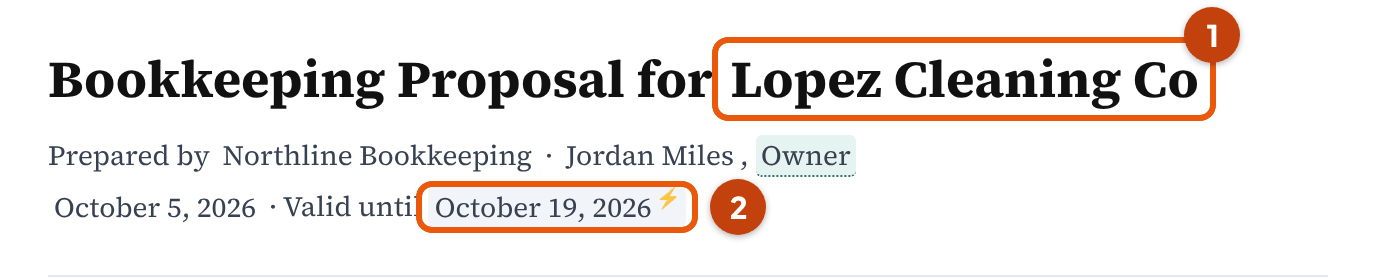
Sample wording
Bookkeeping Proposal for Lopez Cleaning Co
Prepared by Northline Bookkeeping · Jordan Miles, Owner
October 5, 2026 · Valid until October 19, 2026
In the builder: The client, and Dates and deadlines. The dates fill in automatically. Open the builder ↑
How should a bookkeeping proposal open?
In short: With what the client told you on the call, in their words. It's the reason for the scope, the catch-up, and the start date.
"We provide full-service bookkeeping solutions" could go to any client, so it gives the reader nothing to check. When you repeat what the client said, they see the price is built on their situation. A year later, it also reminds you what that situation was.
On the call, Maria said three things. She's been doing the books herself since she took over the business. She's five months behind. And her bank wants current statements before her line of credit renews in the spring.
Each of those shows up later in the proposal. The five months become a catch-up fee, and the bank's deadline sets when the catch-up has to be done. So the opening names all three.
Sample wording
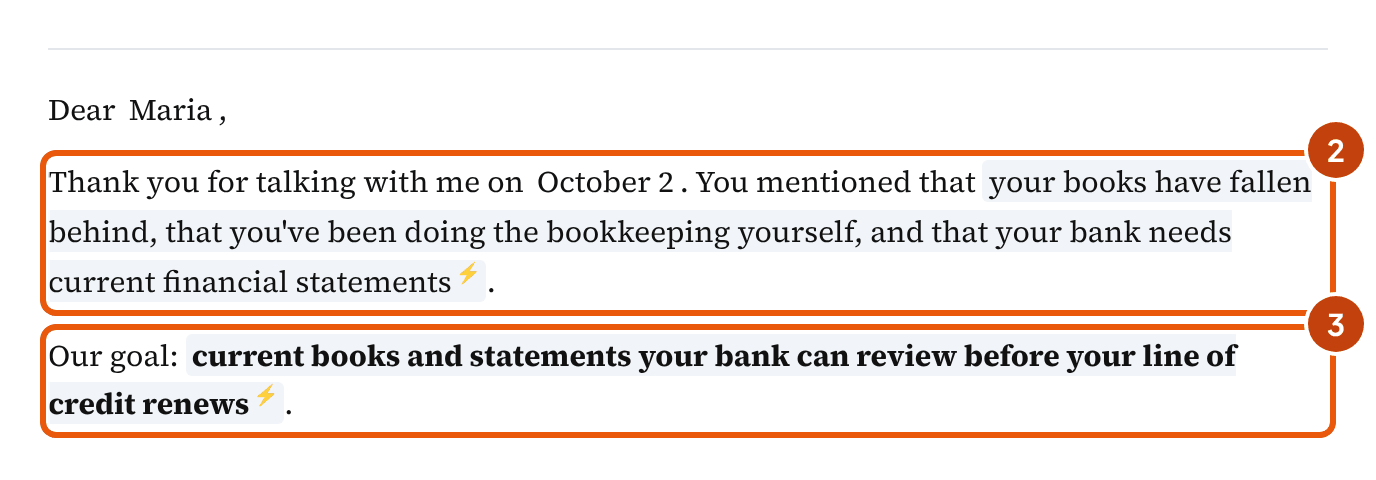
Thank you for talking with me on October 2. You mentioned that your books have fallen behind, that you've been doing the bookkeeping yourself, and that your bank needs current financial statements.
Our goal: current books and statements your bank can review before your line of credit renews.
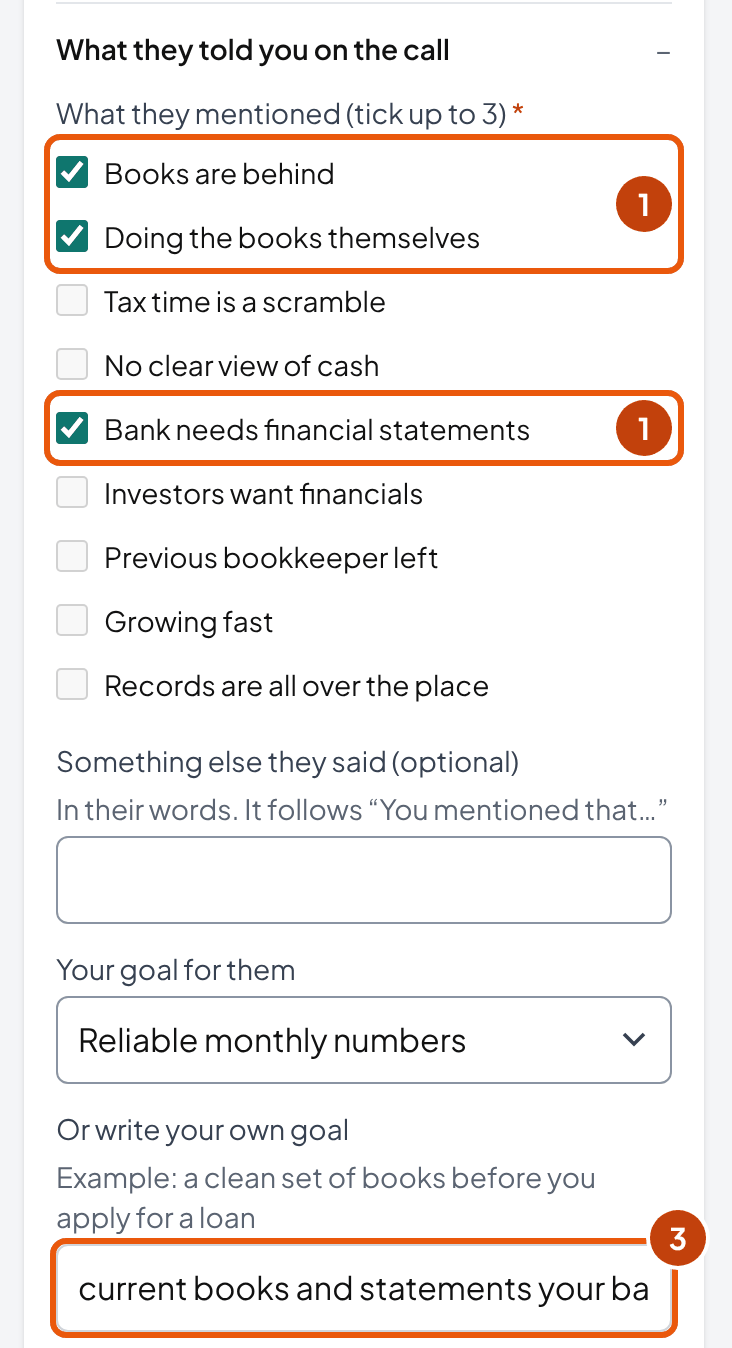
In the builder: What they told you on the call. Tick up to three things they said, and write your own goal if the ready-made ones don't fit. Open the builder ↑
The ready-made goal names the bank but not the deadline, so Maria's goal line adds the renewal. Want her exact words in the first sentence too? Edit text freely under the proposal lets you change it before you send.
| Could go to any client | Written to this client |
|---|---|
| We provide full-service bookkeeping solutions. | You mentioned that the books are about five months behind and that you've been doing them yourself. |
| We will improve your financial processes. | Our goal: current books and statements your bank can review before your line of credit renews. |
Does a personalized opening win more clients? Proposify's 2024 report found close rates about 50% higher when roughly 30% of the executive summary was customized (Proposify, 2024).
Those are its customers' proposals, though. Firms that customize may also choose clients more carefully, price more accurately, or follow up sooner, and the data can't separate those. Write the opening anyway: it's your record of what the client told you.
How do you count the work before you quote?
In short: From the client's bank and card statements, not their estimate. The price rests on the count, and an estimate from memory can leave whole accounts out.
An owner's estimate often counts only the checking account. One who says 100 transactions a month may mean 100 in checking, with 300 more in Stripe payouts and on the card. A price built on that guess changes a few months in. Changing it means reopening something the client thought was settled.
So before you quote, ask for three months of bank and credit card statements, or access to the accounting file. Count the transactions per month and every account the books reconcile: bank, credit card, loan, and payment-processor accounts such as Stripe, Square, or PayPal. The pricing template counts accounts the same way, so a client lands at the same price in both.
| Her estimate: about 150 transactions a month, 3 accounts | |
| Hours: 3 + (1.2 × 1.5) + (0.5 × 2) | 5.8 hours |
| Price: 5.8 × $65 = $377, rounded to the nearest $25 | $375 a month |
| Her statements: about 250 transactions a month, 2 bank accounts and 1 card | |
| Hours: 3 + (1.2 × 2.5) + (0.5 × 2) | 7 hours |
| Price: 7 × $65 = $455, rounded to the nearest $25 | $450 a month |
Quoted on her guess, the price would have been $75 a month short, or $900 over a year, for work you'd be doing anyway.
Where do the hours come from? The builder starts at 3 hours a month, adds 1.2 hours for every 100 transactions, and adds half an hour for each account after the first. Then it multiplies the hours by your rate.
It also multiplies by 1.25 for retail, e-commerce, or construction clients, by 1.5 for restaurants, and by 1.25 for accrual reporting. All of these are our starting assumptions, not published standards, and so is the $65 hourly rate. Time your first few clients and replace them with your own numbers. The pricing template works out your hourly rate from your income goal and costs.
What if the owner pays personal bills from the business account? Each of those transactions needs a question and a decision, so mixed spending adds hours rather than saving them. Practitioners in the r/Bookkeeping threads we read treat it as a reason to charge more, not less. We'd count it in the hours, or bill it hourly until the accounts are separate.
How does the price compare with the market?
Maria's $450 falls inside the most common monthly bookkeeping price in Ignition's 2025 survey of 219 US firms that use its software: $250 to $499, reported by 29% of them (CPA Practice Advisor).
It's below Catalyst CPA's range for a freelance bookkeeper at 100 to 300 transactions, $500 to $800 (Catalyst CPA, 2026). That range is one firm's own estimate, not a survey, and the firm sells bookkeeping itself. We read it on September 29, 2026. The page wouldn't load when we re-checked it on October 11, 2026, so treat it as that date's figure.
| Source | What it measures | Figure | $450 is |
|---|---|---|---|
| Ignition 2025 benchmark | 219 US firms that use Ignition, most common monthly bookkeeping price | $250 to $499 (29% of firms) | Inside the range |
| Catalyst CPA 2026 price guide (read September 29, 2026) | One firm's estimate for a freelancer, 100 to 300 transactions | $500 to $800 a month | Below the range |
Neither figure tells you what your local market pays. Use them to check that your number isn't far off, not to set it. If yours lands outside both, recheck your hours first. Then compare two or three local quotes before you move the price.
Questions to ask on the call
The first five questions get you the count, and the statements confirm it. The last three tell you what the books are for. That sets the reporting basis, the deadline, and whether the client's CPA needs to be in the loop:
- How many bank, credit card, loan, and payment processor accounts does the business have?
- Which accounting software do you use, and can we have read-only access before we quote?
- Does your tax preparer or lender need cash or accrual reporting?
- When were the books last reconciled?
- Do you run payroll or collect sales tax, and if so, for how many employees and in which states?
- Who prepares your tax return, and may we talk to them?
- Will a bank, investor, or buyer read these statements in the next year?
- What do you want from the books each month, and by what date?
Bookkeeper tip: Asked "how much?" before you've seen anything? Give the range for their size from the builder, and say you'll confirm it once you've seen three months of statements.
If you send the proposal before the statements arrive, say what happens when the count differs. Otherwise a client with six accounts instead of three meets the new price as a surprise:
Before you've seen the statements
The price above assumes the 3 accounts we discussed on the call. If your statements show more accounts or a different volume, I'll send you the updated price before any work starts.
Enter the counts under Client's books and volume in the builder, and the three package prices update as you type.
What should the proposal say the price assumes?
In short: One sentence that lists what the price assumes. A later price change then starts from a record the client has already read.
Volume grows. Clients open new accounts. A lender may ask for accrual statements. Without the sentence, each of those changes is your word against the client's memory of the call.
The second sentence covers the client's side. Your reporting dates hold only if their statements and answers arrive on time.
Sample wording
This proposal assumes about 250 transactions a month, 3 accounts (the bank, credit card, loan and payment-processor accounts the books reconcile), QuickBooks Online, cash-basis reporting, and books that are up to date once the catch-up below is complete. If any of these change significantly, we'll tell you before the price changes. It also assumes your statements, receipts and answers to our questions reach us in time to reconcile by the 10th of the following month; when they come later, your reports move back by the same number of days.
In the builder: Filled in from Client's books and volume. Anything you don't offer as an add-on moves to "Not included" automatically. Open the builder ↑
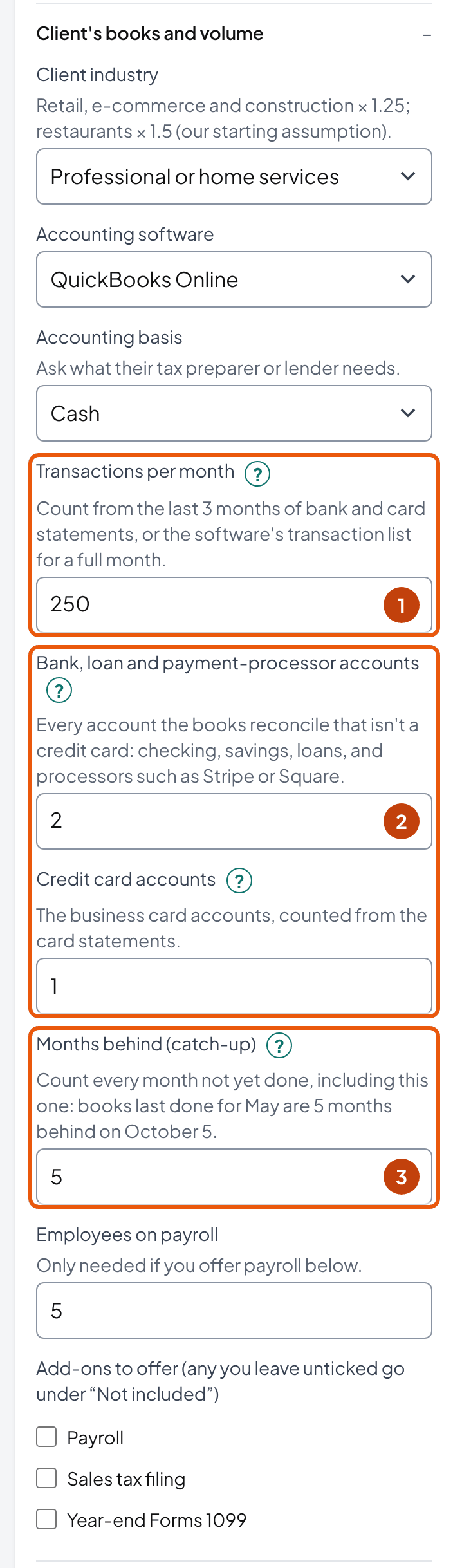
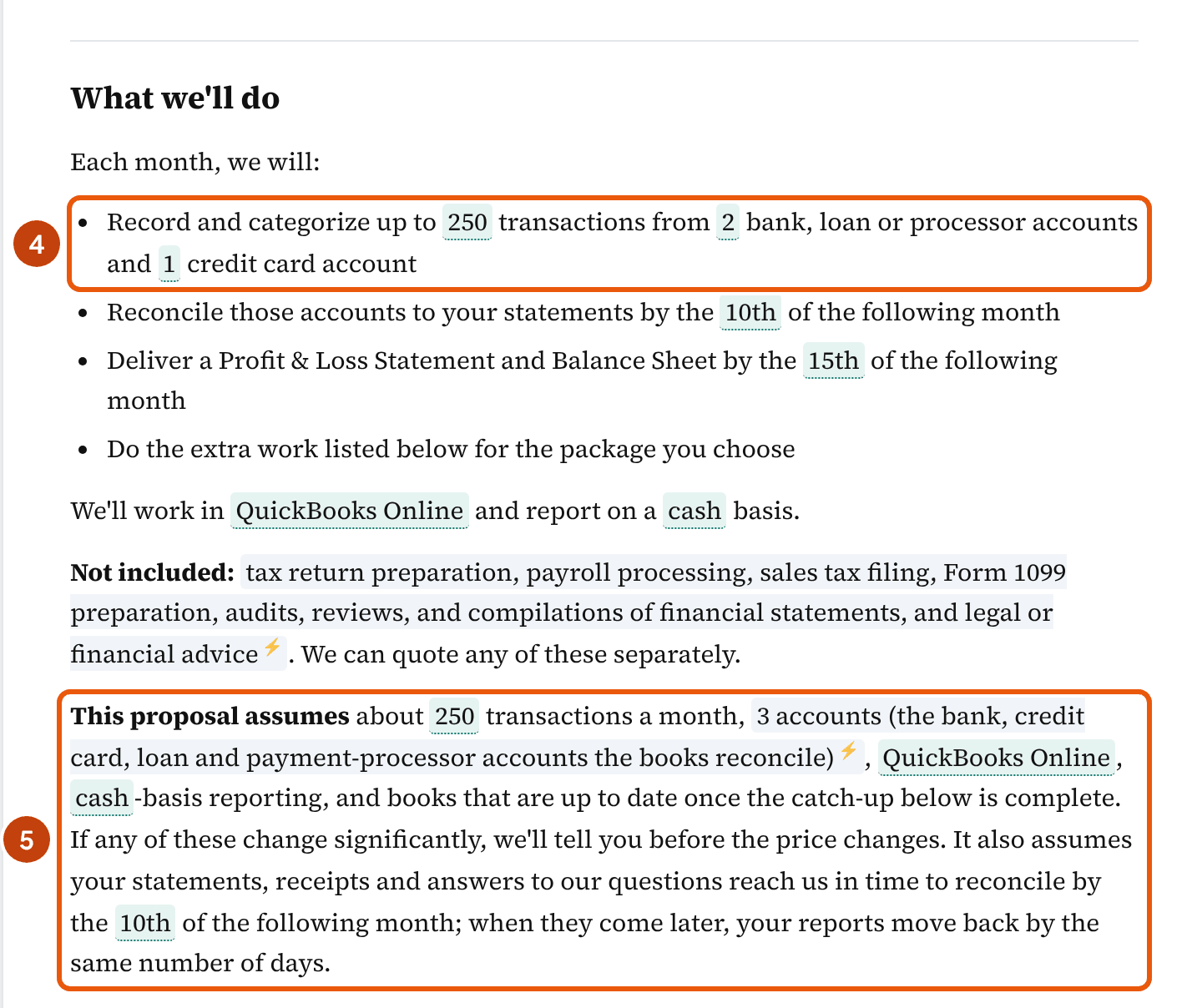
The builder's list of monthly work also says "up to 250 transactions". So the count appears twice: once as a limit on the work, and once as an assumption behind the price.
What's left out needs the same care. Maria has five employees, so she could reasonably assume payroll comes with "bookkeeping". The builder lists payroll under "Not included" unless you tick it as an add-on under Client's books and volume. Ticked, it's priced at $100 a month plus $5 per employee, $125 for her. That price is our starting assumption.
| Today: 250 transactions, cash basis, 7 hours | $450 a month |
| Volume grows to 500 transactions: 3 + (1.2 × 5) + (0.5 × 2) = 10 hours | $650 a month |
| Her bank asks for accrual statements: $455 × 1.25 = $568.75, rounded | $575 a month |
The 1.25 for accrual is our assumption (a quarter more work). With the sentence in the proposal, both conversations start from something she read and accepted.
What does "significantly" mean?
It's the soft word in that sentence, so some firms say how they'll check instead. Fullstack Advisory, an Australian bookkeeping firm, tells clients it reviews fees quarterly and that "[a]ny changes will be sent to you at least 3 weeks beforehand" (Fullstack Advisory).
You can also put a number on it. The safer version below uses 20% above the assumed volume for two months running. That's our example, not a rule.
| Risky | Safer |
|---|---|
| Prices are subject to change. | If volume stays above 300 transactions a month for two months in a row, we'll send an updated price at least three weeks before it applies. |
| Price may vary depending on complexity. | This price assumes cash-basis reporting. If you need accrual statements, we'll quote the change before we start. |
The risky lines don't tell the client when the price will change or why. The safer lines name the trigger and the notice, so the conversation starts from a number she already accepted. To add a threshold, use Edit text freely under the proposal and change the sentence.
Quoting before you've seen every month? Tick Say you'll review the price after the first 3 months under Your prices, and the proposal adds one line. The wording is ours:
Price review line
We'll review the price with you after the first three months of monthly work, against the volume we actually see.
In the builder: Your prices, "Say you'll review the price after the first 3 months". Off by default. Open the builder ↑
How do you price catch-up and setup?
In short: As one-time fees, separate from the monthly price. The backlog is cleared once, and the monthly work goes on.
Fold catch-up into the monthly price, and the price is too low while you clear the backlog, then too high once the books are current. The client also can't tell which part of the number pays for what.
| First package | $450 a month |
| Catch-up per month behind: the full first package | $450 |
| Catch-up fee: 5 × $450 | $2,250 one time |
| Half when she signs, half when the books are current | $1,125 + $1,125 |
| Setup fee (the builder's default) | $500 one time |
The full monthly fee for each month behind is the builder's default, with a floor of $150 a month. It's our starting assumption, not a market rate. Catch-up, % of package 1 under Catch-up terms changes it.
How does that compare?
Two published figures give a rough comparison, and both come from firms that sell catch-up work. Merritt Bookkeeping lists $200 for each month behind, or $100 if the month is mostly complete (Merritt Bookkeeping). Etisson's 2026 guide puts catch-up at $150 to $300 per month for low-complexity books and $300 to $600 for medium ones (Etisson). We don't know where either firm draws the line between low and medium.
In the r/Bookkeeping threads we read in October 2026, bookkeepers most often start from the full monthly fee for each month behind. They add more for missing statements or personal spending on the business card. Several who discounted catch-up to win the monthly work said they regretted it. Those are individual posts, not a survey.
That's why the builder starts at the full fee. If the books look messy, go above it: raise Catch-up, % of package 1 past 100%, or type your own fee over the catch-up line, because each messy month takes longer than a clean one. Anything under 100% is a discount, so keep it for clean books with statements for every month.
| Source | Per month behind | Five months, like Maria |
|---|---|---|
| Builder default (our assumption): the full monthly fee, the frame practitioners describe most often | $450, the first package, at least $150 | $2,250 |
| Merritt Bookkeeping | $200 ($100 if mostly complete) | $1,000 |
| Etisson, low complexity | $150 to $300 | $750 to $1,500 |
| Etisson, medium complexity | $300 to $600 | $1,500 to $3,000 |
Open the file before you quote catch-up. Missing statements, accounts nobody has reconciled, and personal spending on the business card all take longer than the month count suggests.
What the proposal says about the catch-up
A catch-up price with no terms leaves four questions for the end of the job. Which months does it cover? What counts as done? What happens when a fourth account turns up? When is the money due? The builder answers them in a short paragraph under the one-time fees:
Sample wording
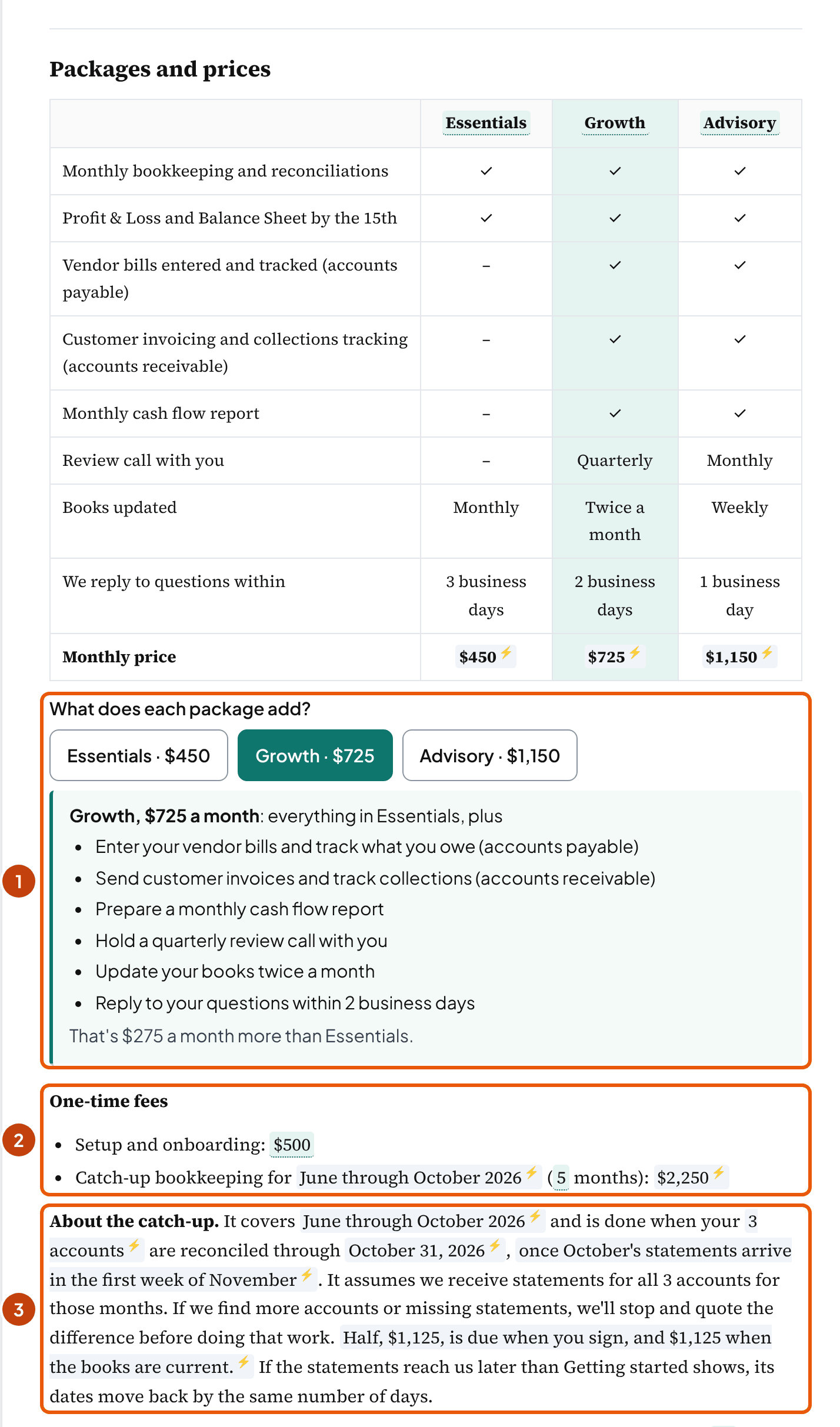
About the catch-up. It covers June through October 2026 and is done when your 3 accounts are reconciled through October 31, 2026, once October's statements arrive in the first week of November. It assumes we receive statements for all 3 accounts for those months. If we find more accounts or missing statements, we'll stop and quote the difference before doing that work. Half, $1,125, is due when you sign, and $1,125 when the books are current. If the statements reach us later than Getting started shows, its dates move back by the same number of days.
In the builder: Catch-up terms, "When the catch-up is paid". The months come from the proposal date and the months behind. Open the builder ↑
Why "once October's statements arrive"? On October 5, October isn't over, so its bank and card statements don't exist yet. The builder expects them about a week after the month ends, our assumption. So week 1 asks for June through September, and October's reconciliation waits for its statements in early November, still before the first monthly reports on December 15.
Half when the client signs is the builder's default. You can switch it to all at signing or all when the books are current. Create engagement letter carries your choice over, and the engagement letter repeats this sentence word for word, so the client reads the same terms twice.
What if the client stops sending what you need? The terms above move the dates back when statements arrive late, so a late client doesn't become your missed deadline. One bookkeeper in the threads we read counts catch-up deadlines from the day all the documents arrive. Owners in those threads are told to expect a written "stop and ask" before any extra hours, so send one.
When you explain the fee, put it beside the monthly price and the client's own deadline. The client then sees what's paid once, what continues, and what the catch-up gets them:
Explaining it to the client
Your books are five months behind, so before the monthly work starts we bring June through October up to date: $2,250, once, half when you sign. That gives your bank current statements before your line of credit renews. From November it's $725 a month for Growth.
When you can't scope it: hourly up to a cap
Some catch-ups can't be priced as a fixed fee: several years behind, a file nobody has reconciled, or books a buyer will rely on in a sale. In one r/Bookkeeping thread about a multi-year rebuild before a sale, every high-scoring reply said to bill hourly. Replies there and in another thread add a retainer the client refills, with the work stopping when it runs out. Those are individual posts, not a survey.
Set How the catch-up is priced to Hourly, up to a cap. The catch-up fee becomes the cap, $2,250 for Maria, and the starting retainer is half of it, our assumption. The proposal then says:
Hourly catch-up
We bill it hourly at $65 an hour and won't go over $2,250 (about 34.6 hours) without your written approval. You pay a $1,125 retainer when you sign and refill it when it runs out; work pauses until it's refilled, and what's left of it comes back to you when the books are current.
In the builder: Catch-up terms, "How the catch-up is priced". The rate is your hourly rate. Open the builder ↑
The engagement letter builder charges catch-up as one fixed fee, so it receives the cap. Change the letter's fees section to these hourly terms before you send it.
When you can't see the books first: a paid diagnostic
Most bookkeepers quote monthly work for free. For a large backlog, some charge a fixed fee for a diagnostic first: a look at the file that ends in a list of findings, a plan for the fixes, and an hours estimate.
In the threads we read, clients accepted it when two things were true. The fee and the deliverable were stated before the work started. And the fee was credited against the catch-up. If you can't open the file before quoting a large catch-up, offer the diagnostic, so the catch-up price rests on what you saw.
Offering a diagnostic
Before I quote the catch-up, I'd like to review your file. The review has a fixed fee. You get a list of what I found, a plan for the fixes, and an hours estimate, and the fee comes off the catch-up if you go ahead.
Once you quote, Diagnostic review under Catch-up terms puts the fee in the proposal as a one-time line, credited against the catch-up. With a $300 diagnostic (our example), Maria's proposal would say $1,950 is left: half, $975, when she signs, and $975 when the books are current.
When the catch-up has a deadline
Maria's bank wants statements before the spring renewal. So the timeline shows the week the backlog is done, and the week-one line names what she sends first.
On October 5, five months behind means June through October, so the catch-up closes October too. In the builder's timeline, week one is the engagement letter, bank feeds, software access, and her statements for June through September. Weeks two to four are setup and the catch-up, ending with October once its statements arrive. The first monthly reports are for November, and the builder dates them December 15.
| When | What happens |
|---|---|
| Week 1 | We both sign the engagement letter. You connect your bank feeds, give us access to QuickBooks Online, and send bank and card statements for June through September 2026. |
| Weeks 2 to 4 | We set up your file and catch up June through September 2026. October's statements follow in the first week of November: you send them, we reconcile October, and the catch-up is done. |
| By December 15 | You receive your first monthly reports, for November. |
| Day 90 | We review the first three months with you and check that your package still fits. |
The builder's proposal says the work begins once both sides sign an engagement letter, so setup doesn't start on a "yes" by email. If you move the start date later and a month falls between the catch-up and the first monthly reports, the builder says so above the price and under the months behind.
Ask Maria what the bank wants to see. If it asks for reviewed or compiled statements, bring in her CPA before you promise anything. Who may prepare those depends on each state's accountancy law, and we haven't checked every state. The builder lists audits, reviews, and compilations under "Not included". The proposal can say you'll have the books ready for her CPA by a date the CPA agrees to.
The setup fee
The setup fee covers connecting accounts, cleaning up the chart of accounts, and onboarding. Estimate the hours and multiply them by your rate. For comparison, Bookkeeper360 lists onboarding and prior bookkeeping from $1,000 per project on its own pricing page.
Enter the months behind under Client's books and volume. The catch-up fee appears as its own line under the one-time fees, with the months it covers.
Should you offer three packages or one price?
In short: Three packages let the client choose how much help they want; one price fits when you already know what they need. The evidence either way is thin, so we'd pick by client: one price for a one-account client with simple books, three when you can't yet tell.
If you offer three, make the differences answer the client's question: what do I get for the extra $275 a month?
Ryan Lazanis of Future Firm founded an accounting firm that was later acquired. He builds packages from the services, the support, and the technology. In his template, support includes how fast you reply: same-day for the top package, 2 days for the middle one, and 5 days for the lowest (Future Firm).
The builder follows a similar pattern. Firms offer different things, so every row can be renamed, changed for each package, removed, or added under What each package includes:
| Essentials | Growth | Advisory | |
|---|---|---|---|
| Monthly bookkeeping, reconciliations, reports by the 15th | ✓ | ✓ | ✓ |
| Entering vendor bills, invoicing and collections tracking, cash flow report | – | ✓ | ✓ |
| Review call | – | Quarterly | Monthly |
| Books updated | Monthly | Twice a month | Weekly |
| Reply to questions within | 3 business days | 2 business days | 1 business day |
| Lopez Cleaning Co | $450/month | $725/month | $1,150/month |
For Maria, Growth fits. Her customers are businesses she invoices, and she needs to know who hasn't paid.
The builder prices the packages at 1, 1.6, and 2.5 times the base estimate, rounded to the nearest $25. Her $455 becomes $450. $455 × 1.6 = $728 becomes $725. $455 × 2.5 = $1,137.50, exactly halfway, rounds up to $1,150. The multipliers are our assumption. If you set the first package's price yourself, the other two follow it.
Is one price better?
Better Proposals found in its 2019 data that proposals with no package options ended with initial fees about 21% higher and monthly fees about 33% higher (Better Proposals, 2019).
Does that mean dropping packages earns more? Not necessarily. These are its own users across every industry. People who send one price may be the ones who already know the client's needs, or who charge more to begin with. Future Firm's template uses three packages, and so does the builder by default, with a one-package option.
What if the client pushes back on price?
We'd offer the smaller package rather than a lower price for the same work, so the price stays tied to what you'll do. Bookkeepers in the threads we read give the same advice: cut the scope, not the rate. In Proposify's 2021 data, discounted proposals closed 13% less often than full-price ones (Proposify). That's older data from its own customers, and it doesn't show why.
When the client asks for a discount
I can't lower the price for the same work, but I can fit the work to your budget. Essentials at $450 a month covers the books and the monthly reports, and we can look at it again at the 90-day review.
The builder's annual prepay discount (10% by default) is a different trade, since the client pays for the year up front. Set it to 0 to leave it out.
Which promises can carry into the engagement letter?
In short: The specific ones. So promise only what you can count, because wording in a proposal can become part of what you agreed to.
The Tax Adviser, published by the AICPA, wrote about this for tax engagements. When a formal proposal comes first, it notes, "the engagement letter operates as an acceptance, with any changes noted, to the terms of the proposal" (The Tax Adviser, 2014).
Bookkeeping isn't tax work, but we'd assume the same logic applies. "We'll make sure your books are always accurate", written to win Maria in October, can be read as an obligation when her tax preparer finds an error in February.
| Hard to deliver | Countable |
|---|---|
| Complete management of your finances | Monthly bookkeeping and reconciliation of the 3 accounts listed above |
| We'll make sure your books are always accurate | Profit & Loss and Balance Sheet by the 15th of each month |
| Fast answers whenever you need us | We reply to questions within 2 business days |
| Tax-ready books | Books reconciled through December 31 and sent to your tax preparer by February 15 |
CAMICO, which insures accounting firms, lists the words to avoid in engagement letters: "all, every, any, complete, confirm, totally, validate and verify" (CAMICO). They cause the same trouble in a proposal. The left column above uses "complete", and "always" has the same problem: neither can be checked at the end of a month.
Tax work and titles
Listing tax return preparation? The IRS generally requires a PTIN from anyone paid to prepare all or substantially all of a federal return. Forms W-2 and 1099 are excluded, and a bookkeeper who only organizes records "is not a tax return preparer" (IRS).
Titles count too, and some states restrict them. Minnesota, for example, bars unlicensed people from titles such as "CPA" or "public accountant". It also bars using "accountant" or "accounting" in a way that implies a license or special competence (Minnesota §326A.10). "Bookkeeper" is the safer word.
The builder always lists tax return preparation, audits, reviews, and compilations of financial statements, and legal or financial advice under "Not included".
Liability, termination, records, and monthly payment due dates belong in the engagement letter. The one payment term the builder puts in the proposal is when the catch-up is paid, because the client is choosing that price. The letter and the service agreement repeat that split.
When the client picks a package, Create engagement letter under the builder carries the client, the package, its price, and the scope over to the free engagement letter builder. Sending a numbered contract instead? The service agreement template holds the same terms; enter this proposal's fees there.
What happens after you send it?
In short: An expiry date and a short follow-up schedule keep an old price from staying open.
Ignition, a proposal tool for accounting firms, sets new proposals created from scratch to expire after 14 days (Ignition Help Center). The builder does the same. A proposal to Maria dated Monday, October 5, is valid until October 19, and the builder plans the start for the Monday after that.
Does sending it fast matter?
Better Proposals found in its 2022 data that proposals sent within 24 hours of the call were linked to 42% higher conversion (Better Proposals, 2022). That's its own users, and people who send quickly may also be more organized in other ways.
We'd put the count first. If you're waiting on statements, tell the client when the proposal will arrive, and send it the day the statements do.
The same report found that 58% of proposals were opened on a phone and only 12% were downloaded as a PDF. The introduction and pricing took 67% of the reading time. So keep the prices where someone scrolling on a phone finds them. The builder puts the packages fourth, right after the scope.
When to follow up
The builder's schedule is about 3, 7, and 14 days after sending, then a call or a short note asking whether to close it out. That's our schedule, not a published standard.
Ignition can send up to three automatic reminder emails after a proposal goes out, and it suggests a phone call after that (Ignition). The builder writes each email from the client's name and what they told you:
Day 3
Hi Maria, did the proposal come through? Which package is closest to what you need? I can adjust the scope if something doesn't fit.
Day 7
Hi Maria, when we talked, you mentioned getting the books caught up. If we start by October 26, your first monthly reports would arrive by December 15. Any questions I can answer?
Day 14
Hi Maria, the proposal expires today, October 19. If now isn't the right time, tell me and I'll close it out. To go ahead, reply with the package you want and I'll send the engagement letter today.
Bookkeeper tip: The emails are drafts to edit: click an email's subject or text under the proposal and type over it. For Maria, mention the bank renewal again in the day 7 email, since that's the deadline she named.
Rather not track this by hand? Send to client & track opens the proposal in the Ledgental app, which is ours and free during the beta. The app emails the proposal from your firm, tells you when the client opens it, and sends the day 3, 7, and 14 follow-ups for you.
When the client says yes
The next document is the engagement letter. Proposify's 2026 report found a 15% higher close rate and deals closing 60% faster with an e-signature, again from its own customers (Proposify, 2026). We'd send the letter the same day either way, while the proposal is still fresh.
Before you send: a last check
A typical slip is a price quoted for 150 transactions when the statements show 250. Before you send, check that:
- a price is on the page, not "we'll discuss fees later"
- the opening could only have been written to this client
- the count comes from statements or the software, not the client's guess
- one sentence says what the price assumes, and what happens if the statements show more
- catch-up and setup are listed as one-time fees, apart from the monthly price
- the catch-up names its months, what counts as done, and when it's paid
- every promise can be checked at the end of a month, with no "all", "complete", or "guarantee"
- liability, termination, and records terms are left for the engagement letter
- there's a "valid until" date and one clear way to accept
Frequently asked questions
How do I write a proposal for bookkeeping services?
Start after the first call. Ask for three months of bank and credit card statements, and count the transactions and accounts from them. Then write what the client told you and the monthly work, with what's not included. Add one sentence on what the price assumes, the packages, catch-up and setup as one-time fees, the first weeks, and a "valid until" date. The builder on this page puts those parts in that order from your call notes.
How long should a bookkeeping proposal be, and in what format?
In our view, two to four pages as a PDF covers most small-business clients, and a detailed email works for a very small one. In Better Proposals' 2022 data, 58% of proposals were opened on a phone, so keep the prices where someone scrolling finds them. In Proposify's 2025 data across all industries, proposals that closed averaged 11 pages and those that didn't averaged 13. Both are the vendors' own customers.
Does QuickBooks have a proposal template?
QuickBooks Online has a proposal builder under Customer Hub, then Proposals (Intuit's help article, updated August 2026). You add text blocks, can attach one estimate, and the client signs online. It lays out text you write, so the count, the price, and what it assumes still come from you. Older QuickBooks Community answers suggest renaming an estimate to "Proposal", but an estimate on its own is a quote: prices without what they're based on.
How do I price one client in a proposal?
Count the client's transactions and accounts from three months of statements, turn them into hours, and multiply by the hourly rate you need to earn. For a client with 250 transactions and 3 accounts, the builder estimates about 7 hours of work a month from its starting assumptions, which is $450 at $65 an hour. In Ignition's 2025 survey of 219 US firms that use its software, the most common monthly bookkeeping price was $250 to $499, reported by 29% of them. To set your hourly rate and a price list for every client size, use the bookkeeping pricing template.
Should I offer more than one package?
The builder defaults to three packages and marks none, so the client chooses how much help they want. If you already know exactly what the client needs, one price works too. The evidence either way comes from proposal software vendors' own data and doesn't settle it.
How long should a proposal be valid?
A short window, such as 14 or 30 days. Ignition, a proposal tool built for accounting firms, sets new proposals created from scratch to expire after 14 days. The date gives you a reason to follow up, and it keeps a $450 quote from staying open after the client's volume has doubled.
When should I follow up after sending a proposal?
The builder's schedule is about 3, 7, and 14 days after sending it, then a short call or a note asking whether to close it out. Keep each follow-up short and end it with one step, such as "Reply Growth and I'll send the engagement letter."
Is a bookkeeping proposal legally binding?
A proposal the client accepts can become part of your agreement, and wording from it can carry into the engagement letter. That's why the builder's proposal says that work starts once both sides sign an engagement letter, which governs the services. Whether a specific document binds you depends on its wording and your state's law, so ask an attorney if it matters.
Should catch-up work be included in the monthly price?
No. Price catch-up as a separate one-time project, and say in the proposal which months it covers, when it counts as done, and when it's paid. Mixed into the monthly price, it leaves the price too low while you clear the backlog and too high once the books are current. The builder starts at the full monthly fee for each month behind, our starting assumption: five months at $450 is $2,250. For a large rebuild you can't scope yet, it can bill the catch-up hourly up to a cap instead.
What's the difference between a bookkeeping proposal and an engagement letter?
The proposal comes after the first call and shows what your price is based on: the client's situation, the work, the packages, and a start date. The engagement letter comes after the client says yes and sets the agreed terms, including client responsibilities, liability, termination, and records. Both sides sign it.
Where do payment terms go, in the proposal or the engagement letter?
Mostly in the engagement letter. The one payment term the builder puts in the proposal is when the one-time catch-up is paid, half when the client signs and half when the books are current by default (or a retainer, for an hourly catch-up), because the client is choosing that price. Monthly due dates and anything else that governs the relationship, such as liability, termination, and records, belong in the letter the client signs.
Can I download the proposal as a Word document or PDF?
Yes. Use Download Word for an editable .docx file or Download PDF for a copy that's ready to send. You can also copy the text into your own email or proposal tool. To edit it in Google Docs, download the Word file, upload it to Google Drive, and open it with Google Docs.
How we built this page
Ledgental Team wrote this guide and built the builder. Ledgental also makes a bookkeeping app that's free during its beta, and the builder's "Send to client & track" button opens your proposal in it. The guide and the builder work without the app.
What the numbers rest on
- Prices and rates are published figures from the firms and surveys named in the text, each labeled with who measured it. We checked each against its source in September and October 2026.
- Legal points come from the IRS's PTIN guidance and Minnesota's statute. Other states differ, and this isn't legal advice.
- The price calculator uses the hours model and multipliers described above. They're our starting assumptions, not market data. "How we worked this out" in the builder shows every step for your numbers.
- Practitioner practice (the full monthly fee for each month behind, hourly catch-up with a refilled retainer, the paid diagnostic, the questions to ask on the call) comes from r/Bookkeeping threads we read in October 2026. It describes what posters say they do, not market data, and we don't quote their figures as prices.
- Not covered: tax return preparation, audits, reviews, and compilations, the terms of the engagement letter (the letter builder covers those), and state licensing rules beyond the Minnesota example.
What changed
- October 12, 2026: catch-up now defaults to the full monthly fee for each month behind (5 × $450 = $2,250 for Maria, was 80%, $1,800), and the % is a field the pricing template hands over. The last catch-up month is done once its statements arrive the next month, and the timeline says so. New options: hourly catch-up up to a cap with a refilled retainer, a paid diagnostic credited to the catch-up, and a line that the price is reviewed after three months. One meaning of "account" in the proposal and the pricing template (bank, credit card, loan and payment-processor accounts). Also: no package is marked "Recommended" (the client chooses), packages can be compared under the table, and their rows can be changed. Five figures were retaken. The guide is rewritten in shorter sentences and adds wording for a quote sent before the statements arrive, a discount request, a client who stops sending documents, and mixed personal spending. Later the same day: the accounts payable row now says you enter and track vendor bills, as the engagement letter does, since paying bills is a separate service the letter lists only when ticked. "Create engagement letter" now also carries the chosen package's reply time, review calls and how often the books are updated.
- October 11, 2026: the proposal now states the catch-up's months, what counts as done, what it assumes, and when it's paid (half at signing by default), and a line on when statements need to arrive. The guide adds the full-fee catch-up frame beside the 80% default, three more questions for the call, a paid diagnostic, and wording to explain the catch-up. A price you type now shows what it earns per hour. Date fields are plain text, the lender option is split into bank and investors, and the Catalyst CPA figure is dated because its page was unreachable.
- October 2026: added a finished example to the builder, a price summary beside the fields, and a "How we worked this out" panel. Corrected how we describe Minnesota's title rule, Future Firm's response times, and Ignition's reminders. Added where payment terms go, how to use the Word file in Google Docs, how to write a proposal, the format, and QuickBooks Online's proposal builder to the FAQ; moved the hourly-rate question to the pricing template. Prices with cents now always show two digits ($1,137.50), and this page states its reuse license (CC BY 4.0).
- September 30, 2026: guide rewritten around one client, Lopez Cleaning Co, with new screenshots.
- September 2026: first published.
Cite this page
Copy one of these lines to credit the page. To link to one section, use the link icon beside its heading.
- Plain line
- Ledgental, Free Bookkeeping Proposal Template, updated October 2026, https://ledgental.com/tools/bookkeeping-proposal-template
- APA
- Ledgental. (2026, October). Free Bookkeeping Proposal Template. https://ledgental.com/tools/bookkeeping-proposal-template
- Chicago
- Ledgental. “Free Bookkeeping Proposal Template.” Last modified October 2026. https://ledgental.com/tools/bookkeeping-proposal-template.
Reusing this page: the guide's text, tables, and screenshots are licensed under CC BY 4.0. Credit "Ledgental" with a link to this page. Quotations from the IRS are public domain, and quotations from other sources stay under their owners' terms.
Sources
- Frequently asked questions: Do I need a PTIN?, Internal Revenue Service
- Minnesota Statutes §326A.10, Minnesota Office of the Revisor of Statutes
- Engagement letters (Tax Practice Responsibilities, November 2014), The Tax Adviser (AICPA)
- CPA engagement letter do's and don'ts, CAMICO
- 2025 Accounting & Tax Pricing Benchmark (report coverage), CPA Practice Advisor
- Create and send proposals, Intuit QuickBooks Help (updated August 2026)
- Proposal expiry, Ignition Help Center
- Following up on proposals awaiting acceptance, Ignition
- State of Proposals 2026, Proposify
- State of Proposals 2024, Proposify
- Proposal best practices, Proposify
- Proposal Report 2022, Better Proposals
- Proposal Report 2019, Better Proposals
- Bookkeeping pricing template, Future Firm
- What happens if the bookkeeping work increases materially?, Fullstack Advisory
- Bookkeeping cost for small businesses (2026); read September 29, 2026, page unreachable October 11, 2026, Catalyst CPA
- Catch-up bookkeeping pricing, Etisson
- Merritt Bookkeeping (pricing on home page), Merritt Bookkeeping
- Pricing, Bookkeeper360
Price figures are general information from published sources, checked in September and October 2026, not tax, legal, or financial advice. Your market, experience, and clients matter more. Keep your legal terms in a signed engagement letter. This page isn't affiliated with the IRS or any state agency.