Key takeaways
- Work out your hourly rate before any price: the pay you want, plus self-employment tax, plus business costs, divided by the hours you can bill. In our example that's $77,373 ÷ 1,200 hours = $64.48, so $65.
- Billable hours move the rate most: the same pay goal needs $81 an hour at 20 billable hours a week and $54 at 30. Published figures aren't a rate to copy. $24.36 is the BLS median wage for employed clerks, and $43 is the average rate listed on Upwork; neither covers a firm's costs.
- Price monthly packages by transaction band, with each band priced at its top. A client at 250 transactions pays $450 / $725 / $1,150, the same as in our proposal builder.
- Give everything outside a package its own price (extra volume, accounts, payroll, catch-up), and check that each band still earns your rate before you publish. Catch-up is a one-time fee: for a client at 250 transactions who is five months behind, the builder's default of the full monthly fee for each month gives 5 × $450 = $2,250.
- The calculator shows its arithmetic. Open How we worked out the 101 to 250 band under the price sheet to see the hours, the rate, the minimum, and the $25 rounding behind each price.
What is a bookkeeping pricing template?
In short: Your hourly rate turned into a price list a client can check. It holds monthly packages by transaction volume, what each includes, and a price for everything that isn't included.
Jordan Miles runs Northline Bookkeeping, the fictional firm this page follows from start to finish. The builder above starts where Jordan's prices come from: the hourly rate, then the hours each client size takes, then the price. It shows the arithmetic under the sheet, and you can type over any price.
Every price on Jordan's list traces back to the same chain, so a client's question about any price has an answer in hours and dollars:
- What the firm needs a year$77,373$60,000 pay + $9,873 self-employment tax + $7,500 costs
- Hours it can bill1,200 hours25 a week × 48 weeks
- Hourly rate$65$77,373 ÷ 1,200 = $64.48, rounded up
- Hours for one client size7 hoursUp to 250 transactions, 3 accounts: 3 + 1.2 × 2.5 + 0.5 × 2
- Monthly prices$450 / $725 / $1,1507 × $65 = $455; × 1, 1.6, 2.5, rounded to $25
Essentials, Growth and Advisory for a client with up to 250 transactions. Change the rate or the hours in the builder and every price moves with them.
The list sets prices for everyone. The proposal applies them to one client's count, and the engagement letter, or a numbered service agreement, records what that client agreed to.
| Price list | Proposal | Engagement letter | |
|---|---|---|---|
| Who it's for | Anyone who asks | One prospective client | One client who said yes |
| What it answers | What does your firm charge? | What will this client pay, and for what? | What exactly did we agree? |
| How often | Once a year | After each first call | Once per client, renewed yearly |
How do you use the pricing template?
In short: Six steps, top to bottom: your firm, your rate, the four bands, what each package includes, your add-ons, and the pricing check before you download.
- Your firm: name, phone, and email go at the top of the price sheet.
- Your rate and typical client: enter your hourly rate, or open Work out your hourly rate and let the builder calculate it (the hourly rate section explains the math). Set your minimum fee, the clients you mostly serve, and cash or accrual.
- Bands and prices: check the four transaction bands. The 12 prices fill in; type over any of them.
- What each package includes: services, review calls, how often the books are updated, and how fast you reply.
- Add-ons and one-time fees: switch on what you offer and set the prices.
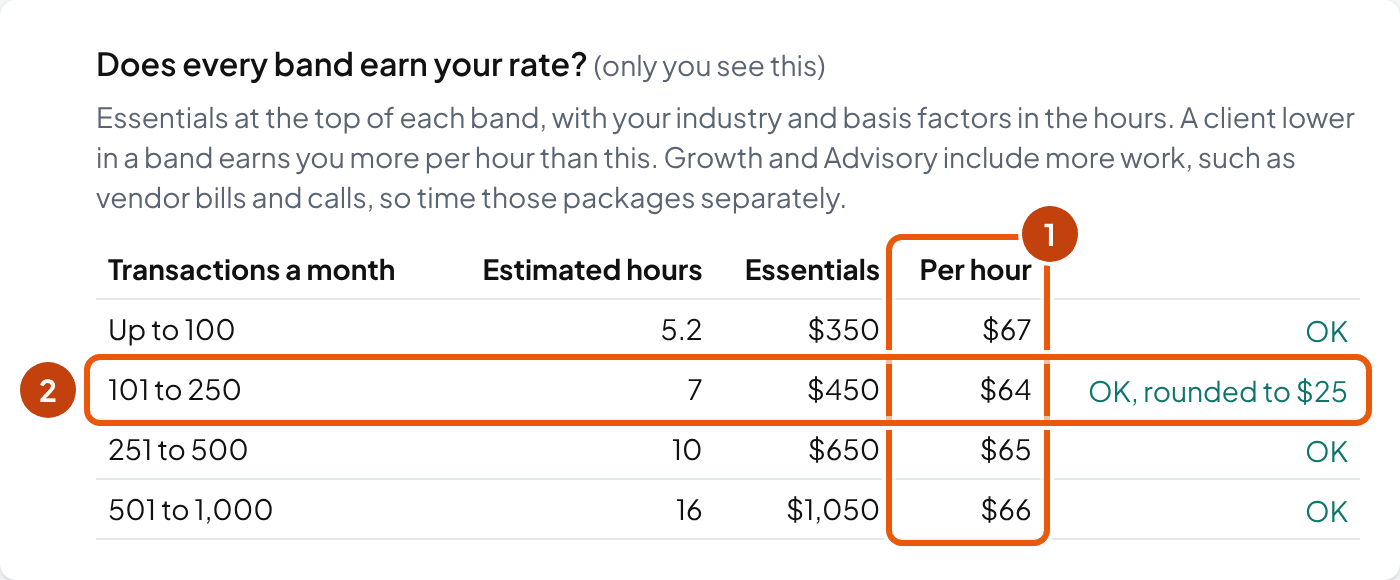
- Does every band earn your rate? (under the sheet): what each band earns per hour, with any band more than 5% below your rate in red, and named in a warning above the builder. Where does my client land? above it does the same for one client's numbers.
Each field has a ? button with what to enter and its range. The field details section lists where to find each number.
How we worked out the 101 to 250 band, under the price sheet, shows the hours, the rate, the minimum fee, and the $25 rounding behind its three prices. When your rate came from the helper, the line under the rate above the builder shows its calculation.
Then download Excel, Word, or PDF. The Excel file has four tabs: the client-ready price sheet, a calculator with working formulas, the hourly rate calculation, and a Checks tab. Its master check (OK or CHECK) sits at the top right of every tab: bands in order, packages in order, and the sheet's prices equal to the calculator's. A price you typed by hand shows CHECK, which is expected.
Everything stays saved in your browser, so next year you change the numbers and download again. To price one client, Use these prices in a proposal copies your rate, package names, and what each package includes into the proposal builder.
What goes in each field?
In short: Every input, what to enter, where the number comes from, and the range the builder accepts. The defaults are the example firm's numbers or our starting assumptions, never market data.
Jordan sits down with three things: last year's Schedule C, the firm's own books for the past 12 months, and three months of statements from a typical client. Everything below comes from one of those.
Your firm
Firm name, phone, and email go at the top of the price sheet, and the website is optional. They're saved in your browser only. The one thing that sends them anywhere is the Save my prices in Ledgental button, which copies your price list into our app when you click it.
Your rate and typical client
| Field | What to enter | Where to find it | Range and example |
|---|---|---|---|
| Your hourly rate | What one billable hour must bring in | Open Work out your hourly rate and build it from the next four fields, or type the rate you already use | Above $0; example $65 |
| Pay you want a year, before income tax | What you want to keep after self-employment tax | Last year's Schedule C net profit if it suited you, or the salary you'd accept as an employee | $0 or more; example $60,000 |
| Business costs a year | Everything the business pays for | The last 12 months of expenses in your own books: software, insurance, training, phone | $0 or more; example $7,500 |
| Billable hours a week | Hours you can charge to clients | Time your work for a month; emails, sales calls, and admin don't count | 1 to 60; example 25 |
| Working weeks a year | Weeks you work | 52 minus vacation, holidays, and sick days | 1 to 52; example 48 |
| Minimum monthly fee | The least any client pays | Your call; see when the minimum matters | $0 or more; example $250 |
| Clients you mostly serve | The industry closest to most of your clients | Your client list | Retail or e-commerce and construction price at 1.25 times the hours, restaurants and hospitality at 1.5, services and other at 1. Our assumption |
| Prices assume | Cash or accrual books | Ask the client or their tax preparer which method their return uses | Accrual prices at 1.25 times the hours, our assumption |
| Accounts included | The bank, credit card, loan and payment-processor accounts reconciled every month in every package | Count them on a typical client's balance sheet or statements | A whole number, 1 or more; example 3 |
Bands and prices
| Field | What to enter | Where to find it | Range and example |
|---|---|---|---|
| Band 1 to 4: up to | The most transactions a month a client can have and still pay this band's price | Count a client's transactions from their last 3 bank and card statements to see where they land | A whole number above the band before it; defaults 100, 250, 500, and 1,000. Above band 4 the sheet says "Custom quote" |
| Package 2 and 3 = Package 1 × | How many times the Package 1 price the package costs | Our starting points; the proposal builder and the Ledgental app use the same two | 1.0 or more; defaults 1.6 and 2.5 |
| Each 50 transactions over the band | Calculated: 0.6 hours at your rate and factors, in $5 steps | Type over it to set your own | Example $40 (with accrual books, $50) |
| The 12 prices | Calculated from the fields above | Type over any of them; Use calculated brings the formula back | Example $450 / $725 / $1,150 at 101 to 250 transactions |
What each package includes
This group holds the package names (Essentials, Growth, and Advisory by default) and the services ticked for each.
It also holds the support rows: the review call, how often the books are updated, and how fast you reply. Reports go out by the 15th of the month by default, and you can change the day. Promise only what you can keep in your busiest month.
Add-ons and one-time fees
| Field | Default | Priced by |
|---|---|---|
| Each extra account (bank, credit card, loan or payment processor) | Calculated: half an hour at your rate and factors, $35 at $65 | Per account, per month |
| Payroll | $100 a month + $5 per employee | Base plus headcount; our example |
| Sales tax filing | $150 per return | Per return; our example |
| Forms 1099 | $75 for the first 3, $15 each after | Per year; our example |
| Payroll tax returns (941/940) | $150 per quarter | Per quarter; our example. Preparing them for pay generally requires a PTIN |
| Year-end package for the CPA | $300 a year | Per year; our example |
| Work outside the packages | Calculated: your hourly rate | Per hour, quoted before you start |
| Each additional business or entity | Off; "Priced as its own client from this list" | A second set of books, priced from the grid |
| Mixed personal and business spending | Off; your hourly rate until the accounts are separate | Per hour |
| Moving to new accounting software | Off; "Quoted after we see your file" | Per project |
| Each rental property | Off; calculated at half an hour a month at your rate and factors, $35 at $65 | Per property, per month; our assumption |
| Rework from late or incomplete records | Off; your hourly rate | Per hour |
| Up to three services of your own | Blank | Name and price in your own words, for example inventory tracking or job costing |
| Setup and onboarding | $500, one-time | Our example |
| Catch-up, % of Package 1 per month behind | 100% (the full Package 1 price), at least $150 a month | Per month behind; our assumption. It goes to the proposal builder with your prices |
Terms and notes on the sheet
The annual prepay discount is 10% by default; set it to 0 to leave the line out. Prices valid through fills in December 31 of this year, or of next year from November on, and you can type any date.
Three lines under Good to know can be switched on or off here. Two are on by default: the package and band are confirmed after you review three months of statements for every account, and your minimum monthly fee. The third, off by default, says new clients whose books you haven't seen may start hourly for three months.
What hourly rate should a bookkeeper charge?
In short: Enough to cover the pay you want, self-employment tax, and your business costs in the hours you can bill. For the example firm in this guide, that works out to $65.
Clients see a monthly fee, but each fee is a number of hours times a rate. Without a rate, you can't tell when a client's price stops paying for the time, and you can't check the price list. So the builder asks for the rate first and derives every price from it.
From pay goal to hourly rate
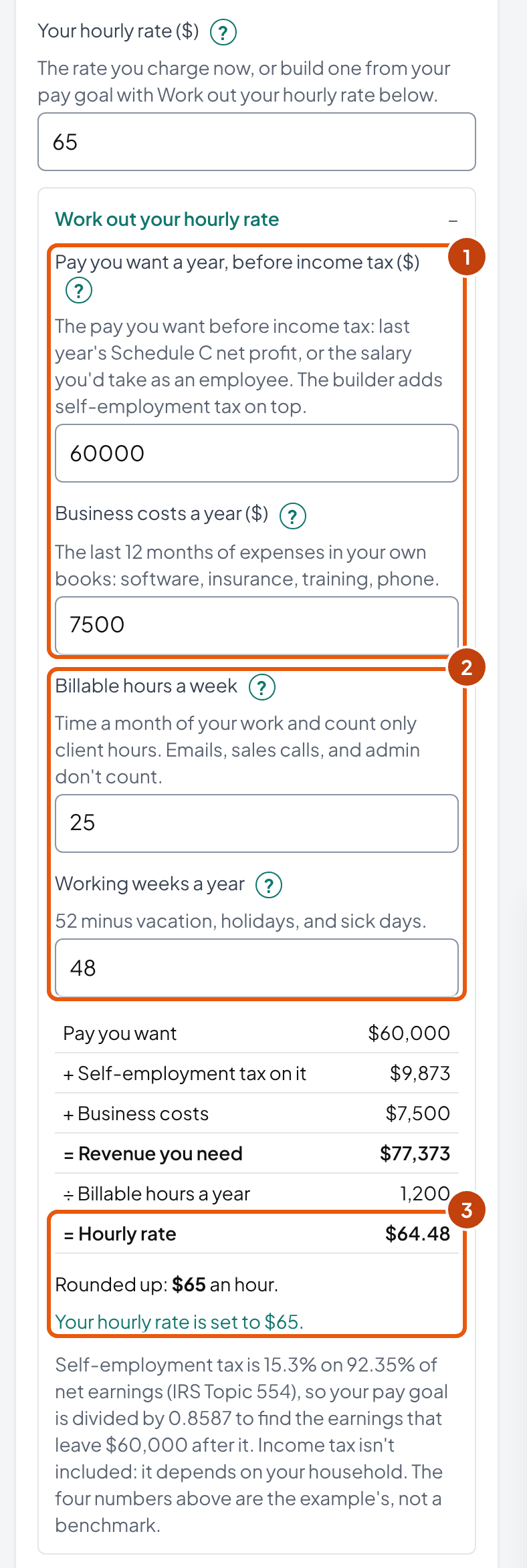
Jordan runs Northline Bookkeeping alone and wants $60,000 a year before income tax. The business spends about $7,500 a year on software, insurance, training, and a phone. About 25 hours of each working week are client work Jordan can bill, over 48 working weeks.
| Pay Jordan wants a year, before income tax | $60,000 |
| Self-employment tax: $60,000 ÷ 0.8587 = $69,873 of earnings; $69,873 − $60,000 | + $9,873 |
| Business costs a year | + $7,500 |
| Revenue the firm needs | $77,373 |
| Billable hours: 25 a week × 48 weeks | 1,200 |
| Hourly rate: $77,373 ÷ 1,200 | $64.48 |
Rounded up, $65 an hour, which is the builder's default rate. The tax line is self-employment tax only; income tax isn't included. The $60,000, $7,500, and 25 hours are our example, not a benchmark.
Why divide by 0.8587? Self-employment tax is 15.3% (12.4% Social Security and 2.9% Medicare) on 92.35% of net earnings, or about 14.13% of earnings (IRS Topic 554).
The tax takes 14.13% of earnings, so the pay Jordan keeps is 85.87% of earnings. Dividing $60,000 by 0.8587 finds the earnings that leave $60,000 after the tax. Adding 14.13% on top of $60,000 instead would put the tax at $8,478. Jordan would then end up about $1,200 a year short after the real tax.
The Social Security part stops at $184,500 of earnings in 2026 (SSA), and the builder accounts for that. Income tax isn't in the calculation, because it depends on the household. When you do work out income tax, half of the self-employment tax is deductible.
Billable hours move the rate more than anything else
Of the three inputs, billable hours are the one with no record behind them. The pay goal is a decision and the costs are in your books, but nobody logs billable hours unless they time them. Client emails, sales calls, admin, and learning software fill a 40-hour week without being billable.
Here is Jordan's rate at three different weeks, with the same pay goal and costs. The last column shows what each rate does to the Essentials price for a client with 250 transactions a month:
| Billable hours a week | Hours a year | Hourly rate | Essentials at 250 transactions |
|---|---|---|---|
| 20 | 960 | $80.60 → $81 | $575 |
| 25 | 1,200 | $64.48 → $65 | $450 |
| 30 | 1,440 | $53.73 → $54 | $375 |
Bookkeeper tip: Track your billable hours for a month before you trust any number here. If you bill 20 hours in a week you planned as 25, the rate that pays you what you planned is $81, not $65.
How do published rates compare?
The hourly figures published online measure different things, so none of them is a rate to copy. Here is what each one measures, and what it leaves out:
| Source | What it measures | Figure | What it leaves out |
|---|---|---|---|
| BLS, 2025 | Median wage of employed bookkeeping, accounting, and auditing clerks | $24.36 an hour ($50,670 a year) | A wage: the employer pays the software, the office, and 7.65% payroll tax on top |
| NerdWallet, citing Upwork (updated March 2026) | Freelance bookkeepers' rates on one marketplace | $43 an hour on average, some $80 or more | How many freelancers, what work, and whether they get that rate |
| Etisson, 2026 | One firm's guide, rates by role | $40–90 production bookkeeping; $75–125 senior or cleanup; $125–200+ controller review | It's one firm's own guide, not a survey |
Jordan's $65 sits inside Etisson's range for production bookkeeping, above Upwork's average, and about 2.7 times the BLS median wage.
Is the gap to the wage a sign the rate is too high? No, it's expected. An employee is paid for every hour worked, billed or not, pays only half the payroll tax, and works with the employer's software and office.
None of these sources tells you what clients in your area will pay. We would use them to see whether your rate is far off, not to set it.
When you hire, price from their cost
A rate built from your own pay goal covers you. It doesn't cover a second person at a margin.
Dream Firms, a broker of accounting firms, suggests a floor price for staff work. Multiply the hours by the wage and by 1.3 for payroll taxes and overhead, then divide by 0.30 for a 70% gross margin. Their own example is 6 hours at $26 an hour, a floor of $680 a month (Dream Firms).
| Hours a month for 250 transactions and 3 accounts | 7 |
| Loaded cost: 7 × $26 × 1.3 | $236.60 |
| Floor at a 70% gross margin: $236.60 ÷ 0.30 | $788.67 |
| Jordan's Essentials price at $65 an hour | $450 |
At Jordan's prices, handing this client to a $26-an-hour hire leaves a gross margin of about 47% ($450 − $236.60 = $213.40), not 70%. If you plan to hire, run the floor on each band before you publish the list.
Ryan Lazanis of Future Firm has a shorter check: add up the yearly hours and cost of everything in a package, then add a 50% margin (Future Firm). Both are ways to find a floor. The price clients see still comes from the packages.
How do you price by transaction volume?
In short: With a few bands of monthly transactions, each priced from the hours it takes at your rate. The client can check their band against their own statements.
Why transactions? Every transaction has to be categorized, matched, and reconciled, so the monthly count is the best single measure of the work. A client can count it too.
The builder assumes 3 hours a month for the close and reports. It adds 1.2 hours for every 100 transactions, and half an hour for each account after the first. That's our starting assumption, not a published standard, so time your own clients and adjust. The proposal guide shows how to get the count from statements.
The example client on this page is Lopez Cleaning Co, Maria Lopez's cleaning company, the same client the proposal guide prices.
| Transactions a month (from 3 months of statements) | about 250 |
| Band: 101 to 250. Hours: 3 + (1.2 × 2.5) + (0.5 × 2) | 7 hours |
| Essentials: 7 × $65 = $455, rounded to the nearest $25 | $450 |
| Growth: $455 × 1.6 = $728, rounded | $725 |
| Advisory: $455 × 2.5 = $1,137.50, rounded | $1,150 |
The same three prices as the proposal builder for 250 transactions and 3 accounts, because both use the same formula.
Why not a percentage of revenue?
Revenue says little about the hours: a large client with simple books can take less time than a small one with messy books. In the r/Bookkeeping threads we read, the hours came from the work itself: manual invoicing, job costing, collections, payroll, and loans and cards to reconcile.
Pricing as a percentage of revenue came up in those threads and was disputed, so we don't present it as a norm. Those are individual posts, not a survey. Price from the count and the accounts, because the client can check both on their own statements.
Each band is priced at its top
A price list has to hold for every client in a band, so the builder prices each band at its highest count. A client near the bottom of a band then pays for time they don't use.
The proposal builder prices the exact count instead, so for these clients the two tools give different numbers:
| Client's transactions | Hours | Price list (Essentials) | Earns per hour | Proposal builder |
|---|---|---|---|---|
| 101 | 5.2 | $450 | $86 | $350 |
| 175 | 6.1 | $450 | $74 | $400 |
| 250 | 7 | $450 | $64 | $450 |
Neither number is wrong. The list gives a client a price they can see before a call, and the proposal gives the price for their count. If the gap bothers you, narrow the bands (more rows), or say on the sheet that you confirm the price after seeing the statements.
In the r/Bookkeeping threads we read, bookkeepers repeat one rule here: no flat fee until you've seen statements for every account. So the sheet says it under Good to know by default:
A line on the sheet
Your package and band are confirmed after we review three months of statements for every account.
In the builder: Terms and notes on the sheet, "Say the package is confirmed after you see the statements". On by default. Open the builder ↑
Where does one client land?
Under the sheet, Where does my client land? takes one client's transactions and accounts. It shows their band, the three list prices, what Essentials earns per hour of their work, and what the proposal builder charges for the exact count.
A client with 175 transactions and 3 accounts lands in the 101 to 250 band: $450, $725, or $1,150 on the list. The builder estimates 6.1 hours a month for this client, so Essentials earns about $74 an hour. The proposal builder prices the exact count at $400, $625, and $1,000, and the card links there with the numbers filled in.
What happens when a client goes over the band
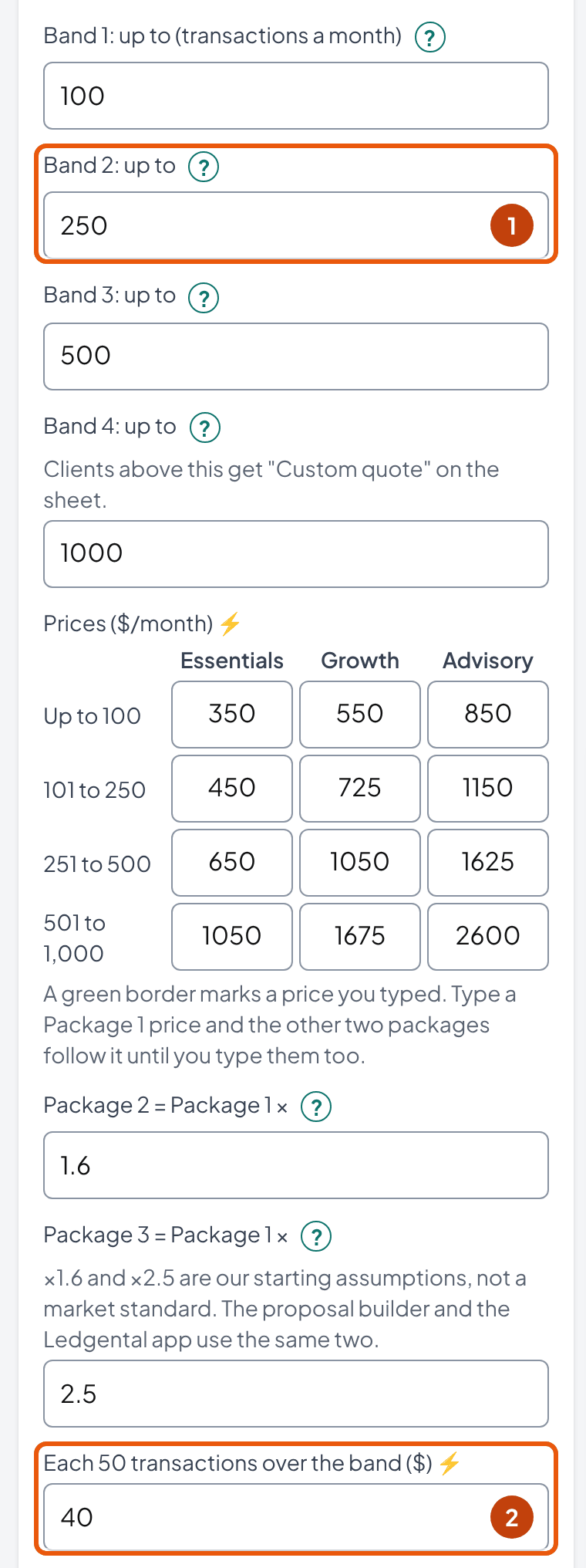
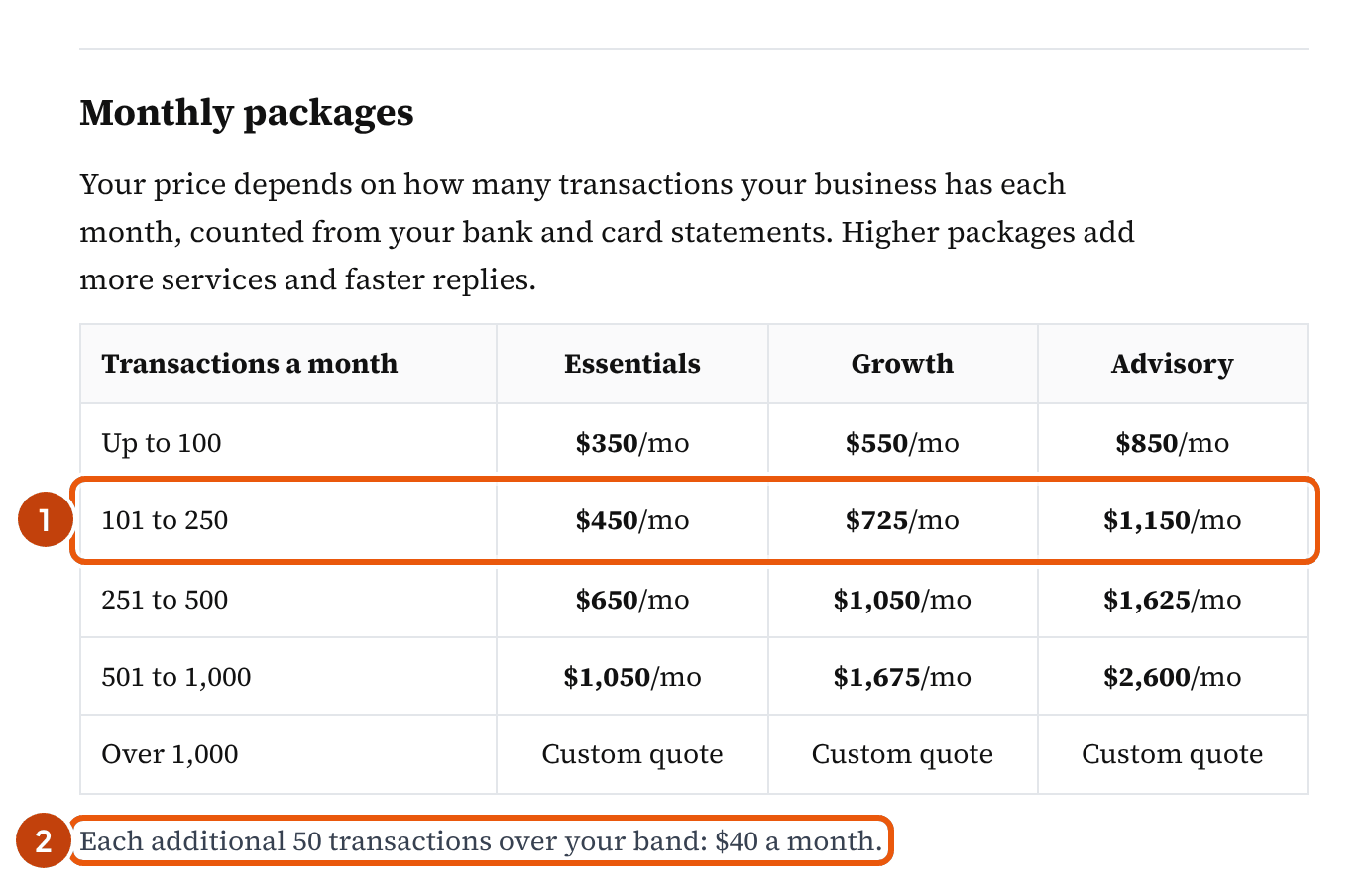
Clients grow, and your list needs a rule for it. The builder prices each extra 50 transactions from the same hours, rate, and factors as the grid: 0.6 hours at $65 = $39, rounded to $40.
If Lopez Cleaning grows to 300 transactions, the list charges $450 + $40 = $490. That's close to the $500 the proposal builder gives for 300.
Moving her straight to the next band would charge $650, the price for 500 transactions. So the sheet says you'll suggest the price for the new size after three months in a row above the band.
Sample wording
Each package includes the transactions in your band. Each additional 50 transactions is $40 a month. If your transactions stay above your band for three months in a row, or you add accounts, entities, or employees, we'll suggest the price for your new size.
In the builder: Bands and prices: "Each 50 transactions over the band." The engagement letter builder uses the same three-month trigger. Open the builder ↑
Accounts included
Each bank or credit card account adds a reconciliation. So the builder includes three accounts in every package and prices each extra one at half an hour at your rate and factors: $32.50 at $65, rounded to $35.
An account here means the bank, credit card, loan and payment-processor accounts you reconcile, the same as in the proposal builder. Loans and processors such as Stripe, Square, and PayPal take reconciliation time too, so the sheet counts them, and a client counts the same things you do.
How does the grid compare with published monthly prices?
Three published sources put monthly prices next to client size, and each has limits.
Ignition, which sells proposal and billing software, surveyed 219 US firms that use it in July 2025. Monthly bookkeeping "most commonly" ran $250 to $499. But only 29% of the firms reported that range, so about seven in ten charge outside it (CPA Practice Advisor).
One bookkeeper's real hours per client
Morgan Law, a solo bookkeeper who writes the FinePoints blog, publishes what her own clients pay and about how long they take. "In general, I charge my smallest clients $250 a month, the mid-sized clients pay $500 a month, and my larger clients are billed at $1,000 a month", she writes (FinePoints).
Those clients take at most 5, 10, and 20 hours a month, "right around $50 an hour". She sizes clients by revenue and employees rather than transactions. Of the hours, she says she doesn't necessarily keep track of them.
Still, of the pages Google showed us for this search in October 2026, hers is the only one with real hours next to the prices. Here it is beside our hours model:
| Hours a month | FinePoints (one bookkeeper, about $50 an hour) | Northline's grid at $65 an hour |
|---|---|---|
| About 5 | Small client: $250 | Up to 100 transactions, 5.2 hours: $350 |
| About 7 | 101 to 250 transactions: $450 | |
| About 10 | Medium client: $500 | 251 to 500 transactions: $650 |
| About 16 to 20 | Large client: $1,000 | 501 to 1,000 transactions, 16 hours: $1,050 |
The two lists move at the same pace: roughly double the hours, double the price. The gap between them is the rate, $50 against $65, not the hours. So if your grid's prices land near hers while your rate is $65, your grid probably counts fewer hours than her clients take. Check your hours before you trust the prices.
Published ranges by transaction volume
Catalyst CPA publishes ranges by transaction volume, but they're the firm's own estimates, not a survey (Catalyst CPA). We read the figures on September 29, 2026. The page wouldn't load when we re-checked it on October 11, 2026, so treat them as that date's figures.
Its bands don't line up with ours, so the table puts each Northline band next to the closest one:
| Northline band | Essentials / Growth at $65 | Catalyst CPA, freelance bookkeeper | Catalyst CPA, CPA firm |
|---|---|---|---|
| Up to 100 | $350 / $550 | $300–500 (under 100) | $400–700 |
| 101 to 250 | $450 / $725 | $500–800 (100 to 300) | $700–1,100 |
| 251 to 500 | $650 / $1,050 | $800–1,500 (300 to 700) | $1,100–2,000 |
| 501 to 1,000 | $1,050 / $1,675 | $800–1,500 or $1,500–2,500 (300 to 700, 700 to 1,500) | $1,100–2,000 or $2,000–3,500 |
Northline's Essentials is inside Ignition's most common range for the two smallest bands. It's below Catalyst's freelance range for 101 to 500 transactions, where Growth falls inside it.
Neither source says what clients in your area pay. So we would read this as a check that the grid isn't far off, not as a reason to move it.
How should your three packages differ?
In short: By support as much as by services: how fast you reply, how often you meet, and how often the books are updated.
Ryan Lazanis founded and sold a cloud accounting firm before starting Future Firm. He builds packages from three parts: the services, the support, and the technology.
In his template the reply time sets the tiers apart: "Gold clients might get a same-day response, 2 days for Silver clients, and 5 days for Bronze clients" (Future Firm). The builder's defaults follow the same idea:
| Essentials | Growth | Advisory | |
|---|---|---|---|
| Bookkeeping, reconciliations, reports by the 15th | ✓ | ✓ | ✓ |
| Vendor bills, invoicing and collections, cash flow report | – | ✓ | ✓ |
| Review call | – | Quarterly | Monthly |
| Books updated | Monthly | Twice a month | Weekly |
| Reply to questions within | 3 business days | 2 business days | 1 business day |
| Lopez Cleaning Co (250 transactions) | $450 | $725 | $1,150 |
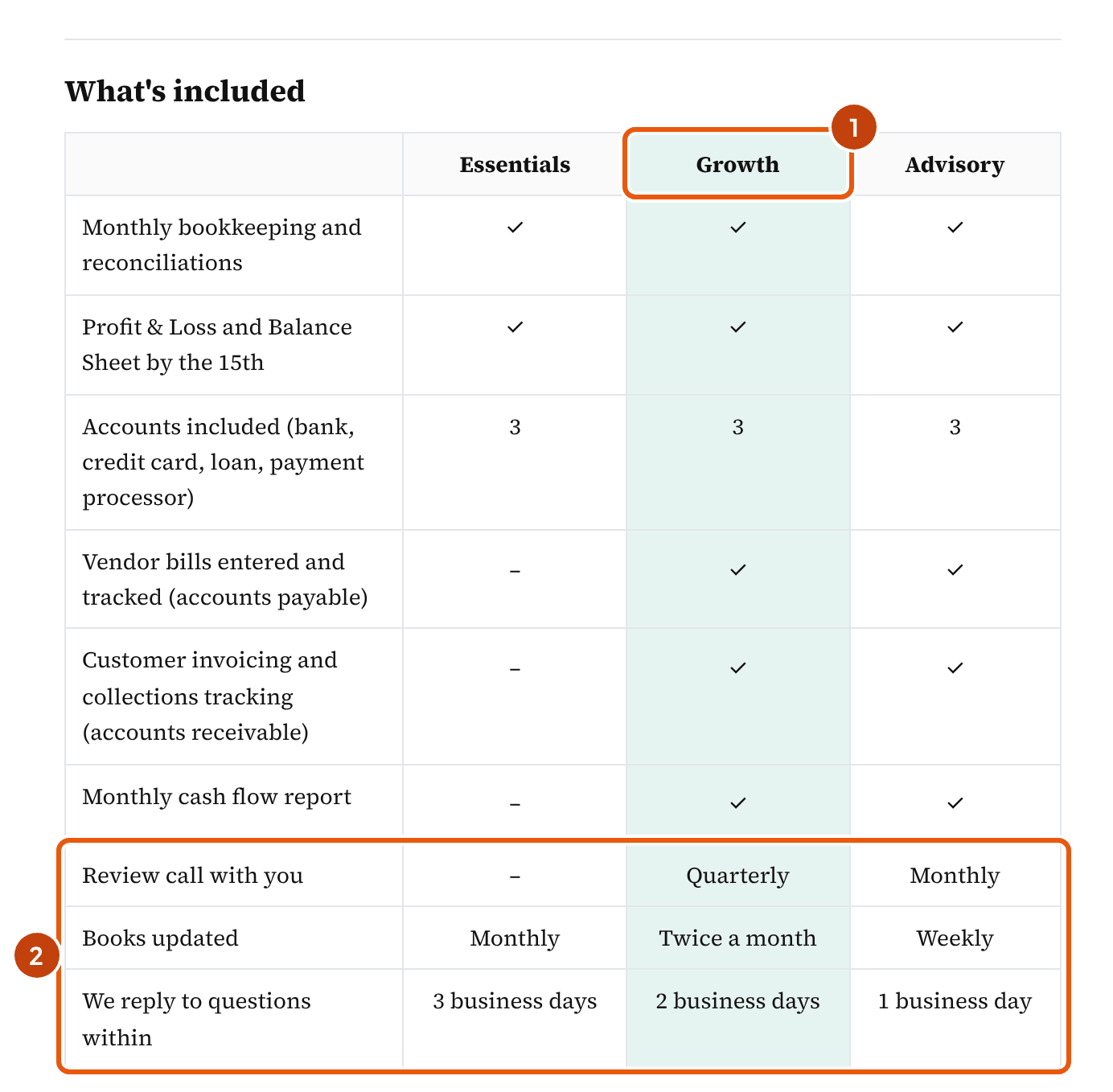
Packages 2 and 3 are priced at 1.6 and 2.5 times Package 1. Those multipliers are our assumption. They're the same in the proposal builder and the Ledgental app, so the same inputs give the same prices in all three.
The sheet doesn't mark any package as recommended. A new list has no data on which package clients pick, and each client needs something different. Under the grid, select a package to see what it adds over the one before.
Keep unlimited access for the top package
Lazanis writes that he included unlimited support in his $275 premium plan when he started his previous firm. He also writes that "$275 isn't even good enough for a basic plan". If you offer unlimited questions or a direct line, put it only in the top package, and price it for the time it takes.
Sample package descriptions
Essentials: reconciled books and monthly reports, for businesses that mainly need clean numbers at tax time.
Growth: everything in Essentials, plus vendor bills entered and tracked, invoicing, a cash flow report, and a quarterly call.
Advisory: everything in Growth, updated weekly, with a monthly call and a reply within one business day.
In the builder: What each package includes: names, services, and support. Open the builder ↑
How do you price add-ons, setup, and catch-up?
In short: Each gets its own line and price, so "can you also…" has an answer that isn't free work. Catch-up and setup are one-time fees.
We couldn't find a reliable public survey of add-on prices, so the builder's add-on prices are editable examples. Price each one from the time it takes you at your rate:
| Add-on | Builder's default | Priced by | Worth knowing |
|---|---|---|---|
| Extra account (bank, card, loan or processor) | $35 a month | Half an hour at your rate and factors | Calculated; changes with your rate, industry, and basis |
| Payroll | $100 a month + $5 per employee | Base plus headcount | Weekly payroll and several states take longer |
| Sales tax filing | $150 per return | Per return | Monthly filers cost more a year than quarterly ones |
| Forms 1099 | $75 for up to 3, $15 each after | Per year | From 2026, Form 1099-NEC is for payments of $2,000 or more, an amount the IRS may adjust for inflation from 2027 (IRS) |
| Payroll tax returns (941/940) | $150 per quarter | Per quarter | Preparing them for pay generally requires a PTIN |
| Other work | $65 an hour | Your rate, quoted before you start | Put the quote in writing before the work, so the client never meets the hourly line by surprise |
When the client mixes personal and business spending
Each personal charge on the business card needs a question and a decision, so mixed spending adds hours rather than saving them.
In one r/Bookkeeping thread we read, a beginner offered a lower price if the client stopped mixing. The top reply said that discount doesn't add up, and the thread's better answer was a firm price for six months that goes up if the mixing continues.
We would count the mixing in the hours, or bill it hourly until the accounts are separate. Switch on Mixed personal and business spending under Add-ons, and the sheet bills it at your hourly rate until the accounts are separate.
Four more add-ons are off until you switch them on. Each additional business or entity says a second set of books is priced as its own client from the list. Moving to new accounting software is quoted after you see the file. Each rental property prices rental work per property, at half an hour a month at your rate and factors ($35 at $65), our assumption. If you price landlord clients per property, the rental property bookkeeping template shows what one property's year involves. Rework from late or incomplete records bills it at your hourly rate.
Catch-up and setup
Catch-up is a one-time fee for each month behind, kept apart from the monthly fee. The backlog ends, and the monthly fee goes on.
The builder charges the client's full Essentials price for each month behind, with a floor of $150. That's our starting assumption. Use these prices in a proposal carries your % to the proposal builder, so a client's catch-up is the same in both.
| Catch-up per month: the full Essentials price | $450 |
| Five months: 5 × $450 | $2,250 |
| Setup and onboarding (builder's default) | $500 |
| For comparison: Merritt Bookkeeping, $200 a month behind | $1,000 |
| Etisson, simple books, $150 to $300 a month behind | $750 to $1,500 |
Merritt's price is from its own site, and Etisson's from its 2026 guide; both firms sell catch-up work. The proposal guide covers quoting catch-up for one client.
Why the full fee? In the r/Bookkeeping threads we read, bookkeepers most often start from the full monthly fee for each month behind. They add more for missing statements or mixed personal spending. Several who discounted catch-up to win the monthly work said they regretted it. Those are individual posts, not a survey.
So set the % above 100 when statements are missing or spending is mixed, and below it only for clean books with statements for every month and nothing mixed. Merritt, for comparison, charges $100 instead of $200 for months that are mostly complete.
In one thread about a multi-year rebuild before a sale, every high-scoring reply said to bill hourly from a retainer. Replies there and in another thread add that the client refills the retainer, and the work stops when it runs out. The proposal builder can write the catch-up that way: hourly up to a cap, with a starting retainer.
For a fixed catch-up fee, the proposal builder starts at half when the client signs and half when the books are current. That's our starting assumption, and the same split as the cleanup version of the engagement letter builder.
How do you check that every price is profitable?
In short: Divide each band's price by its hours and compare the result with your rate. The pricing check under the builder does it for you.
Your list can look fine and still underpay one size of client, for example after you type over a price by hand. The check shows what Essentials earns per hour at the top of each band, counting the industry and accrual factors in the hours. It marks in red any band more than 5% below your rate, a threshold that's ours.
Above the builder, a warning names any band the check marks red, with what it earns per hour and what to do: raise the price, or go back to the calculated one with Use calculated if you typed it. With the example numbers there's no warning. The 101 to 250 band earns $64 an hour against $65, a gap that comes from rounding $455 down to $450.
When does the minimum fee matter?
Only when a band's hours times your rate come out lower than the minimum ($250 by default). With three accounts, the smallest band takes 5.2 hours, so at $65 the price is $350 and the minimum never applies.
It starts to apply below about $48 an hour ($250 ÷ 5.2), or if you add a band for very small clients; the line above the builder then names the band. Set it anyway: it's the price for the client with 30 transactions who still needs year-end work and answers to questions. The sheet states it under Good to know ("Our minimum monthly fee is $250."), so a small client sees it before the call; switch it off under Terms and notes on the sheet.
Ryan Lazanis of Future Firm goes further. He recommends never charging less than $500 a month for bookkeeping, which he gives as his opinion (Future Firm). At $65 an hour that's about 7.7 hours of work, so a $500 minimum would lift Northline's two smallest bands.
The minimum applies before the package multipliers, so each of those rows becomes $500, $800, and $1,250, not only the Essentials column. Whether that fits depends on who calls you. A firm that turns away the 30-transaction client can set it; a firm that wants those clients keeps the minimum near what their hours cost.
Two more checks sit in the rate section. Run the staff cost floor if someone else will do the work, and read the published figures to see whether your rate is far off.
How do you explain your price to clients?
In short: Point to the rows that differ. When a client pushes back, offer a smaller package rather than a lower price for the same work.
"Why is Growth $275 more?"
Maria Lopez sees Essentials at $450 and Growth at $725 on Northline's list. The answer is on the sheet already: the rows where the two columns differ.
| Row on the sheet | Essentials, $450 | Growth, $725 |
|---|---|---|
| Vendor bills entered and tracked | – | ✓ |
| Customer invoicing and collections tracking | – | ✓ |
| Monthly cash flow report | – | ✓ |
| Review call | – | Quarterly |
| Books updated | Monthly | Twice a month |
| Reply to questions within | 3 business days | 2 business days |
Sample reply to Maria
The $275 covers the work in the Growth column. We enter and track your bills, send your invoices and follow up on who hasn't paid, update the books twice a month, and walk through the numbers with you each quarter. If you'd rather keep invoicing yourself, Essentials at $450 covers the books and the monthly reports.
If she asks for Growth at $600, the offer that keeps the price tied to the work is Essentials, with invoicing added later if she needs it. In one r/Bookkeeping thread we read, the most-upvoted advice was the same: cut the scope, not the rate.
In Proposify's 2021 data, discounted proposals closed 13% less often than full-price ones (Proposify). That's older data from its own customers, and it doesn't show why.
When a client asks for a discount
I can't lower the price for the same work, but I can fit the work to your budget. What monthly amount works for you? Essentials at $450 covers the books and the monthly reports, and we can look at it again in three months.
When a client mentions a $99 plan
The entry plans come with limits, listed on the services' own pages (October 2026).
The other thing a client can compare you with is hiring. A clerk at the BLS median wage of $50,670 costs an employer about $54,500 a year with its 7.65% payroll tax. That's about $4,500 a month before benefits.
| Service | Entry price | What that price includes |
|---|---|---|
| Pilot Essentials | $99 a month | AI categorization and reconciliation, cash basis, up to $100,000 of monthly expenses |
| Bench Bookkeeping Light | $199 a month | Businesses with $250,000 a year or less in revenue |
| Merritt Bookkeeping | $250 a month | One price, no tiers; catch-up extra |
| Bookkeeper360 | From $399 a month | Monthly bookkeeping; onboarding from $1,000 |
When Maria mentions the $99 plan, name what's in it and what isn't, without running the other service down. Her books have 250 transactions a month, three accounts, and bills to pay, so compare it with the work she's buying:
Sample reply when a client mentions a $99 plan
The $99 plan is software that categorizes your transactions with AI and reconciles them, on a cash basis, and that's a fair price for that. What it doesn't include is someone who enters and tracks your bills, sends your invoices, follows up on who hasn't paid, and answers your questions within two business days. That's what the $725 covers. If you want to start with the software and a quarterly review instead, Essentials at $450 is the closest fit on our list.
Hourly, fixed fee, or value pricing?
In short: A fixed monthly fee for ongoing work, with the hourly rate kept behind it. Bill hourly for a new client's first months if you can't scope the work yet.
Maria asks Jordan for a quote before anyone has opened her books. A fixed fee needs a count and a scope; the rate alone needs neither.
So the rate sets and checks each fee, and it's the price for work outside a package, quoted before you start. In Ignition's 2025 survey, 10% or fewer firms billed hourly for the services it covered.
Value pricing sets the price by what the service is worth to the client, not by the hours. It fits the top package, where the calls and faster replies are what the client chooses to pay for. The proposal guide covers whether to offer three packages or one price to a given client.
Start hourly, then move to a fixed fee
Morgan Law of FinePoints starts a new client on an hourly rate and moves them to a fixed monthly fee after a few months (FinePoints). The same approach came up in three of the r/Bookkeeping threads we read.
On Northline's list, that means quoting $65 an hour for the first three months. Then you place the client in the band their count and your timesheet agree on. The engagement letter can say so, with the date the fixed fee starts.
A line for the sheet
If we haven't seen your books before, the first three months may be billed hourly at $65 an hour; then we set your package from what the work took.
In the builder: Terms and notes on the sheet, "Say new clients may start hourly". Off by default. Open the builder ↑
When and how should you raise your prices?
In short: Once a year, at renewal. Raise the rate and let the prices follow.
In Ignition's 2025 benchmark, 80% of firms planned to raise prices in 2026, by 5% to 10% on average. If your engagement letters run for 12 months, start the new prices with the new letter.
We would give written notice a month or two ahead; that's our suggestion, not a rule. Move a client who has outgrown their band when it happens, not at the next review.
| Rate: $65 × 1.05 | $68.25 |
| Essentials at 250 transactions: 7 × $68.25 = $477.75, rounded | $475 (was $450) |
| Growth: $477.75 × 1.6 = $764.40, rounded | $775 (was $725) |
| Advisory: $477.75 × 2.5 = $1,194.38, rounded | $1,200 (was $1,150) |
Rounding to $25 turns a 5% rate increase into price increases of 4% to 7%. Check the new prices before you send the notice, and change the "valid through" date so everyone knows which list is current.
What does the notice say? The new price, the old one, and the reason. In the r/Bookkeeping threads we read, the advice on raises was to tie them to the work the client needs, not to the bookkeeper's new certificate. If the client's work grew, name what grew. If it didn't, say the services stay the same:
Sample price notice
Starting January 1, 2027, Growth is $775 a month (was $725). We review our prices once a year, at renewal. Your services, reply times, and report dates stay the same. If you'd like to talk it through, reply to this email or call me.
When bank feeds and automation cut your hours
We have no data on this, so this is our judgment. Bank feeds and automatic categorization can cut a client's close below the builder's 1.2 hours per 100 transactions. A fixed price is tied to the scope on the sheet, not to your minutes, so the price stays until the scope changes.
We would re-time a few clients each year, and change the hours in the grid only when the difference holds across several of them. Then we would decide whether to pass part of it on, for example through a lower band price for new clients.
Rules to check before you publish your prices
In short: Four kinds of line on a list can be a problem: tax returns without a PTIN, sales tax on your fee, card surcharges, and titles.
Jordan's draft list has a line for payroll tax returns, a 3% card surcharge, and the words "accounting services" in the header. Each is fine in some states and for some firms, and a problem in others. Check these before the list goes out:
| If your list… | Check | Source |
|---|---|---|
| Includes payroll tax returns (941/940) or other returns | Preparing a federal return for pay generally requires a PTIN; Forms W-2 and 1099 are exceptions | IRS |
| Is used in Hawaii, New Mexico, South Dakota, or West Virginia | These states tax services by default, with exceptions; ask the state whether bookkeeping is taxable | Avalara |
| Passes card fees to clients | Visa caps surcharges at 3%; Connecticut, Maine, and Massachusetts ban them; none on debit cards | Nickel |
| Uses "CPA" or "accountant" | "CPA" is for licensed CPAs; some states, such as Minnesota, restrict "accountant" too | Minnesota §326A.10 |
The builder lists tax return preparation, audits, reviews, and compilations, and legal or financial advice as not included. When you switch on payroll tax returns, the checks under the sheet flag the PTIN.
Common pricing mistakes
In short: Each risky line below has nothing behind it: no count, no hours, no date. Next to each is the line on the example firm's list.
| Risky | On Northline's list |
|---|---|
| "Unlimited transactions" | "101 to 250 transactions: $450. Each additional 50: $40 a month" |
| Catch-up folded into the first months' fee | "Catch-up: the Essentials price for your size, at least $150, for each month behind" |
| "Unlimited support" in every package | Replies within 3, 2, or 1 business days by package |
| "Prices subject to change" | "Prices valid through December 31" of the year on the sheet, and "Prices are reviewed once a year." |
| "Tax preparation" in a package | "Not included: tax return preparation, audits, reviews, and compilations" |
Frequently asked questions
What hourly rate should a bookkeeper charge?
Enough to cover the pay you want, self-employment tax, and your business costs in the hours you can bill. Add your pay goal, the self-employment tax on it, and your yearly costs, then divide by your billable hours. A $60,000 pay goal needs $69,873 of earnings after $9,873 of self-employment tax. Add $7,500 of costs and divide by 1,200 billable hours, and the rate is $64.48, or $65 rounded up. At 20 billable hours a week instead of 25, the same goal needs $81.
What does an average bookkeeper charge per hour?
Published figures measure different things. The BLS median wage for employed bookkeeping, accounting, and auditing clerks was $24.36 an hour in 2025, a wage paid by an employer who also covers overhead. NerdWallet reports an average of $43 an hour for bookkeepers on Upwork, with some at $80 or more. One firm's 2026 guide (Etisson) lists $40 to $90 for production bookkeeping and $75 to $125 for senior or cleanup work. None of these covers your own costs, so work out your rate first.
How should I price my bookkeeping services?
Charge a fixed monthly fee by transaction band and package, and keep an hourly rate for setting and checking those fees. Estimate the hours a month takes at the top of each band, multiply by your rate, and offer three packages that differ in support as well as services. Give add-ons, extra volume, setup, and catch-up their own prices. In Ignition's 2025 survey of 219 US firms, 10% or fewer billed hourly for the services it covered. Keep hourly billing for work you can't scope yet, quoted before you start, and for a new client's first months if you don't know how long the books take.
How much do independent bookkeepers charge per month?
In Ignition's 2025 benchmark of 219 US firms that use its software, monthly bookkeeping most commonly ran $250 to $499, reported by 29% of firms. NerdWallet puts typical small business bookkeeping at about $300 a month or more, with packages from about $200 to $700 and up. Clients with more transactions, accounts, payroll, or inventory pay more.
What should a bookkeeping pricing template include?
Monthly packages with a price for each transaction band, and what each package includes: services, reports, reply times, calls, and how often the books are updated. Then add-ons with a unit price, one-time fees for setup and catch-up, the rules that change the price (accounts included, extra volume, cash or accrual), and a valid-through date.
Why does the price list give a different price than the proposal builder?
The price list prices each band at its top number of transactions, so it holds for every client in the band. The proposal builder prices one client's exact count. At the top of a band they match: 250 transactions and 3 accounts at $65 an hour give $450, $725, and $1,150 in both. A client with 175 transactions pays $450 on the list and $400 in the proposal builder.
What are examples of bookkeeping packages?
The example price list on this page has three. Essentials: reconciled books and monthly reports by the 15th, a reply within 3 business days, $450 a month for 101 to 250 transactions. Growth: Essentials plus vendor bills entered and tracked, invoicing and collections tracking, a cash flow report, books updated twice a month, a quarterly call, and a reply within 2 business days, $725. Advisory: Growth plus weekly updates, a monthly call, and a reply within 1 business day, $1,150. The prices follow the hours at $65 an hour; the support rows are what set the packages apart.
How much should I charge for catch-up bookkeeping?
Price it once for each month behind, apart from the monthly fee, after you've seen the books. The builder starts at the client's full Essentials price for each month, at least $150, which is our assumption: five months at $450 is $2,250. Go above it when statements are missing or personal spending is mixed in. Merritt Bookkeeping publishes $200 for each month behind, and Etisson's 2026 guide puts simple books at $150 to $300 per month behind.
What if I hire a bookkeeper to do the work?
Price from their cost, not your own rate. Dream Firms suggests a floor of hours times wage times 1.3, divided by 0.30 for a 70% gross margin. For a client who takes 7 hours a month, done by someone paid $26 an hour, the floor is about $789 a month. That's well above the $450 price built on a $65 rate.
Do I charge sales tax on bookkeeping services?
Most states don't tax services by default, and four do: Hawaii, New Mexico, South Dakota, and West Virginia, with exceptions. If you work there, ask the state's tax department whether bookkeeping fees are taxable. Other states tax specific listed services, so check your own state's list before you add sales tax to an invoice.
How often should I raise my bookkeeping prices?
Review them once a year, at renewal. In Ignition's 2025 benchmark, 80% of firms planned to raise prices in 2026, by 5% to 10% on average. Raise the rate and let the prices follow: a 5% increase from $65 to $68.25 moves $450, $725, and $1,150 to $475, $775, and $1,200 after rounding to $25.
Is there a free bookkeeping pricing calculator?
Yes. The builder on this page is free and needs no sign-up. It works out your hourly rate from your pay goal and costs, suggests prices for three packages at four transaction bands, and shows what each band earns per hour. The sheet downloads as an Excel file with working formulas, or as Word or PDF.
How we built this page
Ledgental Team wrote this guide and built the pricing builder. Ledgental also makes a bookkeeping app that's free during its beta, and the builder's "Save my prices in Ledgental" button stores your price list there. The guide and the builder work without the app.
What the numbers rest on
- The hourly-rate helper adds the pay you want, self-employment tax (15.3% on 92.35% of net earnings, the Social Security part stopping at the 2026 wage base of $184,500: IRS Topic 554 and the SSA) and your costs, then divides by billable hours. Income tax is left out because it depends on the household.
- The price grid uses our hours model (3 hours a month, plus 1.2 per 100 transactions, plus 0.5 per account after the first) and package multipliers of 1, 1.6 and 2.5, rounded to $25. These are our starting assumptions, not market data, and the same engine runs the proposal builder. Every step is checked by known-answer tests in the code.
- Published figures (the BLS median wage, Upwork's listed rates, firms' public price pages, Ignition's benchmark coverage, Future Firm's method) are labeled with who measured them and when we checked them. None is a survey of bookkeepers' prices.
- Reader threads: r/Bookkeeping posts and comments we read in October 2026 are individual posts, not a survey; we quote no poster's price.
- Not covered: value pricing beyond the three-package model, state sales tax on your own services beyond naming the states that tax services, and tax return pricing (which needs a PTIN).
What changed
- October 12, 2026: catch-up now defaults to the full Package 1 price for each month behind (5 × $450 = $2,250 for Lopez Cleaning, was 80%, $1,800), and "Use these prices in a proposal" carries your % along with what each package includes. The check counts the industry and accrual factors in the hours, and the line above the builder speaks only when there's something to act on: a band under your rate, the minimum fee setting a band's prices, a missing or invalid rate, or the example rate still in place. New: "Where does my client land?" for one client's numbers, five add-ons (another entity, mixed spending, software migration, rental properties, rework), three switchable Good to know lines (price confirmed after the statements, the minimum fee, hourly first), one meaning of "account" shared with the proposal builder, a Checks tab with a master check on every tab of the Excel file, and a rate-to-price diagram. The sheet no longer marks a package "Recommended". The guide is rewritten in shorter sentences and adds pricing by revenue, mixed personal spending, and wording for a price notice and a discount request. The builder's own wording now says which figures are its estimated hours or our starting assumptions. On the sheet, the accounts payable row now reads "Vendor bills entered and tracked", as in the proposal and the engagement letter, which price paying bills separately; the payroll tax line says Form 941 is quarterly and Form 940 yearly; and the price range line under the grid is gone, since the grid shows the same prices.
- October 11, 2026: added "How we worked out" panels under the price sheet (every step with its numbers), a "Field details" section, one bookkeeper's real hours per client (FinePoints) next to our hours model, Future Firm's $500 minimum, the start-hourly-then-fixed approach, a sample reply to the $99-plan question, and refreshed screenshots. Money rounding now goes through the site's shared helper.
- October 4, 2026: added this "How we built this page" section, a citation box and the reuse license (CC BY 4.0); a link icon beside every heading; known-answer tests for the engine (the grid, overage, catch-up and the rate helper); field borders and phone text sizes brought up to the site's accessibility floor.
- September 30, 2026: guide rewritten with one firm (Northline Bookkeeping at $65 an hour) and one client (Lopez Cleaning Co); the hourly-rate helper and its Excel tab added; new screenshots and card preview.
- September 2026: first published.
Cite this page
Copy one of these lines to credit the page. To link to one section, use the link icon beside its heading.
- Plain line
- Ledgental, Free Bookkeeping Pricing Template and Calculator, updated October 2026, https://ledgental.com/tools/bookkeeping-pricing-template
- APA
- Ledgental. (2026, October). Free Bookkeeping Pricing Template and Calculator. https://ledgental.com/tools/bookkeeping-pricing-template
- Chicago
- Ledgental. “Free Bookkeeping Pricing Template and Calculator.” Last modified October 2026. https://ledgental.com/tools/bookkeeping-pricing-template.
Reusing this page: the guide's text, tables, and screenshots are licensed under CC BY 4.0. Credit "Ledgental" with a link to this page. Quotations from the IRS and state agencies are public domain, and quotations from other sources stay under their owners' terms.
Sources
- Topic no. 554, Self-employment tax, Internal Revenue Service
- Contribution and benefit base, Social Security Administration
- Bookkeeping, Accounting, and Auditing Clerks (Occupational Outlook Handbook), U.S. Bureau of Labor Statistics
- Publication 926 (2026), Household Employer's Tax Guide (Social Security and Medicare rates), Internal Revenue Service
- Frequently asked questions: Do I need a PTIN?, Internal Revenue Service
- Instructions for Forms 1099-MISC and 1099-NEC, Internal Revenue Service
- Minnesota Statutes §326A.10, Minnesota Office of the Revisor of Statutes
- Ignition report shows shift in pricing for accounting firms, CPA Practice Advisor
- The end of hourly billing: Ignition's 2025 benchmark signals pricing shift for firms, Ignition
- Bookkeeping cost for small businesses (2026); read September 29, 2026, page unreachable October 11, 2026, Catalyst CPA
- How to price bookkeeping services for small, medium and large clients, FinePoints Bookkeeping (Morgan Law)
- Proposal best practices, Proposify
- Bookkeeping prices for small business: what to expect in 2026, NerdWallet
- Catch-up bookkeeping pricing, Etisson
- Bookkeeping pricing guide, Dream Firms
- Bookkeeping pricing template, Future Firm (Ryan Lazanis)
- Pricing, Pilot
- Bookkeeping pricing packages and plans, Bench
- Pricing, Bookkeeper360
- Merritt Bookkeeping (pricing on home page), Merritt Bookkeeping
- State-by-state guide to charging sales tax on services, Avalara
- 2026 credit card surcharge laws by state, Nickel
General information, not tax, legal, or financial advice. Market figures, tax rules, and competitor prices were checked at the source in September and October 2026 and change over time. The builder's hours, multipliers, and add-on prices are our starting assumptions: check them against your own clients. This page isn't affiliated with the IRS or any state agency.