Key takeaways
- The entry: accrue the gross wages earned by the period end and not yet paid. Debit Wages Expense and Payroll Tax Expense, and credit Accrued Wages Payable and Accrued Payroll Taxes Payable. Reversing the entry on the first day of the next period is optional, but it lets payday post as usual.
- Accrue gross pay, not net. Withholdings come out of the gross on payday. In our example, net pay would leave out at least $455.94 of employee Social Security and Medicare.
- Use the payday's wage bases. Employer Social Security and Medicare attach when wages are paid (26 CFR 31.3111-3). FUTA's $7,000 counts the wages paid in each calendar year (Form 940 instructions). So December work paid in January starts FUTA over, and state unemployment in states that count the same way. In our example, that's $652.62 of employer taxes to accrue, not the $455.94 of Social Security and Medicare alone.
- Count days, not paychecks. Only the work through the period end is accrued: January 2's $480.00 belongs to 2027, even though the same paycheck pays it.
- Tax timing: an accrual-method business generally deducts wages in the year earned if they're paid within 2½ months after year end. Related owners and cash-method clients are the exceptions.
What is the journal entry for accrued payroll?
In short: Debit Wages Expense and Payroll Tax Expense; credit Accrued Wages Payable and Accrued Payroll Taxes Payable. The amounts are the gross wages earned by the period end and not yet paid, and the employer's taxes on them.
Jordan Miles of Northline Bookkeeping is closing December 2026 for Lopez Cleaning Co LLC. It's a Texas cleaning company with five hourly employees (both businesses are fictional).
The payroll provider pays every other Thursday for the two weeks that ended the Sunday before. The last paycheck of 2026 went out on December 24. The next one, dated Thursday, January 7, 2027, pays Monday, December 21, through Sunday, January 3.
Nine of those workdays fall in 2026. Their wages are 2026 expense, and the 2026 books don't show them yet.
| Account | Debit | Credit |
|---|---|---|
| Wages Expense | 5,960.00 | |
| Payroll Tax Expense | 652.62 | |
| Accrued Wages Payable | 5,960.00 | |
| Accrued Payroll Taxes Payable | 652.62 |
Gross wages for December 21 to 31, and the employer's Social Security, Medicare, FUTA and Texas unemployment tax on them. The taxes are figured at 2027 wage bases, because the paycheck is dated in 2027.
“Accrued expenses are expenses incurred in a period but have yet to be recorded, and no money has been paid. Some examples include interest, tax, and salary expenses.”
| Line | Account type | Why it's there |
|---|---|---|
| Wages Expense (debit) | Expense | The labor cost of the days worked by December 31 lands in 2026. |
| Payroll Tax Expense (debit) | Expense | The employer's own taxes on those wages are part of the same cost. |
| Accrued Wages Payable (credit) | Current liability | The business owes the employees for that work until January 7. |
| Accrued Payroll Taxes Payable (credit) | Current liability | The employer's taxes become due once the wages are paid. |
On January 1, 2027, a reversing entry undoes the accrual, and the January 7 payroll posts as usual. The reversing entry section shows all four entries for this paycheck.
The accrual sits with the other month-end adjustments (prepaids, depreciation, inventory) in our journal entry examples. The calculator above builds the payroll entries from a client's own hours, rates and dates.
Which days do you accrue?
In short: Every day worked on or before the period end that's paid after it. Days after the period end belong to the next period, even when the same paycheck pays them.
Week 1
- Mon21Accrue
- Tue22Accrue
- Wed23Accrue
- Thu24Accrue
- Fri25Closed
- Sat26Accrue
- Sun27Off
Week 2 · the books close after Thursday, December 31
- Mon28Accrue
- Tue29Accrue
- Wed30Accrue
- Thu31Accrue
- FriJan 1Closed
- SatJan 22027
- SunJan 3Off
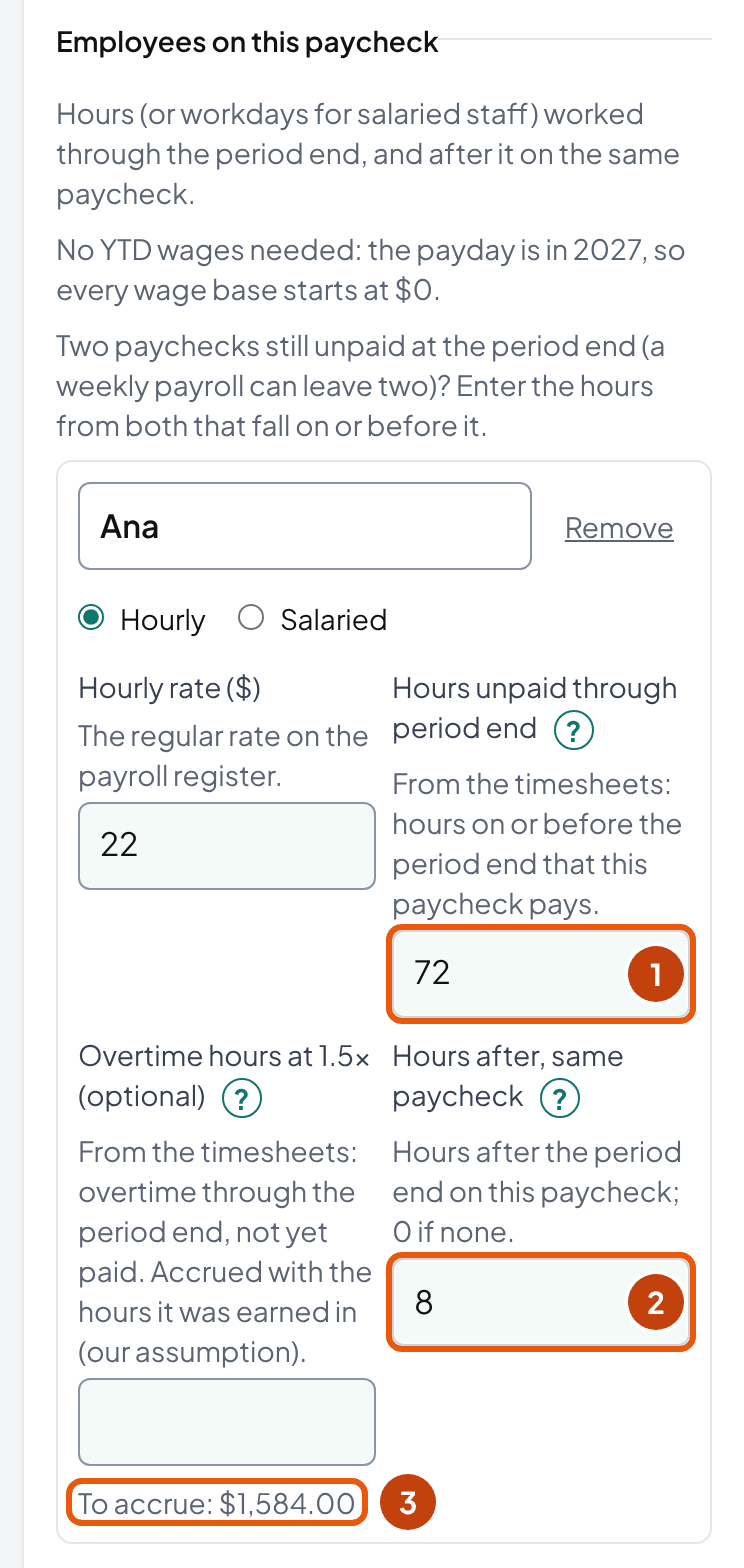
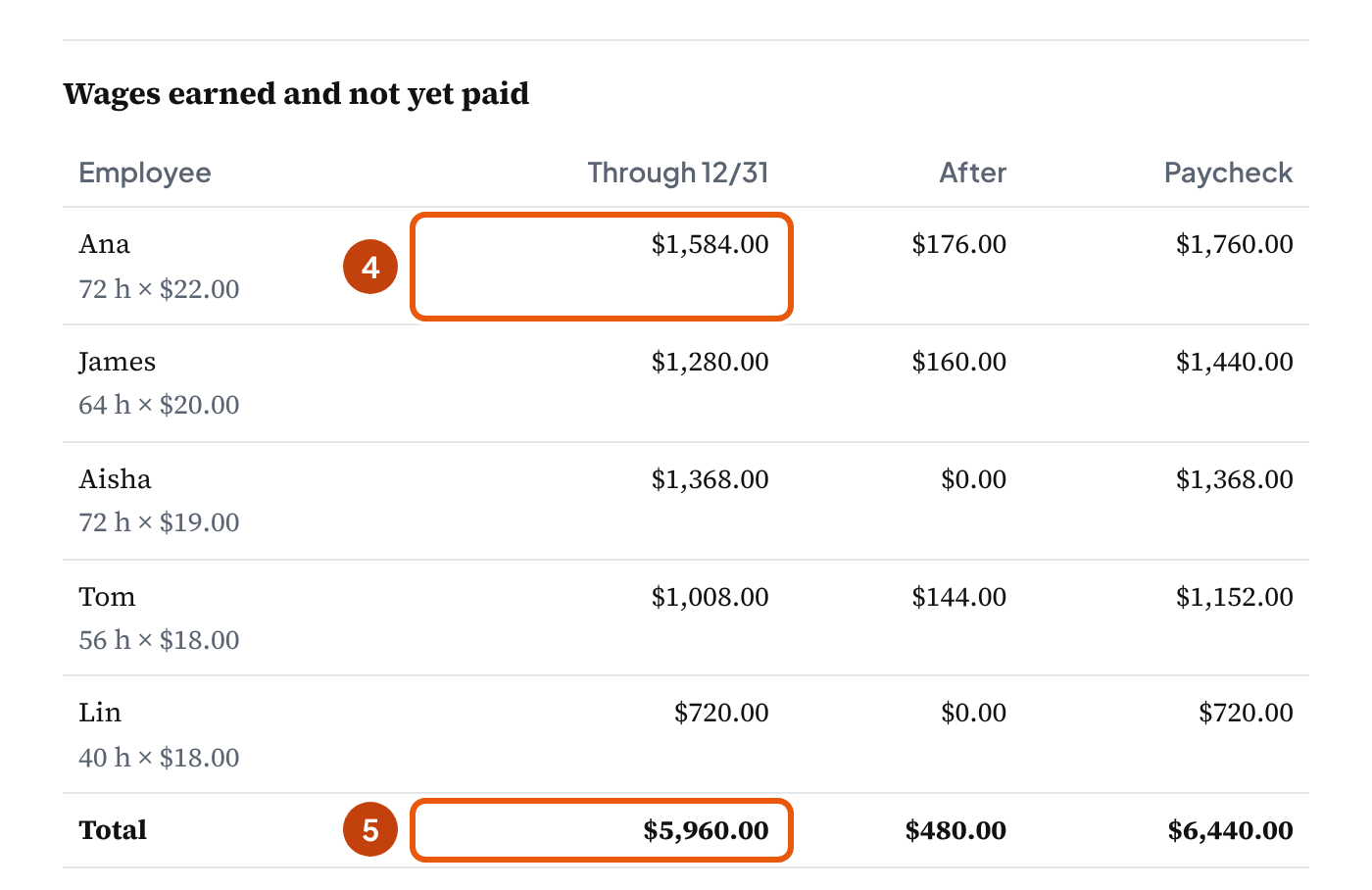
Payroll is usually paid in arrears, so the paycheck after a month end often covers days on both sides of it. At Lopez Cleaning, the January 7 paycheck pays 328 hours. 304 were worked from December 21 through 31, and 24 on Saturday, January 2. Only the 304 December hours go into the accrual.
| Ana: 72 hours × $22.00 | $1,584.00 |
| James: 64 hours × $20.00 | $1,280.00 |
| Aisha: 72 hours × $19.00 | $1,368.00 |
| Tom: 56 hours × $18.00 | $1,008.00 |
| Lin: 40 hours × $18.00 | $720.00 |
| Wages to accrue | $5,960.00 |
The same paycheck pays 24 hours for January 2, 8 hours each for Ana, James and Tom. That's 8 × $22.00 + 8 × $20.00 + 8 × $18.00 = $480.00 of 2027 expense.
When two paychecks are open
A weekly payroll can leave two paychecks unpaid at the period end. A bookkeeper on the QuickBooks Community described this at a year-end financial review. The January 3 paycheck paid December 22 to 28, and the January 10 paycheck paid December 29 to January 4.
Both paychecks hold December work, so the accrual takes all of the first and the December days of the second. In the calculator, enter the hours from both paychecks that fall on or before the period end.
Hourly employees: timesheets first
Hours by date from the time records give the actual amount, including overtime already earned. Without them, the calculator's second mode prorates the paycheck's total gross by workdays.
Lopez Cleaning's paycheck covers ten workdays, nine of them in December: 9 ÷ 10 × $6,440.00 = $5,796.00. That's $164.00 less than the timesheets show, because fewer people worked on January 2. The proration also has to assume every employee is still under the wage bases.
Bookkeeper tip: Ask the client or the payroll provider for hours by date for the open pay period before the close. The pay stub totals the whole period, and the accrual needs the split at the period end. Does a workweek that crosses the period end include overtime? Enter the overtime hours earned through the period end in their own field. The calculator accrues the 1.5 premium with the hours it was earned in, which is our assumption. If payroll splits the premium differently, ask how.
Salaried employees: workdays
A salaried employee earns the same pay every period, so the accrual counts workdays. The calculator divides the annual salary by 260 workdays (52 weeks of five days). The 260 is our assumption; no rule sets it.
An office manager on $52,000 earns $52,000 ÷ 260 = $200.00 a day, so three unpaid workdays accrue $600.00. Some payroll systems use calendar days or the workdays in each pay period instead. Use the one the client's payroll uses, the same way every month.
Do you accrue gross pay or net pay?
In short: Gross. The expense is the full wage. Withholdings come out of it on payday and are owed to the government instead of the employee.
The regulations put the withholding on payday. Until January 7 nothing has been withheld, so Lopez Cleaning owes $5,960.00 of wages.
On payday the payroll entry splits the gross between net pay and the withholding liabilities. The accrual and its reversal never touch them.
“The employer shall make the collection by deducting or causing to be deducted the amount of the employee tax from such wages as and when paid.”
| Gross wages earned through December 31 | $5,960.00 |
| Employee Social Security: $5,960.00 × 6.2% | $369.52 |
| Employee Medicare: $5,960.00 × 1.45% | $86.42 |
| Left out of the accrual, at least | $455.94 |
Federal income tax withholding comes on top and depends on each employee's Form W-4, so the real shortfall is larger. State income tax withholding, where the state has one, adds to it again.
Which employer payroll taxes do you accrue?
In short: The employer's own share: Social Security 6.2%, Medicare 1.45%, FUTA, and state unemployment, plus any other employer-paid state payroll tax. The employee's withholdings, including the 0.9% Additional Medicare Tax, are already inside the gross wages.
| Tax | Employer rate | Wage base (2026) | Source |
|---|---|---|---|
| Social Security | 6.2% | $184,500 per employee | IRS Publication 15 |
| Medicare | 1.45% | None | IRS Publication 15 |
| FUTA | 6.0% less a credit of up to 5.4%: 0.6% for most employers | $7,000 per employee | Form 940 instructions |
| State unemployment | The rate on the employer's notice from the state | Texas $9,000; California $7,000; New York $17,600 ($12,800 in 2025); Washington $78,200 ($72,800 in 2025) | State agencies (see Sources) |
In a FUTA credit reduction state the credit is smaller, so the rate is higher. The Department of Labor lists California at 1.2% and the U.S. Virgin Islands at 4.5% for 2025. That put California employers' FUTA at 0.6% + 1.2% = 1.8%.
A reduction applies to wages paid in its year, and each year's figure is final only after November 10 of that year. For 2026, the Department lists California's potential reduction at 5.3% (1.5% plus an estimated 3.8% add-on).
So the calculator's California preset follows the payday's year. A 2025 payday gets 1.8%. A 2026 payday gets 0.6% + 1.5% = 2.1%, the reduction from the advance alone, and the result also shows FUTA at 0.6% + 5.3% = 5.9%. On $5,960.00 of wages that's $125.16 at 2.1%, against $351.64 at 5.9%.
A January 2027 paycheck falls under the 2027 reduction, which nobody knows at the close. Until 2026's figure is final, the preset uses 2026's 2.1% for it and says so next to the result. Accrue at the latest figure you have, then true it up on Form 940. After November 10, 2026, type 2026's final figure from the Department's page instead.
New York's 2026 wage base is $17,600, from the state's employer guide (Form NYS-50). Starting with 2026, it's 18% of the state's average annual wage. Some payroll pages still show an older figure, so check the state's own page.
The state rate has a year too. Each employer gets a new rate for the year, and Washington's employment department says it normally mails them in December. So for a January paycheck, use the new year's rate if the notice has arrived.
California also charges employers a 0.1% employment training tax on the first $7,000 per employee (EDD). Other states have their own employer charges. The calculator covers the four common taxes. Add any other employer tax as its own line in the entry.
Which year's wage bases apply to a year-end accrual?
In short: The payday's year. Wages earned in December and paid in January are next year's wages for payroll tax, so FUTA and state unemployment start over on them.
“The employer tax attaches at the time that the wages are paid by the employer.”
“…if the employee worked from December 13, 2026, through December 26, 2026, and the wages for that period were paid on January 1, 2027, include those wages on the 2027 Form W-2.”
FUTA follows the same calendar. The Form 940 instructions apply it to "the first $7,000 you pay to each employee during a calendar year." State wage bases run by calendar year as well.
New York, for one, charges contributions "on remuneration paid to each employee in a calendar year up to the annual wage base amount" (Form NYS-50). Check the client's state. The calculator assumes it counts wages by the date they're paid, as FUTA does.
That's where the usual shortcut fails at year end. In the example, each of Lopez Cleaning's employees was paid more than $9,000 in 2026. So 2026 FUTA and Texas unemployment were used up by December.
So why not accrue only Social Security and Medicare? Because the January 7 paycheck is the first paycheck of 2027, and FUTA and Texas unemployment apply to all of it.
- Social Security 6.2%
- $369.52
- Medicare 1.45%
- $86.42
- FUTA 0.6% (new $7,000 base)
- $35.76
- Texas unemployment 2.7% (new $9,000 base)
- $160.92
- Total
- $652.62
| How the employer taxes are estimated | Accrued | Against the payday rule |
|---|---|---|
| The payday's wage bases (2027): all four taxes | $652.62 | Correct for these dates |
| 2026 bases: FUTA and state treated as used up | $455.94 | $196.68 too low |
| A flat 15% of the wages | $894.00 | $241.38 too high |
The 15% comes from an answer on the QuickBooks Community that put the employer taxes at about 15% of gross. It's a fair warning that the taxes are large enough to record. But the real figure depends on the state rate and on where each employee stands against the wage bases. Here it's 10.95% ($652.62 ÷ $5,960.00).
A month end in the same year
During the year, the opposite happens. Say Jordan closes June 30, 2026, and the paycheck for the open days (June 22 to July 5) is dated July 9, 2026. Each employee has already been paid $20,000 in 2026.
FUTA's $7,000 and Texas's $9,000 are used up, so the same $5,960.00 of wages carries only Social Security and Medicare: $455.94. The entries look the same as at year end; only the wage-base question changes.
That's why the calculator asks, for a payday in the same year, what each employee was already paid that year. For a payday in a new year it skips the question, because every base starts at $0.
For a same-year close, enter each employee's year-to-date gross from the payroll register, before this paycheck. If every employee's YTD is still $0, the calculator applies FUTA and state unemployment to the whole accrual and warns you above the result. Leave $0 only for employees hired on this paycheck. In total-gross mode, answer whether every employee has already passed the FUTA and state bases.
Social Security's base matters only near the top. An employee already paid $184,400 in 2026 owes Social Security on only the next $100. The 2027 base wasn't announced when we checked in October 2026. For 2027 paydays the calculator uses 2026's $184,500 and warns you when an employee passes it on the paycheck.
How does the reversing entry work?
In short: On the first day of the next period, post the exact opposite of the accrual. The payday entry then goes in as usual, and the new period keeps only its own days.
“Reversing entries are optional accounting procedures which may sometimes prove useful in simplifying record keeping. A reversing entry is a journal entry to “undo” an adjusting entry.”
| Account | Debit | Credit |
|---|---|---|
| Accrued Wages Payable | 5,960.00 | |
| Accrued Payroll Taxes Payable | 652.62 | |
| Wages Expense | 5,960.00 | |
| Payroll Tax Expense | 652.62 |
| Account | Debit | Credit |
|---|---|---|
| Wages Expense | 6,440.00 | |
| Cash and withholding liabilities (from the payroll register) | 6,440.00 |
Gross pay for the whole paycheck. The payroll register splits the credit into net pay, federal income tax withheld, and the employee's Social Security and Medicare.
| Account | Debit | Credit |
|---|---|---|
| Payroll Tax Expense | 705.18 | |
| Social Security payable (the employer's share) | 399.28 | |
| Medicare payable (the employer's share) | 93.38 | |
| FUTA payable | 38.64 | |
| Texas unemployment tax payable | 173.88 |
$6,440.00 × 6.2%, 1.45%, 0.6% and 2.7%.
Wages Expense
2027 so far: 6,440.00 − 5,960.00 = 480.00
Payroll Tax Expense works the same way. The $705.18 on payday less the $652.62 reversal leaves $52.56 in 2027. That's the employer taxes on January 2's $480.00, at 10.95%.
At the January close, Accrued Wages Payable and Accrued Payroll Taxes Payable are both back to zero. A balance left in either one means an entry was missed or posted twice. Prove Accrued Payroll at month end with the balance sheet reconciliation template, the same way as any other liability account.
Without a reversing entry
Without the reversal, the payday entry clears the liability and books only the new days as expense. It ends in the same place, but someone has to split every paycheck by hand. Payroll that posts each paycheck to the books automatically won't split it.
| Account | Debit | Credit |
|---|---|---|
| Accrued Wages Payable | 5,960.00 | |
| Wages Expense | 480.00 | |
| Cash and withholding liabilities (from the payroll register) | 6,440.00 |
| Account | Debit | Credit |
|---|---|---|
| Accrued Payroll Taxes Payable | 652.62 | |
| Payroll Tax Expense | 52.56 | |
| Payroll taxes payable (the four lines above) | 705.18 |
| Risky | Safer |
|---|---|
| Post the January 7 payroll in full and skip the reversal: 2027 shows $6,440.00 of wages for one day of work. | Reverse on January 1, or split the payday entry as above: 2027 shows $480.00. |
| Call the payday entry the "reversal" of the accrual. | Keep them apart: the reversal undoes the accrual on day one, and payday pays the employees and clears what's left. |
Recording the payday from the provider's report
The payday entries above keep the employees' side on one credit line, because the payroll register holds the split. Several practitioners in Reddit threads we read don't sync the payroll provider. They enter each pay run from the provider's report, then tie it to the bank. Record the payday from the provider's report, under the calculator, does both: paste the report's totals, and it builds the entry and checks it against the withdrawals. To lay out the pay run employee by employee, with the taxable wages for each tax and the entry from the totals row, use the payroll register template.
On the January 7 paycheck, the $6,440.00 credit splits four ways. They're net pay, federal income tax withheld, and the employee's Social Security and Medicare. The employee's share is $399.28 of Social Security ($6,440.00 × 6.2%) and $93.38 of Medicare ($6,440.00 × 1.45%). Net pay and income tax depend on each employee's Form W-4, so take them from the register. With $520.00 of income tax withheld, an example amount, net pay is $6,440.00 − $520.00 − $399.28 − $93.38 = $5,427.34.
- Federal income tax (example)
- $520.00
- Social Security 6.2%
- $399.28
- Medicare 1.45%
- $93.38
- Withheld
- $1,012.66
- Social Security 6.2%
- $399.28
- Medicare 1.45%
- $93.38
- FUTA 0.6%
- $38.64
- Texas unemployment 2.7%
- $173.88
- Debit Payroll Tax Expense
- $705.18
$1,012.66 withheld + $705.18 the employer's = $1,717.84
Both withdrawals clear Payroll Clearing: $5,427.34 + $1,717.84 = $7,145.18, the gross plus the employer's taxes.
Why is the tax withdrawal so much bigger than the withholding? Posters on r/Bookkeeping describe the provider pulling net pay and taxes as separate withdrawals. The tax withdrawal then carries at least the income tax withheld plus both halves of Social Security and Medicare. On this paycheck that's $492.66 from the employees and $492.66 from the employer. With the example's income tax, FUTA and Texas unemployment, it comes to $1,717.84, against $1,012.66 withheld.
| Account | Debit | Credit |
|---|---|---|
| Wages Expense | 6,440.00 | |
| Payroll Tax Expense | 705.18 | |
| Payroll Clearing (net pay) | 5,427.34 | |
| Payroll Clearing (taxes) | 1,717.84 |
One common setup, our assumption, not a rule: the two bank withdrawals post to Payroll Clearing, which ends at $0.00. A balance left after them points to a fee or a tax deposited later. The calculator shows what's left once you type the withdrawals.
Book an IRS late-deposit penalty to its own account, not Payroll Tax Expense. Among expenses you can't deduct, IRS Publication 334 lists "penalties and fines you pay to a governmental agency or instrumentality because you broke the law." Applying that to a deposit penalty is our reading. The payroll entry in our journal entry examples writes each line in your own amounts.
When the client's accountant changes the year-end accrual
Post only the difference, as its own entry dated December 31, and reverse that entry on January 1 too. Your $5,960.00 + $652.62 accrual and its reversal stay as they are.
The trouble starts when an adjustment has no reversal. Your accrual reverses on January 1, but an accountant's change posted later at December 31 doesn't. And the payday entry never touches the accrued accounts. So the change stays in Accrued Wages Payable or Accrued Payroll Taxes Payable with nothing to clear it.
One accountant on r/Bookkeeping (a UK practice) described this gap. A smaller accrual was reversed, a larger final one was posted, and the difference stayed on the balance sheet. One reply suggested posting only the change at year end, reversing that, and talking it through on a call.
How do you record it in QuickBooks Online or Xero?
In short: As a journal entry dated the period end, in separate accrued liability accounts. QuickBooks Online makes the reversal with a Reverse button; Xero's manual journal takes an auto-reversing date.
QuickBooks Online
- Add two Other Current Liabilities accounts, such as Accrued Wages Payable and Accrued Payroll Taxes Payable. They keep the accrual out of Payroll Liabilities, where the payroll provider's withholdings and taxes land.
- Create a journal entry dated December 31 with the four lines. The calculator's Copy journal entries button gives them as columns.
- To reverse it, open one of the accounts' registers, select the journal entry, select Edit, then Reverse, and save.
- Check the date. Intuit's help article says the new entry "is dated the first day of the month following the original journal entry date". So a December 31 accrual reverses on January 1.
Xero
Add the accrual as a manual journal dated December 31, with January 1 as its auto-reversing date. Set it when you create the journal. A post on Xero's own product forum says the date can't be added once a journal is posted (we couldn't open Xero Central). So a missed reversal needs a manual journal of its own.
If the provider posts the January 7 payroll automatically, the reversal keeps the December days from counting twice.
Can the business deduct accrued wages this year?
In short: Usually, for an accrual-method business, if the wages are paid within 2½ months after year end. Related owners and cash-method businesses are the exceptions. The book entry is the same either way; this part is for the tax preparer.
- Paid within 2½ months (by March 15 for a calendar year): not deferred compensation, so wages earned in December can be deducted for that year. The regulation says pay received "on or before the end of the applicable 2 1/2 month period" isn't deferred (Treas. Reg. 1.404(b)-1T). The calculator flags an accrual at the client's tax year end with a payday more than 2½ months later: after March 15 for December 31. For a fiscal year, tick "This period end is the client's tax year end" at the fiscal year end.
- Paid later: presumed deferred and deducted in the year paid. The employer can rebut that only if paying on time was impracticable and that wasn't foreseeable at year end. Vacation pay treated as deferred is "deductible for the taxable year of the employer in which paid" (26 U.S.C. 404(a)(5)).
- Employer payroll taxes: generally deducted when paid. The recurring item exception lets an accrual-method employer deduct the taxes on year-end wages for the accrual year if three things hold. They're paid by the earlier of the date the return is timely filed (with extensions) or the 15th day of the 9th month after year end. The liability recurs. And it's either immaterial or better matched to that year. The exception “is a method of accounting that must be consistently applied” from one year to the next. It's adopted in the first year the item is incurred (Treas. Reg. 1.461-5; Rev. Rul. 96-51, as summarized in Rev. Rul. 2007-12).
- Related owners: an amount owed to a related person who reports it only when paid is deductible on the day that person includes it in income (26 U.S.C. 267). For an S corporation, that's any person who owns "directly or indirectly" any of its stock. So a shareholder-employee's December wages paid in January are deducted in the year paid, 2027.
- Cash-method businesses: wages are deducted when paid, so the December accrual changes the financial statements, not the return.
When a deduction lands in a different year from the expense, the preparer shows the difference on the return's book-to-tax reconciliation. List those items in the year-end notes, which saves the preparer a question.
Explaining the timing to a client is bookkeeping; deciding the return's position is tax preparation. If you don't prepare the return, list the accrual and its payday in the year-end notes, and leave the deduction to the preparer.
What about bonuses, commissions and vacation pay?
In short: Each is its own accrual in its own accounts, recorded when it's earned and can be estimated. Their employer taxes follow the same payday rule.
Vacation pay (PTO) is accrued under ASC 710 when four conditions are all met. The Journal of Accountancy summarized them. The obligation comes from services already rendered, the rights vest or accumulate, payment is probable, and the amount can be reasonably estimated.
- Vacation: debit Vacation Expense, credit Accrued Vacation Payable. One way to handle it: adjust the balance each period to the liability on the client's PTO report, rather than reverse it.
- Bonus: debit Bonus Expense, credit Accrued Bonus Payable, once the bonus is earned and the amount can be estimated.
- Commissions: the same, for commissions earned on sales closed by the period end.
- Benefits that follow payroll: an employer 401(k) match or the employer's share of health premiums for the same pay period. Each gets its own expense and liability line. Whether payroll taxes apply depends on the benefit, so follow the payroll provider's report.
Each needs its own employer tax line, figured at the wage bases of the year the bonus, commission or vacation pay is paid. A bonus paid after the 2½-month window falls under the deferred compensation rule in the tax section.
When don't you accrue payroll?
In short: Cash-basis books, owners who aren't employees, and wages already paid by the period end get no accrual. Small amounts on internal monthly statements are a judgment call.
- Cash-basis books record wages when paid, so an accrual would mix methods. Some modified cash-basis statements do record payroll liabilities; follow the basis the client's statements are prepared on.
- Owners who aren't employees get no wage accrual. A sole proprietor, and the owner of a single-member LLC taxed the default way, take draws, not wages. Partners aren't issued Forms W-2 (IRS, Paying yourself). So a partner's guaranteed payments are accrued on their own line, outside the payroll accrual and its employer tax lines. An LLC that elected S corporation treatment pays its owner wages, and those are accrued like anyone else's. In the example, Lopez Cleaning is taxed the default way, and its owner, Maria Lopez, isn't on the payroll; see how owner draws are taxed.
- Wages paid by the period end are already in the books. A paycheck dated December 31 for work through December 31 needs no accrual.
- Small amounts on internal monthly statements are a judgment call. Some firms skip the accrual when it wouldn't change a decision. That's a judgment about the client's materiality; statements for a lender, a review, or year end are where it matters most.
Common mistakes with accrued payroll
In short: Errors usually start with the paycheck itself: its net amount, the days it covers, or its date.
| Risky | Safer |
|---|---|
| Accrue net pay from the pay stubs. | Accrue gross wages; the withholdings are inside them. |
| Work from the paycheck instead of the days. Accrue the whole open paycheck. Estimate the taxes at a flat 15% or treat FUTA as used up. Post the January payroll in full with no reversal. | Accrue only the days through December 31 ($5,960.00, not $6,440.00). Figure the four taxes at the payday's wage bases ($652.62, not $0 or $894.00). Reverse on January 1, so January carries $480.00 of wages. |
| Put the accrual in Payroll Liabilities. | Use Accrued Wages Payable, so Payroll Liabilities still ties to the payroll tax returns. |
| Subtract employee deductions from the employer's cost. | The employer's cost is the gross wages plus the employer's own taxes; withholdings are part of the gross. |
| Reverse your accrual on January 1, then post the accountant's year-end change with no reversal of its own. | Post the accountant's change as its own December 31 entry and reverse it on January 1. Both accrued accounts are then back to zero at the January close. |
| Post the payroll from the provider's report, then also categorize the bank withdrawals as wages and payroll taxes. | Match the withdrawals to Payroll Clearing, so the expense is booked once: $6,440.00 of wages and $705.18 of taxes. |
How do you explain the accrual to the client?
In short: Give the client the two figures on their statements, in the example $5,960.00 of wages and $652.62 of taxes. Say their cash doesn't change, and why the taxes start over.
Sample wording
Your December statements include $5,960.00 of wages your crew earned between December 21 and 31, which you'll pay on January 7, plus $652.62 of employer payroll taxes on them. They're listed as Accrued Wages Payable and Accrued Payroll Taxes Payable. Your cash doesn't change: the money leaves your account on January 7, as usual. On January 1 the entry reverses, so January shows only January's work. The taxes are figured on 2027's wage limits because payroll taxes go by the payday. You'd already reached 2026's limits for federal and Texas unemployment tax, but the January 7 paycheck starts 2027's.
In the calculator: Copy summary puts the client's own numbers into an email. Open the calculator ↑
Frequently asked questions
What is the journal entry for accrued payroll?
Debit Wages Expense and Payroll Tax Expense, and credit Accrued Wages Payable and Accrued Payroll Taxes Payable, for the gross wages earned through the period end but not yet paid and the employer's taxes on them. In the example, $5,960.00 of wages and $652.62 of employer taxes are accrued at December 31, 2026, and the entry is reversed on January 1, 2027.
Is accrued payroll a current liability?
Yes. Accrued wages are paid on the next payday, usually within days or weeks, so they belong with the other current liabilities on the balance sheet. Accrued vacation pay is a separate liability in its own account, such as Accrued Vacation Payable; ask the client's accountant how to classify any part not expected to be paid soon.
Do you accrue gross pay or net pay?
Gross pay. The expense is the full wage; the employee's withholdings come out of it on payday and are owed to the IRS and the state instead of the employee. Accruing net pay leaves out at least the 7.65% employee Social Security and Medicare, $455.94 on $5,960.00 of wages, plus any income tax withheld.
What is the reversing entry for accrued wages?
The exact opposite of the accrual, dated the first day of the next period: debit Accrued Wages Payable and Accrued Payroll Taxes Payable, credit Wages Expense and Payroll Tax Expense. The payday entry can then be posted in full as usual, and the new period keeps only its own days. Reversing entries are optional; without one, the payday entry has to split the paycheck between the liability and new expense.
Do you accrue employer payroll taxes on accrued wages?
Yes. The employer's Social Security (6.2%), Medicare (1.45%), FUTA and state unemployment on the accrued wages are part of the cost of the period. Figure them at the wage bases of the year the wages are paid: wages earned in December and paid in January are next year's wages for payroll tax, so FUTA starts over, and so does state unemployment in states that count wages by the date paid.
Why isn't the year-end FUTA accrual zero if every employee passed $7,000?
Because FUTA applies to the first $7,000 paid to each employee during a calendar year, counted by the date the wages are paid. December work paid in January counts toward the new year's $7,000, so FUTA is owed on it again, as is state unemployment on the new year's state wage base.
How do you accrue wages for salaried employees?
Divide the annual salary by the number of workdays in a year and multiply by the workdays earned but not paid at the period end. The calculator uses 260 workdays (52 weeks of 5 days), our assumption: $52,000 ÷ 260 = $200 a day, so three unpaid days are $600.00. Use the method the client's payroll uses, and use it the same way every period.
How do you reverse an accrual in QuickBooks Online?
Open the journal entry from the account's register, select Edit, then Reverse, and save. Intuit's help article says the new entry is dated the first day of the month after the original, so a December 31 accrual reverses on January 1.
Can the business deduct accrued wages in the year they're earned?
An accrual-method business generally can, if the wages are paid within 2½ months after year end (by March 15 for a calendar year). Later payments are presumed to be deferred compensation and deducted when paid. Amounts owed to related owners, such as any direct or indirect shareholder of an S corporation, are deductible when the owner includes them in income. Cash-method businesses deduct wages when paid. Check the details with the client's tax preparer.
Do you accrue payroll for cash-basis clients?
Not on the pure cash basis: wages are recorded when they're paid, so there's nothing to accrue. Some modified cash-basis statements do record payroll liabilities, so follow the basis the client's statements use. The accrual matters for accrual-basis books, financial statements prepared for a lender or a review, and any client who wants each month to carry its own labor cost.
How do you record payroll from the payroll provider's report?
Debit Wages Expense for the gross pay and Payroll Tax Expense for the employer's taxes, and credit what leaves the bank: net pay, and the taxes when the provider withdraws them. One common setup runs the credits through a payroll clearing account that the bank withdrawals then clear. On the example's January 7, 2027 paycheck, with $520.00 of income tax withheld as an example amount, that's debits of $6,440.00 and $705.18, and credits of $5,427.34 of net pay and $1,717.84 of taxes. The tax withdrawal is larger than the $1,012.66 withheld because it also carries the employer's $705.18.
What is the difference between accrued payroll and wages payable?
Accrued payroll is the whole cost of work done but not yet paid at the period end: the gross wages plus the employer's payroll taxes on them, and any bonus, commission or vacation pay earned by then. Wages payable (or accrued wages payable) is one liability account inside it, holding only the gross wages owed to employees. In the example, accrued payroll at December 31, 2026 is $6,612.62: $5,960.00 in Accrued Wages Payable and $652.62 in Accrued Payroll Taxes Payable. Keep it out of the Payroll Liabilities account that the payroll software posts withholdings to, so that account still ties to the payroll tax returns.
How we built this page
Ledgental Team wrote this guide and built the calculator. Ledgental also makes a bookkeeping app that's free during its beta; this calculator doesn't connect to it. Everything you type, including employee names, stays in your browser.
What the numbers rest on
- Rates and wage bases come from IRS Publications 15 and 15-A (2026), the Form 940 instructions, the Department of Labor (FUTA credit reductions), and the state agencies for Texas, California, New York and Washington. The rule that the payday's year decides the wage bases comes from the regulations (26 CFR 31.3111-3 and 31.3121(a)-2) and the Form W-2 instructions. Each was read at the source in October 2026.
- The calculator keeps every rate as a named constant and is checked by known-answer tests worked out by hand: the running example, a same-year month end, the $7,000 FUTA and $184,500 Social Security limits, salaried day rates, overtime, the prorated paycheck (9 of 10 workdays, $5,796.00), California's FUTA preset by payday year, the same-year $0 YTD warning, fiscal year ends, the payday entry from a report (a report that doesn't tie, fees, the bank withdrawals, pasted lines), and entries that balance.
- Our assumptions: 260 workdays for salaried pay; overtime at 1.5 times the rate, accrued with the hours it was earned in; in the total-gross mode, the paycheck prorated by workdays with every employee treated as under the wage bases; taxable wages totaled per tax and rounded once, the way Form 941 figures tax on total wages; state wage bases counted by the date wages are paid; for 2027 paydays, 2026's Social Security and state bases until the 2027 figures are published; California's FUTA preset at the Department of Labor's potential 2026 reduction from the advance (2.1%) until the final figure comes out after November 10, 2026, and the same 2.1% for 2027 paydays; the 2½-month deadline counted as the end of the second month after the tax year end, plus 15 days; the payday entry through a Payroll Clearing account, one common setup; and pasted report lines matched by common words, not by any provider's own labels. The example's 2.7% Texas rate is the 2026 rate for new employers, used as an example for a 2027 paycheck; a real client uses its own rate for the payday's year.
- The example (Lopez Cleaning Co, its employees, Northline Bookkeeping) is fictional.
- Not covered: bonuses, commissions and vacation pay beyond the short section, other state and local payroll taxes, multi-state employers, and the federal income tax withheld from each paycheck.
What changed
- October 2026: first published.
- October 2026, after review: added a second way to give the wages (the paycheck's total gross prorated by workdays), optional overtime hours, state wage bases by year, and the California FUTA preset at 1.8%.
- October 12, 2026, calculator: California's FUTA preset now follows the payday's year: 1.8% for 2025 and 2.1% for 2026, with FUTA at the 5.9% end of the Department of Labor's potential range next to the result. A same-year close with every year-to-date figure at $0 gets a warning, and the comparison bar says it uses the YTD you entered. A new box marks a fiscal year end for the 2½-month flag. A new section records the payday from the provider's report: paste the totals, get the entry through Payroll Clearing, and check it against the bank withdrawals. The guide adds a diagram of where the January 7 paycheck's money goes.
- October 12, 2026: the guide is rewritten in shorter sentences and paragraphs, with the same running example and figures. It adds how to record the payday from the payroll provider's report (the register's split, why the tax withdrawal is larger than the withholding, and a separate account for late-deposit penalties). It also adds what to do when the client's accountant changes the year-end accrual, the FUTA rate for a California payday in 2026, and a reminder to enter year-to-date wages for a close in the same year.
- October 12, 2026, calculator wording: the line above the result now appears only when it carries a warning or what the payday's year adds to the taxes ($196.68 in the example). The inputs follow the order of the close: the dates, the hours or the paycheck, then the state's rates. The payday section shows its total debits as a figure, and the Social Security base note appears only when an employee passes the base.
Cite this page
Copy one of these lines to credit the page. To link to one section, use the link icon beside its heading.
- Plain line
- Ledgental, Accrued Payroll Journal Entry, updated October 2026, https://ledgental.com/tools/accrued-payroll-journal-entry
- APA
- Ledgental. (2026, October). Accrued Payroll Journal Entry. https://ledgental.com/tools/accrued-payroll-journal-entry
- Chicago
- Ledgental. “Accrued Payroll Journal Entry.” Last modified October 2026. https://ledgental.com/tools/accrued-payroll-journal-entry.
Reusing this page: the guide's text, tables, and diagrams are licensed under CC BY 4.0. Credit "Ledgental" with a link to this page. Quotations from federal regulations and the IRS are public domain, and quotations from other sources stay under their owners' terms.
Sources
- 26 CFR 31.3111-3, When employer tax attaches, Code of Federal Regulations (via Cornell LII)
- 26 CFR 31.3111-2, Rate and computation of employer tax, Code of Federal Regulations (via Cornell LII)
- 26 CFR 31.3121(a)-2, Wages; when paid and received, Code of Federal Regulations (via Cornell LII)
- 26 CFR 31.3102-1, Collection of, and liability for, employee tax, Code of Federal Regulations (via Cornell LII)
- Publication 15 (2026), Employer's Tax Guide, Internal Revenue Service
- Publication 15-A (2026), Employer's Supplemental Tax Guide, Internal Revenue Service
- Publication 334 (2025), Tax Guide for Small Business, Internal Revenue Service
- Instructions for Form 940, Internal Revenue Service
- General Instructions for Forms W-2 and W-3, Internal Revenue Service
- FUTA credit reductions, U.S. Department of Labor
- Tax rates (unemployment tax), Texas Workforce Commission
- Tax-rated employers, California Employment Development Department
- Form NYS-50, Employer's Guide to Unemployment Insurance, Wage Reporting, and Withholding Tax, New York State
- Washington's average wage increased to $95,160 in 2024 (2026 wage base), Washington Employment Security Department
- Treas. Reg. 1.404(b)-1T, deferred compensation (2½-month rule), Code of Federal Regulations (via Cornell LII)
- 26 U.S.C. 404, Deduction for contributions of an employer to deferred compensation plans, U.S. Code (via Cornell LII)
- 26 U.S.C. 267, Losses, expenses, and interest with respect to transactions between related taxpayers, U.S. Code (via Cornell LII)
- Treas. Reg. 1.461-4, Economic performance, Code of Federal Regulations (via Cornell LII)
- Treas. Reg. 1.461-5, Recurring item exception, Code of Federal Regulations (via Cornell LII)
- Rev. Rul. 2007-12 (summarizes Rev. Rul. 96-51), Internal Revenue Service
- Principles of Accounting, Volume 1, 4.2 Adjusting entries, OpenStax, Rice University
- Reversing entries, principlesofaccounting.com
- Vacation, sick pay accruals resulting from the coronavirus pandemic (July 2021), Journal of Accountancy (AICPA)
- Reverse or delete a journal entry (QuickBooks Online), Intuit
- How to accrue payroll at year end, QuickBooks Community
- Manual journal editing: add auto-reverse date, Xero Product Ideas
General information about US federal payroll tax rules and accrual accounting, not tax, legal or accounting advice. Ledgental isn't affiliated with the IRS. Rates and rules were checked at the IRS, the Department of Labor and state agencies in October 2026 and change every year. Lopez Cleaning Co, its employees, and Northline Bookkeeping are fictional, and the 2.7% Texas rate is an example. Check the details of any return with the client's tax preparer.